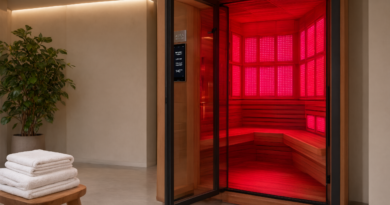

Why Wall Street Is Putting Infrared Saunas in the Office
When a global financial firm builds a new headquarters, every square foot is scrutinized for return on investment. So when State Street’s new London office — visited by Financial News this week — includes an infrared sauna alongside an on-site gym, it’s more than a wellness perk. It’s a signal that heat therapy has moved from fringe biohacking into mainstream corporate performance culture.
The Corporate Wellness Signal
The Financial News piece highlights a broader shift: elite employers now view recovery infrastructure as essential as desks and conference rooms. An on-site gym has been standard for decades, but adding an infrared sauna reflects a deeper understanding of stress physiology. Chronic stress impairs decision-making, sleep, and immune function — all costly for knowledge workers. Heat therapy offers a low-effort, high-compliance intervention that fits a busy workday.
For American homeowners, the same logic applies. A compact home sauna cabin eliminates the commute to a gym or spa, making recovery as accessible as a morning coffee. Research suggests regular sauna use may support cardiovascular health and improve perceived stress, though most studies involve traditional Finnish saunas rather than infrared. Still, the corporate embrace of infrared specifically points to its convenience: lower temperatures, faster warm-up, and no need for a shower immediately after.
From Finnish Tradition to Modern Infrared
Sauna bathing is ancient, but infrared technology is relatively new. The first infrared sauna patents appeared in the 1960s, primarily in Japan, where doctors began experimenting with far-infrared wavelengths for warming patients. By the 1980s, infrared cabins spread to Europe and North America as wellness devices. Unlike traditional saunas that heat the air to 180°F or more, infrared panels emit light that penetrates skin directly, warming the body at lower ambient temperatures — typically 120–140°F. This makes the experience more tolerable for longer sessions and more accessible for people who find conventional saunas overwhelming.
State Street’s London HQ likely uses a commercial infrared unit for the same reasons: minimal space requirements, no steam or humidity control, and quick heat-up times between employees. For a home setting, those advantages translate into a unit that can fit in a spare bedroom, garage, or finished basement without major renovation.
How Infrared Heat Works
Infrared saunas use ceramic or carbon panels to emit electromagnetic radiation in the far-infrared spectrum, roughly 6–14 micrometers. Human tissue absorbs these wavelengths efficiently, converting the energy into gentle heat. The result is a rise in core body temperature and activation of heat shock proteins — cellular repair mechanisms that help refold damaged proteins and reduce oxidative stress. Sweating occurs, but at lower rates than in a hot-air sauna, so hydration demands are less extreme.
Many users report a sense of calm after 20–30 minutes, which may be tied to increased parasympathetic nervous system activity — the body’s “rest and digest” mode. A 2018 systematic review in Evidence-Based Complementary and Alternative Medicine found preliminary evidence that infrared sauna sessions may reduce symptoms of chronic fatigue and improve quality of life, though the authors called for larger randomized trials.
Practical Tips for Bringing Heat Therapy Home
- Start with 15–20 minutes at 120–130°F, three times per week, and increase duration gradually as your heat tolerance builds.
- Hydrate before and after with water plus electrolytes — even low-temperature infrared sessions cause fluid loss through sweat.
- Schedule sessions in the late afternoon or early evening to leverage the natural drop in core temperature afterward, which may deepen sleep onset.
- Keep the room cool and quiet — the contrast between warm skin and cool air enhances the relaxation response without needing a cold plunge.
Infrared vs. Cold Plunge: A Recovery Comparison
Corporate wellness programs increasingly pair heat with cold exposure, but the two serve different purposes. Cold plunges (50–59°F) trigger vasoconstriction and a surge of norepinephrine, sharpening alertness and reducing acute muscle soreness after intense training. Infrared saunas do the opposite: vasodilation, improved peripheral circulation, and a slower, more meditative unwinding. For most office workers, the limiting factor is not muscle damage but mental fatigue and poor sleep — which makes heat the more practical daily tool. A cold plunge is a shock; an infrared session is a reset.
For those with limited space or budget, a single infrared unit delivers more consistent value than a cold tub that sits unused for half the year. And unlike ice baths, which require daily water management and sanitation, a modern low-EMF far-infrared unit needs only a wipe-down and occasional panel inspection.
“The presence of an infrared sauna in a financial headquarters tells you that recovery is no longer a luxury — it’s a performance metric.”
What the Research Actually Shows
One frequently cited study from the University of Eastern Finland, published in JAMA Internal Medicine in 2015, followed 2,315 middle-aged men for over 20 years. Men who used a sauna 4–7 times per week had a 40% lower risk of all-cause mortality compared to once-weekly users, after adjusting for cardiovascular risk factors. That study involved traditional Finnish saunas at 175°F, not infrared, but the physiological overlap — elevated heart rate, sweating, heat shock protein activation — suggests infrared may confer similar benefits at lower temperatures. A smaller 2018 study in Mayo Clinic Proceedings found that infrared sauna use improved vascular function in patients with cardiovascular risk factors, though the sample size was only 30 participants.
No credible research claims infrared saunas “detoxify” the body in any meaningful way — the liver and kidneys handle that job. What the evidence does support is modest improvements in blood pressure, mood, and perceived recovery, especially when used consistently over months.
What This Means for American Homeowners
State Street didn’t install a sauna because it looks good in a brochure. They did it because employees who recover better think better, sleep better, and stay longer. That same calculus applies to a home office, a garage gym, or a quiet corner of a finished basement. A compact home sauna cabin — one that plugs into a standard outlet and fits two people — brings the corporate recovery suite down to a personal scale.
The barrier for most people is not cost but consistency. Gym memberships go unused because of the 20-minute drive each way. A home unit removes that friction. If you’re already investing in a standing desk, an ergonomic chair, or a mattress upgrade for better sleep, an infrared sauna sits in the same category: infrastructure for a longer, calmer, more resilient life. At yardsauna.net, we focus on modern low-EMF models designed for exactly that kind of daily, no-friction use.
Frequently Asked Questions
Is an infrared sauna safe for daily use?
For most healthy adults, daily infrared sauna sessions of 15–30 minutes are considered safe. The lower temperatures (120–140°F) reduce cardiovascular strain compared to traditional saunas. However, people with unstable heart conditions, low blood pressure, or who are pregnant should consult a physician first.
How does infrared heat differ from a traditional sauna?
A traditional sauna heats the air to 170–200°F, which warms your body indirectly. An infrared sauna uses light waves to heat your body directly while the air stays around 120–140°F. This allows longer sessions with less perceived heat stress and lower humidity, making it more comfortable for beginners.
Do I need a dedicated room for a home infrared sauna?
No. Most 1–2 person infrared saunas are compact enough for a spare bedroom, large bathroom, garage, or finished basement. They typically require a standard 120V outlet and minimal clearance around the unit. Some models assemble in under an hour with basic tools.
This article is for informational purposes only and does not constitute medical advice. Always consult a qualified healthcare provider before starting any new wellness routine, especially if you have pre-existing conditions or are pregnant.