
Infrared Sauna in Corporate HQ: What It Means for Home Buyers
When a global financial firm like State Street installs an infrared sauna in its new London headquarters, it signals more than a wellness perk. It marks a shift in how infrared heat technology is being validated in high-traffic commercial settings—and that has direct implications for anyone considering a modern low-EMF far-infrared unit at home.
The news, reported by Financial News, highlights an on-site gym and infrared sauna as part of State Street’s new London office. While the article focuses on corporate amenities, the technical undercurrent is clear: infrared heating systems are being specified for environments where reliability, safety, and electromagnetic field (EMF) performance are non-negotiable. For American homeowners researching a compact home sauna cabin, this is a real-world signal that the technology has matured.
What This News Tells Us About Infrared Heater Engineering
Corporate procurement teams do not choose wellness equipment casually. An infrared sauna in a flagship headquarters must meet stringent building codes, electrical standards, and occupational safety requirements. That means the heaters inside that London sauna likely carry certifications that matter at home, too.
Certifications Behind Commercial-Grade Infrared
In the United States, the relevant marks are UL (Underwriters Laboratories) and ETL (Intertek’s Electrical Testing Laboratories). Both are Nationally Recognized Testing Laboratories (NRTLs) that certify electrical products for fire and shock safety. When a sauna is UL or ETL listed, it has passed tests for wiring integrity, insulation, grounding, and component temperature limits. A commercial installation would almost certainly require such listing, and the same certification protects a residential buyer.
For EMF specifically, there is no single government standard for saunas, but reputable manufacturers test against the International Electrotechnical Commission (IEC) guidelines or the stricter Swedish MPR II standards for low-frequency magnetic fields. Many low-EMF home saunas advertise readings below 10 milligauss (mG) at the seating surface, sometimes below 3 mG. A corporate wellness room, where employees may spend 20–30 minutes daily, would logically demand similarly low emissions.
Why Low EMF Matters More Than Ever
Infrared saunas heat the body directly using electromagnetic radiation in the far-infrared spectrum (typically 6–14 micrometers). This is non-ionizing and fundamentally different from the radiofrequency used by cell phones. However, the electrical components—heaters, controllers, power supplies—can emit low-frequency magnetic fields. In a poorly shielded unit, a user sitting inches from a heater panel could be exposed to 50–100 mG or more. A well-engineered sauna uses shielded wiring, twisted pair leads, and heater element designs that cancel magnetic fields. The State Street installation, if done properly, would be a case study in such engineering.
How Infrared Sauna Technology Works
Infrared heaters convert electrical energy into radiant heat that is absorbed directly by the skin and underlying tissue. Unlike a traditional Finnish sauna that heats the air to 180–200°F, an infrared cabin typically operates at 120–140°F. The lower ambient temperature is more tolerable for longer sessions, and the radiant energy penetrates about 1.5 inches below the skin. This stimulates blood flow and induces a deep, profuse sweat at a lower thermal load.
In a commercial gym setting, this means employees can use the sauna during a lunch break without needing a long cool-down. For a home user, the same mechanism means lower electricity consumption—most 2-person infrared saunas draw 1,200–1,800 watts, similar to a space heater—and a faster warm-up time of 10–15 minutes.
Standards and Testing: What a Buyer Should Verify
When State Street’s facilities team evaluated sauna vendors, they would have asked for documentation. A homeowner should do the same. Here is what to look for:
- UL 962 or UL 499 listing: UL 962 covers household and commercial furnishings, while UL 499 covers electric heating appliances. Either mark means the unit passed fire and shock hazard tests.
- ETL or CSA certification: Equivalent to UL for the US and Canadian markets. Intertek (ETL) and CSA Group are OSHA-recognized NRTLs.
- EMF test report: Ask for a third-party measurement at the seating position, not just at the heater surface. Reputable brands publish readings in milligauss (mG) at 0, 4, and 8 inches from the panel.
- Wood and material safety: Look for low-VOC or formaldehyde-free adhesives, and solid cedar or hemlock construction. The heat can accelerate off-gassing from cheap composites.
How the Commercial Standard Compares to Old-School Saunas
Traditional steam saunas and old-style infrared boxes often used ceramic tube heaters that ran hot (300°F surface) and emitted significant EMF. Modern carbon-fiber or carbon-nanotube panel heaters run cooler and can be designed with magnetic field cancellation. The shift in commercial procurement toward panel-based, low-EMF systems reflects a broader industry consensus that these are the safer, more efficient choice. For a home buyer, that means a 2026-model infrared sauna is likely to outperform a 2010 model in both energy use and EMF control.
When a global financial institution puts an infrared sauna in its headquarters, it is effectively endorsing the technology’s safety and performance profile—an endorsement that carries weight for residential buyers.
Historical Context: From Medical Labs to Corporate Gyms
Infrared therapy has roots in 1960s NASA research on cardiovascular conditioning for astronauts, and later in Japanese medical practice where far-infrared panels were used in clinics. The first home infrared saunas appeared in the US in the 1980s, but they were niche products with inconsistent quality. By the 2010s, carbon panel heaters and digital controllers made the technology reliable enough for daily home use. The presence of an infrared sauna in a 2026 corporate headquarters is the latest milestone in that 60-year arc from experimental to mainstream.
Practical Tips for Home Buyers This Week
- Ask for the EMF test report before buying. If a brand cannot provide one, move on. A reputable company will have measurements from an independent lab.
- Check the heater type. Carbon fiber panels are generally lower EMF than ceramic rods. Look for ‘low EMF’ or ‘ultra-low EMF’ in the spec sheet, but verify with numbers.
- Consider the electrical requirements. Most 1–2 person saunas plug into a standard 120V outlet. Larger 3–4 person units may need a dedicated 240V circuit. Confirm before ordering.
- Look for third-party certification marks. UL, ETL, or CSA logos should be visible on the product page or manual. If absent, treat it as a red flag.
FAQ: Infrared Sauna Tech and Standards
What does ‘low EMF’ actually mean in a home sauna?
Low EMF generally means the magnetic field at the seating position is below 10 milligauss (mG), and often below 3 mG. This is measured with a gaussmeter at specific distances from the heater panels. The term is not regulated, so always ask for the test report.
Is a commercial-grade sauna safer than a residential one?
Not necessarily. Commercial units are built for higher duty cycles and may use more robust components, but residential saunas can be equally safe if they carry the same UL or ETL certifications. The key is to verify the certification and EMF data for the specific model you are buying.
Why would a financial firm install an infrared sauna?
Employee wellness programs are now standard in competitive industries. Infrared saunas offer a low-impact recovery option that fits into a workday. For the firm, it is a recruitment and retention tool; for the sauna industry, it is a sign that the technology has passed commercial scrutiny.
What This Means for Your Home
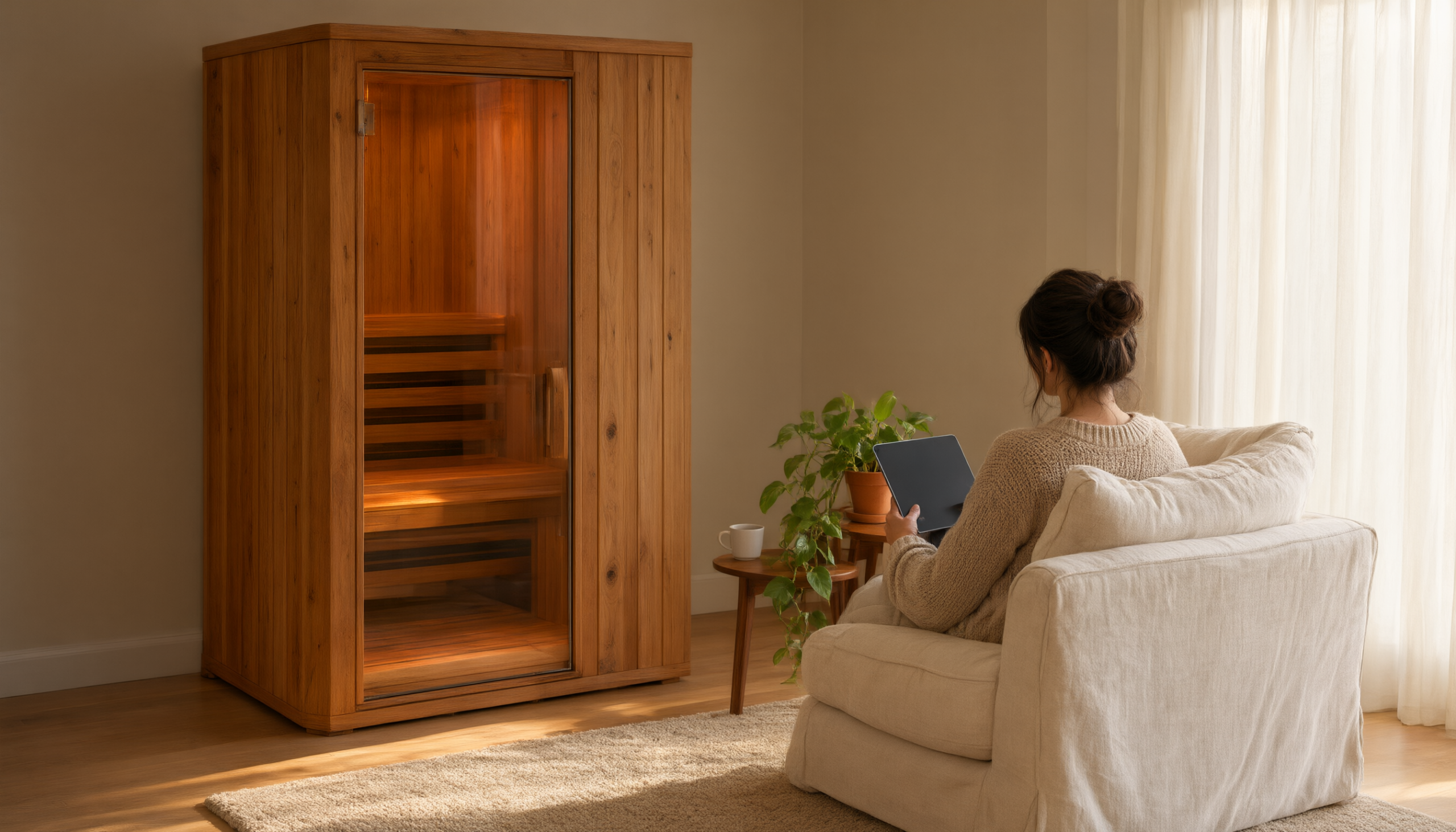
When a company like State Street chooses an infrared sauna for its London headquarters, the message for American homeowners is simple: this technology is no longer experimental. The same engineering that satisfies a corporate facilities team—certified electrical safety, low EMF design, efficient carbon heaters—is available in a 2-person home sauna that fits in a spare room or garage. At yardsauna.net, we focus on modern low-EMF infrared units that meet these commercial-grade standards, so you can bring that same level of confidence into your daily wellness routine.
This article is for informational purposes only and does not constitute medical advice. Always consult a qualified healthcare provider before starting any new wellness routine, especially if you have pre-existing conditions or are pregnant.