Low EMF Claims for Infrared Saunas: What New Measurement Guide Means
A newly published measurement and evaluation guide is giving home sauna buyers a clearer way to assess low EMF claims on infrared saunas. For years, manufacturers have used terms like ‘ultra-low EMF’ or ‘near-zero EMF’ without a consistent industry standard, leaving consumers to sort through conflicting marketing language. This guide aims to change that by outlining how EMF levels should be measured, what thresholds are meaningful, and how to evaluate the credibility of a sauna’s safety claims.
The news matters because infrared saunas have become a mainstream wellness tool in American homes, and electromagnetic field exposure is one of the top concerns among health-conscious buyers. While the sauna itself is not a medical device, many users want reassurance that the technology they sit inside for 20 to 45 minutes at a time does not add unnecessary EMF burden to their environment. A standardized measurement guide could help shift the conversation from vague promises to verifiable data.
Background: Why Low EMF Claims Became a Selling Point
Infrared saunas work by emitting infrared light that heats the body directly, rather than heating the air like a traditional Finnish sauna. The heating panels and electrical components inside an infrared sauna generate electromagnetic fields as a byproduct of normal operation. In most household appliances, EMF levels are low and considered safe by regulatory bodies, but because sauna users sit in close proximity to the heating elements for extended periods, some researchers and consumers have asked for more transparency.
Over the past decade, low EMF became a competitive differentiator in the infrared sauna market. Brands began advertising EMF levels measured in milligauss (mG) or microtesla (µT), often citing figures like ‘under 3 mG’ or ‘less than 1 mG at the seating position.’ However, without a standard measurement protocol, these numbers could be misleading. A sauna measured at a distance of 12 inches from the heater might show a much lower reading than one measured at 2 inches, and different meters have different sensitivities and frequency ranges.
The new guide appears to address this gap by describing how to measure EMF in an infrared sauna, what equipment to use, and how to interpret the results. While the full technical details are not yet widely available, the publication itself signals a maturing industry that is starting to take measurement consistency seriously. For consumers, that is a welcome shift away from marketing-only claims.
Why This Matters for Home Sauna Users
For the average person shopping for a 1-4 person infrared sauna, the guide offers a practical framework for asking better questions. Instead of simply trusting a badge that says ‘low EMF,’ a buyer can now ask how the measurement was taken, at what distance, with what type of meter, and under what operating conditions. That level of detail can separate a genuinely well-engineered sauna from one that simply uses the term as a label.
It also matters for long-term wellness routines. Many infrared sauna users incorporate sessions into their weekly schedule for relaxation, muscle recovery, or general heat therapy. If a person uses a sauna three to five times per week, the cumulative time spent near EMF-emitting components is not trivial. Having a reliable way to evaluate EMF levels helps users make an informed choice that aligns with their personal comfort level.
Consumers should look for sauna brands that publish their EMF measurement methodology, not just a single number. A credible low EMF claim includes the distance from the heater, the meter used, and the testing conditions.
What the Guide Likely Covers
Based on industry practices and the title of the publication, the guide probably addresses several key areas. First, it likely defines what ‘low EMF’ means in the context of infrared saunas, perhaps referencing established exposure guidelines from organizations like the International Commission on Non-Ionizing Radiation Protection (ICNIRP) or the Building Biology standards. Second, it may explain the difference between electric field and magnetic field measurements, since both are relevant but measured differently.
Third, the guide may offer a step-by-step measurement protocol, including where to place the meter, how to account for background EMF from other household devices, and how to test at different power settings. Finally, it could provide a scoring or evaluation system that helps consumers compare saunas on a consistent basis. All of this would be a significant step forward for an industry that has historically lacked standardization.
How to Evaluate a Low EMF Claim Today
Even before the guide becomes widely adopted, there are practical steps a buyer can take. Ask the manufacturer for the specific EMF reading in milligauss at the seating position, not just at the control panel or outside the sauna. Request information about the meter used and the distance from the heating panels. If the company cannot or will not provide this data, that is a red flag.
It is also worth understanding that some EMF is unavoidable in any electrical device. The goal is not zero EMF, which is physically impossible in a powered sauna, but rather a level that is low enough to be considered negligible by independent safety standards. A well-designed sauna with shielded wiring and properly grounded components can achieve very low readings, often below 3 mG at the seating position, which is comparable to or lower than many common household appliances.
What Happens Next
The publication of a measurement and evaluation guide is likely to have several follow-on effects. First, more sauna manufacturers may begin publishing their own test results using the guide’s methodology, creating a more transparent marketplace. Second, third-party testing labs may start offering standardized EMF verification services for sauna brands, similar to how energy efficiency or safety certifications work in other industries. Third, consumer advocacy groups and wellness publications may use the guide to rate and compare popular sauna models, giving buyers independent data rather than marketing claims.
For the home sauna industry, this could also drive innovation in shielding and component design. If a standard measurement protocol becomes widely accepted, manufacturers will have a clear target to engineer toward, which could lead to even lower EMF levels across the board. In the meantime, the guide gives consumers a vocabulary and a framework for asking better questions, which is always a good thing.
Practical Takeaways for Your Wellness Routine
If you already own an infrared sauna, this news does not mean you need to panic or replace your unit. It does mean you can now take a more informed look at your sauna’s EMF profile. Here are a few practical steps to consider:
- Check your sauna’s manual or manufacturer website for any published EMF data. Look for a specific number in milligauss, not just the phrase ‘low EMF.’
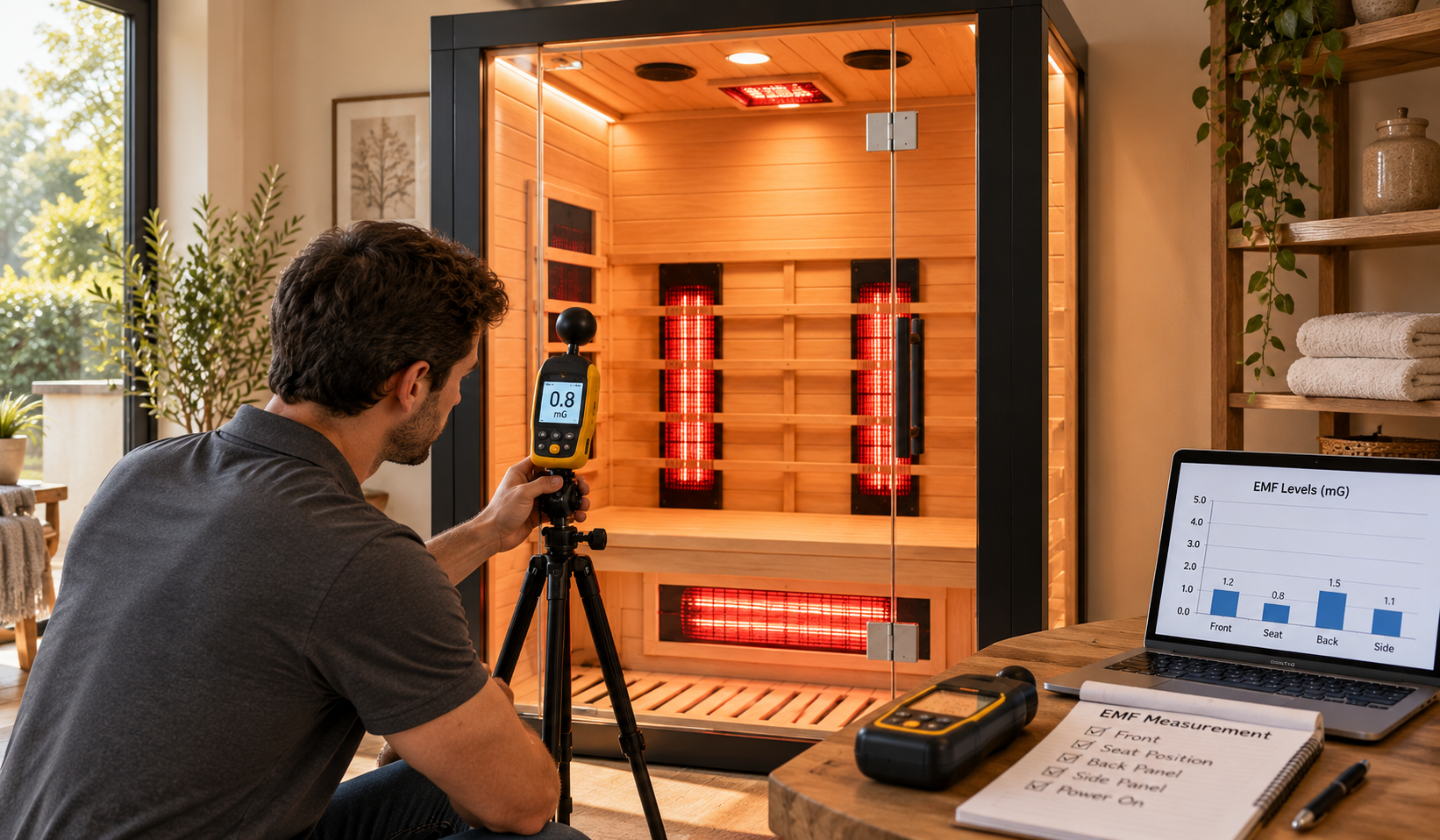
- If no data is available, consider borrowing or purchasing a basic EMF meter (often under $50) and taking your own readings at the seating position while the sauna is running at full power.
- Compare your readings to common reference points: a typical home has background EMF of 0.1 to 2 mG, while a running microwave can exceed 20 mG at close range. A well-shielded infrared sauna should be at the low end of that spectrum.
- Remember that distance matters. EMF strength drops off rapidly with distance, so sitting a few inches farther from the heating panels can significantly reduce exposure.
For those considering a new sauna purchase, the guide provides a checklist for evaluating claims. Here is a simple step-by-step approach to use when comparing models:
- Ask each manufacturer for their EMF measurement report, including the meter model, distance from heater, and sauna power setting during testing.
- Verify that the measurement was taken at the actual seating position, not at the door or outside the sauna.
- Look for third-party verification or independent testing, not just in-house claims.
- Compare the reported EMF levels to a common benchmark, such as 3 mG or less at the seating position.
- Consider the sauna’s overall build quality, shielding, and grounding, as these factors influence long-term EMF performance.
Closing Summary
The publication of a low EMF measurement and evaluation guide for infrared saunas is a meaningful development for anyone who takes home wellness seriously. It moves the conversation from vague marketing language to measurable, comparable data, which empowers consumers to make choices based on evidence rather than hype. While no sauna can claim zero EMF, a well-designed unit can achieve levels that are negligible in the context of everyday household exposure. As the guide gains traction, expect to see more transparency from manufacturers and more informed buyers in the market. This article is for informational purposes only and does not constitute medical advice.
Frequently Asked Questions
1. What does this news mean for home sauna users?
It means you now have a better framework for evaluating low EMF claims. Instead of relying on marketing language, you can ask for specific measurement data and compare saunas on a consistent basis. This helps you make a more informed decision about the technology you bring into your home.
2. Will this change how I use my infrared sauna?
Probably not, unless you discover that your sauna has unexpectedly high EMF levels. Most well-built infrared saunas already operate at low EMF levels, and the guide is more about verification than about changing daily routines. You can continue your normal sauna sessions while using the guide to check your unit if you have concerns.
3. Is low EMF the same as no EMF?
No. Any electrical device produces some electromagnetic fields, so zero EMF is not achievable in a powered sauna. Low EMF means the levels are below commonly accepted safety thresholds, often under 3 mG at the seating position, which is comparable to or lower than many household appliances.
4. How can I measure EMF in my own sauna?
You can use a basic EMF meter, often available for under $50, and take readings at the seating position while the sauna is running at full power. Be sure to account for background EMF from other devices in the room, and take multiple readings at different distances from the heating panels.
5. What EMF level is considered safe for an infrared sauna?
There is no single universal standard, but many experts and industry groups consider levels below 3 mG at the seating position to be low and generally acceptable. Some stricter guidelines, such as Building Biology standards, recommend even lower levels for sleeping areas, but saunas are used for shorter periods.
6. Do all infrared saunas emit the same amount of EMF?
No. EMF levels vary depending on the design of the heating panels, the quality of the wiring, the shielding, and the grounding. Some saunas are engineered specifically to minimize EMF, while others may have higher readings, especially near the heaters.
7. Can I reduce EMF exposure in my existing sauna?
Yes, in some cases. Sitting a few inches farther from the heating panels can significantly reduce exposure because EMF strength drops off rapidly with distance. You can also check that your sauna is properly grounded and that all wiring is intact, though major modifications should be done by a professional.
8. Are low EMF saunas more expensive?
Not necessarily. While some high-end models emphasize low EMF as a premium feature, many mid-range saunas also achieve low readings through good design. The key is to compare measurement data rather than assume that a higher price automatically means lower EMF.
9. Does low EMF affect the sauna’s heating performance?
No. EMF is a byproduct of the electrical components, not a measure of how well the sauna heats. A sauna can be both highly effective at producing infrared heat and low in EMF, as long as the heating panels and wiring are properly designed and shielded.
10. Where can I find the full measurement and evaluation guide?
The guide was recently published and may be available through industry publications, sauna manufacturer websites, or consumer wellness resources. Keep an eye on reputable sauna review sites and standards organizations for updates as the guide becomes more widely distributed.
For more on low-EMF home infrared saunas and the models we offer, visit yardsauna.com.
This article is for informational purposes only and does not constitute medical advice. Always consult a qualified healthcare provider before starting any new wellness routine, especially if you have pre-existing conditions or are pregnant.