Sauna Electrical Requirements: Powering a 3-Person Low-EMF Infrared Sauna
If you’re thinking about adding a 3-person low-EMF infrared sauna to your home, the electrical side of the project can feel like the least glamorous part—but it’s also the most important. Get it right, and your sauna will heat reliably for years; get it wrong, and you could be looking at tripped breakers, damaged electronics, or even a fire hazard. This guide walks you through exactly what you need to know about dedicated circuits, voltage, and amperage for a residential infrared sauna, using the YardSauna Forest 3-Person Infrared Sauna as a concrete example.
Why Electrical Planning Matters for Infrared Saunas
Infrared saunas are not like plugging in a space heater or a hair dryer. A typical 3-person infrared sauna draws a substantial amount of power—often between 2,000 and 3,500 watts—and it does so continuously for 30 to 60 minutes at a time. That kind of sustained load requires a dedicated circuit, which means a circuit that serves only the sauna and nothing else. If you try to share a circuit with other appliances, you risk overloading the wiring, tripping the breaker, and potentially overheating the conductors inside your walls.
Most residential circuits in the United States are 120-volt, 15-amp or 20-amp circuits. A 15-amp circuit can safely deliver about 1,800 watts, and a 20-amp circuit about 2,400 watts. A 3-person infrared sauna with full-spectrum heaters, carbon panels, and a floor heater can easily exceed those limits. That’s why larger infrared saunas typically require a 220-240 volt circuit, which can deliver much more power safely.
Beyond just capacity, a dedicated circuit also protects your sauna’s sensitive electronics. Infrared saunas have digital control panels, Bluetooth audio systems, and sometimes LED lighting. Voltage fluctuations or shared loads can cause those components to malfunction or fail prematurely. A dedicated circuit gives your sauna a stable, isolated power supply.
What the Manufacturer Specifies
For the , the electrical requirement is clearly stated: 220V-240V with a dedicated circuit required, not standard 120V. This is a critical piece of information that every buyer should understand before placing an order. It means you cannot simply plug this sauna into a standard wall outlet. You will need a dedicated 220-240 volt circuit, which in most homes means installing a new circuit breaker in your electrical panel and running appropriate wiring to the sauna location.
The exact amperage requirement will depend on the sauna’s total wattage and the specific voltage supplied. For a sauna of this size and heating configuration, a 20-amp or 30-amp circuit is common, but you should always consult the manufacturer’s installation manual and a licensed electrician to confirm the exact breaker size and wire gauge for your home’s electrical system.
Common Misconceptions About Sauna Power
One of the most common misconceptions is that all infrared saunas are ‘plug-and-play’ on a standard 120-volt outlet. While many 1-2 person infrared saunas do operate on 120 volts, larger models with more heaters and features often require 240 volts. The YardSauna Forest 3-Person Infrared Sauna falls into the latter category. Another misconception is that you can use an extension cord or a power strip. This is never safe for a high-wattage appliance like a sauna. Extension cords add resistance, generate heat, and can cause fires. Always connect your sauna directly to a properly installed, dedicated circuit.
Understanding Voltage, Amperage, and Wattage
To plan your sauna’s electrical installation, you need to understand the relationship between voltage, amperage, and wattage. Voltage (V) is the electrical pressure that pushes current through the wires. Amperage (A) is the amount of current flowing. Wattage (W) is the total power consumed, calculated as voltage multiplied by amperage (W = V × A).
For example, if your sauna draws 3,000 watts at 240 volts, the amperage is 3,000 ÷ 240 = 12.5 amps. However, electrical codes require that a circuit be loaded to no more than 80% of its rated capacity for continuous loads. A sauna is considered a continuous load because it operates for more than three hours at a time in some cases. So a 20-amp circuit can safely handle a continuous load of 16 amps (20 × 0.8). A 30-amp circuit can handle 24 amps.
When you know the sauna’s total wattage, you can calculate the required circuit size. For the YardSauna Forest 3-Person Infrared Sauna, the manufacturer does not list the exact wattage in the product description, but based on the heating elements—full-spectrum quartz heaters, ultra-low EMF carbon panels, a wide-format overhead red light and NIR array, and an extended tourmaline floor heater—it is safe to assume the total wattage is substantial. This is why the manufacturer specifies a dedicated 220-240V circuit. You should always confirm the exact amperage requirement with the manufacturer or a licensed electrician before installation.
Single-Phase vs. Three-Phase Power
Most residential homes in the United States have single-phase 240-volt power available at the main panel. This is the same type of power used for electric dryers, ranges, and air conditioners. A 240-volt circuit uses two hot wires (each carrying 120 volts to neutral) and a ground wire. There is no neutral wire required for a purely resistive load like a sauna heater, but some saunas with electronic controls may require a neutral. Always follow the manufacturer’s wiring diagram.
Three-phase power is typically only found in commercial or industrial buildings. If you are installing a sauna in a residential home, you will almost certainly be working with single-phase power. This is good news because single-phase 240-volt circuits are straightforward for a licensed electrician to install.
Wire Gauge and Breaker Size
The wire gauge (thickness) and circuit breaker size must be matched to the sauna’s amperage draw. For a 20-amp circuit, 12-gauge wire is standard. For a 30-amp circuit, 10-gauge wire is required. Using wire that is too thin for the amperage can cause the wire to overheat and potentially start a fire. A licensed electrician will know the local code requirements and will install the correct wire and breaker for your sauna.
It’s also important to note that the circuit breaker must be a double-pole breaker for a 240-volt circuit. This means it takes up two slots in your electrical panel and trips both hot wires simultaneously. A single-pole breaker would only disconnect one hot wire, leaving the other live and creating a shock hazard.
Step-by-Step: Planning Your Sauna Electrical Installation
Installing a dedicated circuit for your sauna is a job for a licensed electrician, but as the homeowner, you should understand the process so you can plan properly and communicate clearly with your contractor. Here is a step-by-step overview of what to expect.
- Determine the sauna’s electrical requirements. Check the manufacturer’s specifications for voltage, amperage, and any special wiring requirements. For the YardSauna Forest 3-Person Infrared Sauna, this is 220-240V, dedicated circuit required. Note the total wattage if available.
- Choose the sauna location. The location should be dry, well-ventilated, and close enough to your electrical panel to run wiring without excessive cost. The sauna should not be placed in a damp area like a shower room unless it is specifically designed for that environment.
- Check your electrical panel capacity. Your electrician will assess whether your panel has enough spare capacity for a new 20-30 amp double-pole breaker. If your panel is full or near capacity, you may need a subpanel or a service upgrade, which adds cost.
- Run the wiring. The electrician will run the appropriate gauge wire from the panel to the sauna location. This may involve drilling through studs, running conduit, or fishing wire through walls. The wire must be protected and installed to code.
- Install the disconnect switch. Many local codes require a disconnect switch within sight of the sauna. This allows you to cut power to the sauna without going to the main panel. The disconnect can be a simple pull-out or a breaker-type switch.
- Install the outlet or hardwire connection. Some saunas come with a cord and plug, while others are designed to be hardwired directly to the circuit. The YardSauna Forest 3-Person Infrared Sauna may be either, so check the manual. If it uses a plug, the electrician will install the appropriate 240-volt receptacle (such as a NEMA 6-20 or 6-30).
- Test the circuit. After installation, the electrician will test the circuit with a multimeter to ensure correct voltage and polarity, then turn on the sauna to verify it heats properly.
Permits and Inspections
In most jurisdictions, adding a new circuit to your electrical panel requires a permit and an inspection. A licensed electrician will handle this process for you. The inspection ensures that the work meets the National Electrical Code (NEC) and local amendments. Skipping the permit may save money in the short term, but it can cause problems when you sell your home or if there is an insurance claim related to the electrical work.
Cost Considerations
The cost of installing a dedicated 240-volt circuit varies widely depending on your location, the distance from the panel to the sauna, and the complexity of the run. On average, homeowners can expect to pay between $300 and $1,000 for a straightforward installation. If your panel needs upgrading or the wiring run is long, the cost can be higher. It’s wise to get quotes from at least two or three licensed electricians before proceeding.
Common Mistakes to Avoid
Even well-intentioned homeowners make mistakes when planning sauna electrical work. Here are the most common pitfalls and how to avoid them.
- Assuming a standard outlet will work. Many people assume that because the sauna has a plug, it can go into any outlet. A 240-volt plug is physically different from a 120-volt plug, so it won’t fit, but some people try to use adapters or modify the plug. Never do this. It’s dangerous and voids the warranty.
- Using an extension cord. Extension cords are not rated for continuous high-wattage loads. They can overheat and cause fires. Always plug your sauna directly into a dedicated, properly installed outlet.
- Sharing a circuit with other appliances. Even if the circuit has enough capacity on paper, sharing it with a refrigerator, microwave, or other large appliance can cause nuisance tripping and voltage drops that damage the sauna’s electronics.
- Ignoring local code requirements. Electrical codes vary by municipality. Some require a disconnect switch, some require GFCI protection, and some have specific rules about sauna installations. Always check with your local building department and hire a licensed electrician who knows the local code.
- Underestimating the amperage draw. If you install a circuit that is too small, the breaker will trip constantly, and the sauna will never reach full temperature. Worse, if the breaker is faulty, the wire could overheat. Always size the circuit for the sauna’s maximum continuous load.
- DIY electrical work without proper knowledge. Electrical work is not a good DIY project unless you are a qualified electrician. Mistakes can be deadly. The cost of hiring a professional is small compared to the risk of fire or electrocution.
How Infrared Sauna Heating Works (and Why It Affects Electrical Needs)
To understand why a 3-person infrared sauna needs a dedicated 240-volt circuit, it helps to understand how infrared heating works. Unlike traditional saunas that heat the air to 180°F or more, infrared saunas use infrared light to heat your body directly. The air temperature may only reach 120-140°F, but the infrared energy penetrates your skin and warms you from within.
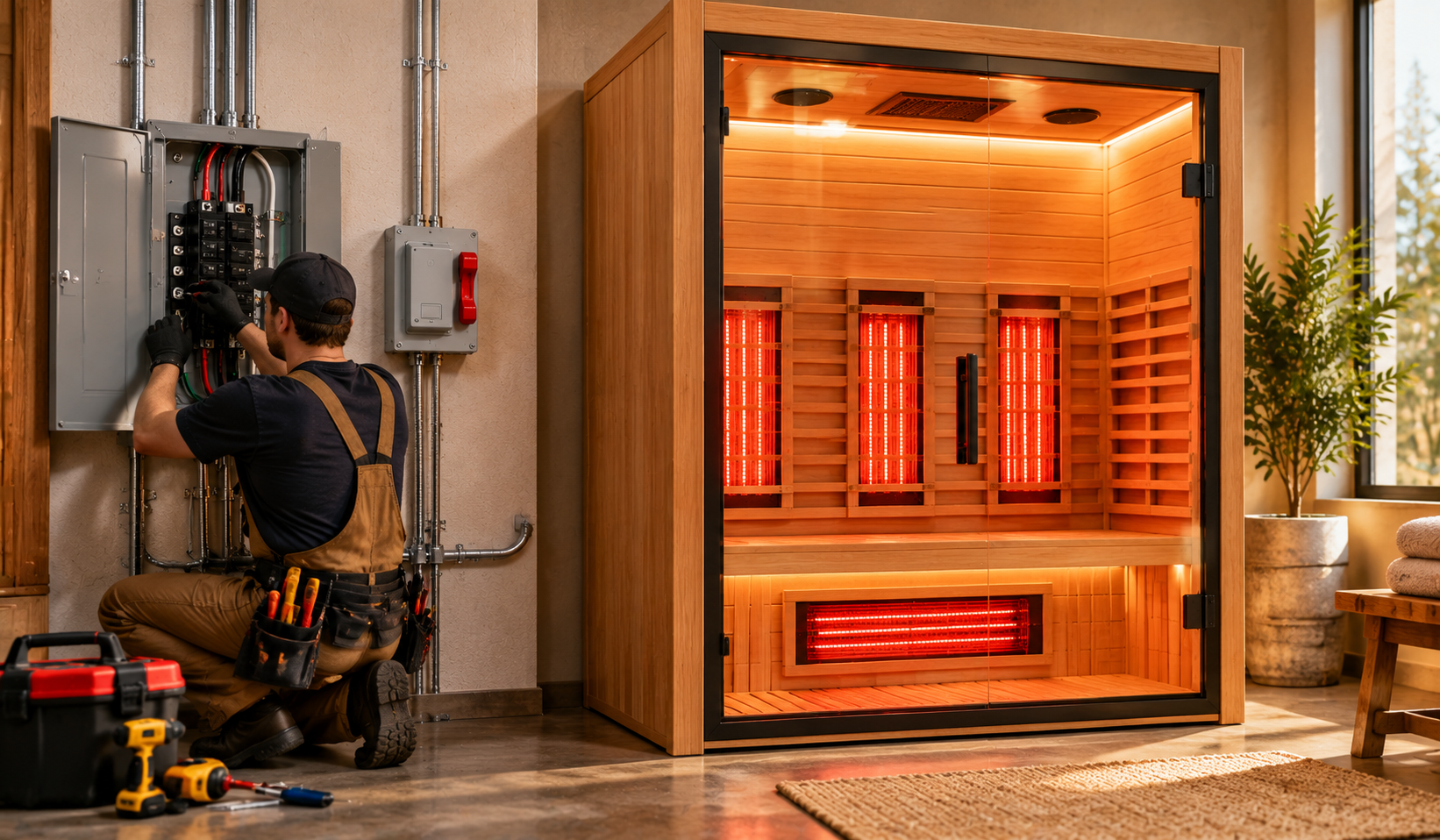
Infrared heaters come in three main types: near-infrared (NIR), mid-infrared (MIR), and far-infrared (FIR). Each type has a different wavelength and penetrates the body to a different depth. Full-spectrum saunas combine all three types for a broader range of effects. The YardSauna Forest 3-Person Infrared Sauna uses a ‘surround full-spectrum heating matrix’ that includes high-output quartz heaters (which emit near and mid-infrared) and ultra-low EMF carbon panels (which emit far-infrared). It also has a wide-format overhead red light and NIR array and an extended tourmaline floor heater.
All of these heating elements require electricity. Quartz heaters are resistive elements that get very hot and emit infrared radiation. Carbon panels are larger, lower-temperature emitters that produce far-infrared. The floor heater adds warmth to the lower body. Together, they can draw a significant amount of power—often 2,000 to 3,500 watts for a 3-person model. That’s why a 240-volt circuit is necessary: it allows the sauna to draw the required wattage at a lower amperage, reducing heat loss in the wiring and allowing for more efficient operation.
Low-EMF Design and Electrical Safety
One of the selling points of the YardSauna Forest 3-Person Infrared Sauna is its ultra-low EMF (electromagnetic field) design. EMF is a concern for some sauna users, and manufacturers have responded by shielding heating elements and using twisted pair wiring to cancel out magnetic fields. From an electrical standpoint, low-EMF design does not change the power requirements, but it does mean the sauna’s internal wiring is carefully engineered. This is another reason to ensure a clean, stable power supply: voltage fluctuations can induce noise in the system that may affect the EMF shielding’s effectiveness.
Continuous Load and Circuit Sizing
Because infrared saunas are often used for 30-60 minutes at a time, and some users do multiple sessions per day, they are considered continuous loads under the National Electrical Code. This means the circuit must be sized at 125% of the sauna’s rated amperage. For example, if the sauna draws 20 amps, the circuit must be rated for at least 25 amps. In practice, this means using a 30-amp breaker and 10-gauge wire. Your electrician will calculate the exact requirement based on the sauna’s nameplate rating.
Practical Tips and Checklist for a Safe Sauna Installation
Here is a practical checklist to ensure your sauna electrical installation goes smoothly and safely.
- Read the manufacturer’s installation manual before buying. Make sure you understand the electrical requirements and that your home can accommodate them.
- Hire a licensed electrician with sauna experience. Not all electricians are familiar with sauna installations. Ask if they have installed infrared saunas before.
- Get a written quote that includes all work. The quote should cover the breaker, wiring, disconnect switch, outlet, permit, and inspection.
- Plan the sauna location near the panel if possible. Shorter wire runs cost less and are easier to install.
- Ensure the sauna is on a dedicated circuit. No other outlets or appliances should be on the same circuit.
- Install a disconnect switch within sight of the sauna. This is required by code in many areas and is a good safety practice.
- Use a surge protector if recommended by the manufacturer. Some saunas have sensitive electronics that can be damaged by power surges.
- Test the sauna before finalizing the installation. Run the sauna at full power for 20-30 minutes to ensure the circuit holds and the sauna heats properly.
Buyer Considerations: What to Look for in a 3-Person Infrared Sauna
When shopping for a 3-person infrared sauna, electrical requirements should be a key part of your decision. Here are some factors to consider.
Voltage: Check whether the sauna runs on 120V or 240V. If you don’t have easy access to a 240V circuit, a 120V model might be more convenient, but it may not heat as quickly or reach the same temperatures as a 240V model. The YardSauna Forest 3-Person Infrared Sauna requires 240V, which is typical for a sauna of this size and heating power.
Heater type and wattage: Full-spectrum saunas with quartz and carbon heaters tend to draw more power than simple carbon-panel saunas. The YardSauna Forest’s surround full-spectrum heating matrix, overhead red light and NIR array, and floor heater mean it has a higher total wattage, which is why a dedicated circuit is essential.
EMF levels: If you are concerned about EMF exposure, look for a sauna that is specifically designed to be low-EMF. The YardSauna Forest is described as having ‘ultra-low EMF carbon panels’ and a ‘surround full-spectrum heating matrix’ that includes high-output quartz heaters. This suggests the manufacturer has taken steps to minimize EMF, but you should always ask for specific EMF readings if this is a priority.
Certifications: Look for safety certifications like UL, ETL, CE, or ISO 9001. The YardSauna Forest is UL/ETL/CE/ISO 9001 certified, which means it has been tested to meet safety standards. This is especially important for an electrical appliance that will be used regularly.
Installation requirements: Some saunas are plug-and-play, while others require hardwiring. The YardSauna Forest comes with tongue-and-groove modular panels that two adults can assemble in 45-60 minutes, but the electrical connection will still require a licensed electrician to install the dedicated circuit.
Comparing 120V vs. 240V Saunas
Many smaller infrared saunas (1-2 person) operate on standard 120-volt circuits, which makes them easy to install—just plug them in. However, they are limited to about 1,800 watts on a 15-amp circuit, which means they heat more slowly and may not reach as high a temperature. A 3-person sauna like the YardSauna Forest needs more power to heat a larger space and multiple users, so it requires 240 volts. The trade-off is a more involved installation, but the benefit is faster heat-up times, more consistent temperatures, and the ability to run multiple heating zones simultaneously.
Real-World Example: Installing a YardSauna Forest 3-Person Infrared Sauna
Let’s walk through a hypothetical installation of the YardSauna Forest 3-Person Infrared Sauna in a typical American home. Suppose you want to place the sauna in a spare bedroom on the second floor. The electrical panel is in the basement, about 40 feet away. Here’s what the process might look like.
First, you confirm the sauna’s electrical requirements: 220-240V, dedicated circuit. You hire a licensed electrician who visits your home to assess the panel. The panel has space for a new double-pole breaker, so no panel upgrade is needed. The electrician runs 10-gauge wire from the panel, through the basement ceiling, up through the wall to the second-floor bedroom. This requires drilling holes in the floor joists and wall studs, which the electrician does carefully to avoid plumbing and other wires.
At the sauna location, the electrician installs a 240-volt outlet (NEMA 6-30) and a disconnect switch on the wall near the sauna. The total cost is $800, including permit and inspection. After the inspection passes, you assemble the sauna (which takes about 45-60 minutes for two adults) and plug it in. You run the sauna for 30 minutes to test it, and it heats up evenly with no tripped breakers. You’re ready to enjoy your sauna.
This example illustrates that while the electrical work adds cost and time, it is a one-time investment that ensures safe, reliable operation for years to come.
Pros and Cons of a 240V Infrared Sauna
To help you decide if a 240V sauna like the YardSauna Forest is right for you, here are the pros and cons.
Pros:
- Faster heat-up times: More power means the sauna reaches your desired temperature more quickly.
- More consistent heat: With a dedicated circuit, there is no voltage drop from other appliances, so the sauna maintains a steady temperature.
- Ability to run multiple heating zones: A 3-person sauna with full-spectrum heaters, carbon panels, and a floor heater needs the extra capacity of a 240V circuit.
- Future-proofing: A 240V circuit can also be used for other high-power appliances if you ever move the sauna.
Cons:
- Higher installation cost: You’ll need to hire an electrician to install the dedicated circuit, which can cost several hundred dollars.
- Not portable: Once installed, the sauna is tied to its location unless you pay to move the circuit.
- Requires panel capacity: If your electrical panel is full, you may need a costly upgrade.
For most homeowners who want a spacious, powerful 3-person infrared sauna, the pros outweigh the cons. The YardSauna Forest 3-Person Infrared Sauna is a good example of a model that justifies the 240V requirement with its comprehensive heating system and thoughtful design.
Closing Summary: Powering Your Sauna Safely and Correctly
Understanding sauna electrical requirements is the foundation of a safe and enjoyable home sauna experience. A 3-person low-EMF infrared sauna like the YardSauna Forest 3-Person Infrared Sauna requires a dedicated 220-240 volt circuit, which means planning ahead and working with a licensed electrician. By taking the time to understand voltage, amperage, and circuit sizing, you can avoid common mistakes and ensure your sauna heats reliably for years. The information in this article is for informational purposes only and should not replace the advice of a qualified electrician or the manufacturer’s installation manual.
Frequently Asked Questions
1. What size breaker do I need for a 3-person infrared sauna?
The breaker size depends on the sauna’s total wattage and voltage. For a 240-volt sauna drawing around 3,000 watts, a 20-amp double-pole breaker is typically sufficient, but many installers use a 30-amp breaker to allow for startup surges. Always check the manufacturer’s specifications and consult a licensed electrician to determine the correct breaker size for your specific model.
2. Can I plug a 240V sauna into a standard outlet?
No. A 240-volt sauna requires a dedicated 240-volt circuit and a matching receptacle, such as a NEMA 6-20 or 6-30. Standard household outlets are 120 volts and will not fit the plug. Attempting to use an adapter or modify the plug is extremely dangerous and can cause a fire or damage the sauna.
3. Do I need a dedicated circuit for my infrared sauna?
Yes, absolutely. A dedicated circuit means the circuit serves only the sauna and nothing else. This prevents overloading and ensures a stable power supply. Sharing a circuit with other appliances can cause breaker trips, voltage drops, and potential damage to the sauna’s electronics.
4. How much does it cost to install a 240V circuit for a sauna?
The cost varies depending on your location, the distance from the electrical panel to the sauna, and whether your panel needs upgrading. On average, expect to pay between $300 and $1,000 for a straightforward installation. If the wiring run is long or your panel is full, the cost can be higher. Always get multiple quotes from licensed electricians.
5. Can I install the electrical circuit myself?
Unless you are a licensed electrician, it is strongly recommended that you hire a professional. Electrical work is dangerous and must meet local building codes. A licensed electrician will pull the necessary permits, install the circuit safely, and arrange for inspection. DIY electrical work can void your homeowner’s insurance and create serious safety hazards.
6. What is the difference between 120V and 240V saunas?
A 120V sauna plugs into a standard household outlet and is limited to about 1,800 watts, which is suitable for smaller 1-2 person saunas. A 240V sauna requires a dedicated circuit and can draw much more power, allowing for faster heat-up, higher temperatures, and more heating elements. Most 3-person and larger infrared saunas require 240V.
7. Does a sauna need a GFCI breaker?
Whether a sauna requires GFCI (ground fault circuit interrupter) protection depends on local electrical codes and the sauna’s location. Some jurisdictions require GFCI for saunas installed in damp locations or within a certain distance of water sources. Always check with your local building department and follow the manufacturer’s recommendations.
8. How far can the sauna be from the electrical panel?
There is no hard limit, but the longer the wire run, the more voltage drop occurs, and the more expensive the installation. To minimize voltage drop, electricians may need to use thicker wire for long runs. Ideally, place the sauna within 50 feet of the panel. If the distance is greater, discuss voltage drop compensation with your electrician.
9. What is a disconnect switch and do I need one?
A disconnect switch is a safety device that allows you to cut power to the sauna without going to the main electrical panel. Many local codes require a disconnect switch within sight of the sauna. Even if not required, it is a good safety practice. The switch can be a simple pull-out or a breaker-type switch installed near the sauna.
10. Can I use an extension cord for my sauna temporarily?
No. Extension cords are not rated for the continuous high-wattage load of a sauna. They can overheat, melt, and cause a fire. Always connect your sauna directly to a properly installed, dedicated outlet. If you need to move the sauna, have an electrician install a new circuit at the new location.
11. Will a 240V sauna increase my electric bill significantly?
Infrared saunas are relatively energy-efficient compared to traditional steam saunas because they heat the body directly and operate at lower temperatures. A 3-person infrared sauna typically costs between $0.20 and $0.50 per hour of use, depending on your local electricity rates. If you use the sauna daily for 30 minutes, the monthly cost is roughly $10 to $25.
12. What should I do if my sauna keeps tripping the breaker?
If your sauna trips the breaker, first check that the circuit is dedicated and correctly sized. If the problem persists, there may be a fault in the sauna’s heating elements or wiring. Turn off the sauna and contact a licensed electrician or the manufacturer for troubleshooting. Do not repeatedly reset the breaker, as this can damage the electrical system.
For more on low-EMF home infrared saunas and the models we offer, visit yardsauna.com.
This article is for informational purposes only and does not constitute medical advice. Always consult a qualified healthcare provider before starting any new wellness routine, especially if you have pre-existing conditions or are pregnant.