
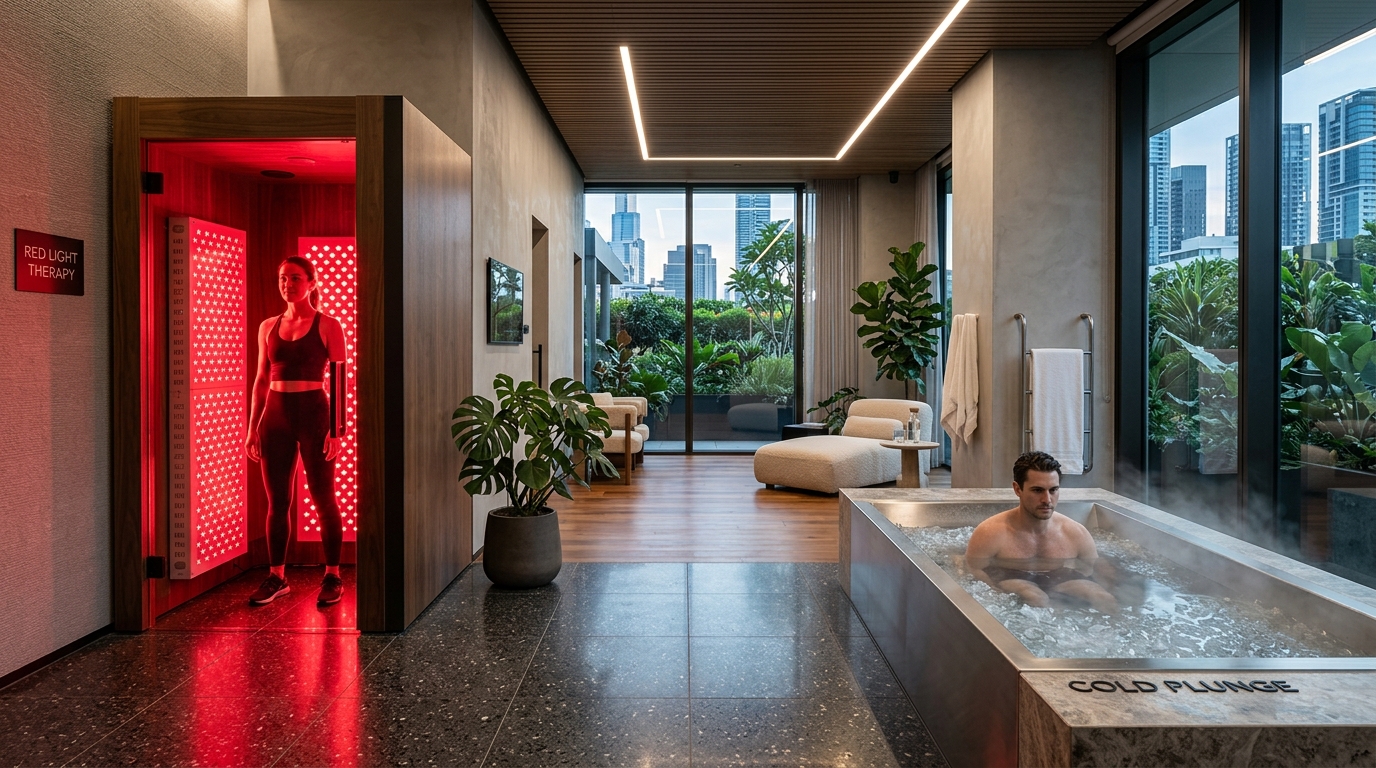
Contrast Therapy vs. Hyperbaric Oxygen & Red Light Therapy: Stacking Biohacks for Peak Recovery
In the rapidly evolving world of performance optimization, biohackers and athletes are moving beyond single-modality treatments. While Contrast Therapy (hot/cold immersion) remains a cornerstone for systemic vascular flushing, emerging tools like Red Light Therapy (Photobiomodulation) and Hyperbaric Oxygen Therapy (HBOT) target recovery at different cellular depths.
Understanding how contrast therapy compares to—and synergizes with—these advanced recovery technologies allows you to design a high-efficiency biohacking stack.
Modality Breakdown: How They Work at a Cellular Level
Each of these three popular recovery modalities operates through a distinct biological mechanism:
- Contrast Therapy (Thermal & Vascular): Uses alternating temperature extremes to cause rapid arterial constriction and dilation. It acts primarily as a mechanical pump for blood and lymphatic fluid, accelerating tissue waste clearance and resetting autonomic nervous system tone.
- Red Light Therapy (Photonic & Mitochondrial): Emits specific wavelengths of red (660nm) and near-infrared (850nm) light that penetrate deep into skin and muscular tissue. These photons stimulate cytochrome c oxidase within mitochondria, significantly boosting cellular ATP (energy) production and accelerating soft-tissue repair.
- Hyperbaric Oxygen Therapy (Atmospheric & Dissolved Oxygen): Delivers 100% pure oxygen in a pressurized chamber (typically 1.5 to 2.0 ATA). The elevated pressure forces oxygen to dissolve directly into blood plasma and cerebrospinal fluid, promoting angiogenesis (new blood vessel growth) and suppressing deep-tissue neuroinflammation.
Modality Comparison Matrix
| Feature / Goal | Contrast Therapy (Hot/Cold) | Red Light Therapy (PBM) | Hyperbaric Oxygen (HBOT) |
| Primary Mechanism | Vascular constriction/dilation | Mitochondrial ATP activation | Plasma oxygen saturation under pressure |
| Target Area | Systemic circulation & lymphatics | Skin surface & localized muscles | Systemic micro-vessels & brain tissue |
| Best For | Acute soreness, swelling, HRV reset | Collagen, wound healing, local inflammation | TBI, deep cellular healing, stem cell release |
| Session Time | 15 – 25 minutes | 10 – 20 minutes | 60 – 90 minutes |
| Accessibility | High (Sauna + Plunge or Shower) | High (At-home panels) | Moderate-to-Low (Clinical clinic/chamber) |
The Ultimate Recovery Stack Protocol
To maximize biological synergies, combine these modalities in a sequential order that builds upon the cellular changes of the previous step:
- Phase 1: Red Light Therapy (15 Mins): Start with red light on bare skin while dry. Pre-charging mitochondrial ATP levels primes tissues to process thermal stress more efficiently.
- Phase 2: Contrast Therapy (20 Mins): Move directly into alternating heat and ice plunge sessions. The thermal pumping mechanism rapidly circulates the ATP-boosted blood through fresh, dilated micro-capillaries.
- Phase 3: Hyperbaric Session (60 Mins): Finish in a hyperbaric chamber when deep tissue recovery or brain fog clearance is needed. The post-contrast vascular network will be fully primed to transport dissolved plasma oxygen deep into damaged tissues.
3 Essential Stacking Guidelines
- Never Do Red Light After Cold Immersion on Wet Skin: Water on the skin reflects light photons and reduces wavelength penetration depth. Always perform red light exposure on clean, dry skin before entering cold plunges or saunas.
- Stack Based on Priority: If time is limited, prioritize Contrast Therapy for acute muscle soreness (DOMS) and Red Light Therapy for joint pain or collagen/skin health.
- Stay Hydrated Between Stack Phases: Both thermal contrast and hyperbaric pressure increase fluid filtration rates in the kidneys. Replenish with mineralized water containing sodium and potassium throughout the stack.