Low-EMF vs Standard Infrared Saunas: A 2026 Buyer’s Comparison
If you are shopping for a home infrared sauna in 2026, you have likely seen the term “low EMF” attached to some models and not others. The difference is not just marketing—it reflects measurable variations in electromagnetic field levels that many buyers now weigh alongside heat output, build quality, and price. This comparison breaks down how low-EMF and standard infrared saunas differ, what the mG numbers actually mean, and whether paying extra for shielding makes sense for your household.
What “Low EMF” Actually Means in a Home Sauna
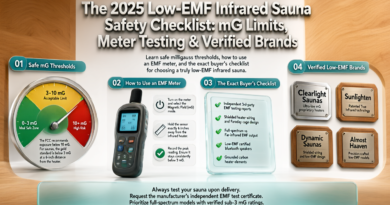
Electromagnetic fields are invisible areas of energy produced by electrical devices. In an infrared sauna, the main sources are the heating panels, power wiring, and control boards. “Low EMF” is not a regulated label, but in practice it refers to saunas engineered to reduce magnetic field (ELF) and sometimes radiofrequency (RF) emissions at typical seating positions. Many manufacturers aim for readings below 3 milligauss (mG) at 4 inches from the panel surface, a threshold used by some building biologists and referenced in older Swedish monitor guidelines. Standard infrared saunas often measure higher—sometimes 10–20 mG or more near the panels—especially in models with unshielded wiring or single-pole heaters.
It is important to note that no universal government standard exists for residential sauna EMF. The 3 mG figure comes from precautionary guidelines rather than law. When a brand advertises “low EMF,” ask how they measured it: distance from the emitter, meter type, and whether testing was third-party or in-house.
How Low-EMF Saunas Are Engineered
Manufacturers reduce EMF through several design changes. The most common is twisting or shielding the AC power wires that feed the heating panels. Twisted pairs cause opposing magnetic fields to cancel each other out. Some brands also use DC-powered heaters or add mu-metal or aluminum shielding behind the panels. Others place the power supply outside the cabin so the occupant is farther from the transformer. These changes do not affect the infrared heat output, but they do add material and labor cost—one reason low-EMF models often carry a $300–$800 premium over comparable standard units.
ELF vs RF: Two Different Concerns
Most sauna EMF discussion focuses on extremely low frequency (ELF) magnetic fields from 60 Hz AC power. However, some saunas with Bluetooth speakers, Wi-Fi controls, or chromotherapy LED drivers also emit radiofrequency (RF) energy. A low-EMF sauna may still have RF if it includes wireless features. If RF matters to you, look for models with wired controls and no built-in wireless transmitters, or turn off Bluetooth when not in use.
How Meters Measure mG: Trifield vs Cornet
Not all EMF meters read the same. A Trifield TF2 measures magnetic, electric, and RF fields but averages differently than a Cornet ED88T, which logs peak and RMS values. For sauna testing, a gaussmeter with a frequency-weighted mode (40–100 Hz) gives the most relevant ELF reading. Hold the meter at the distance where your body would sit—not pressed against the panel—and take readings at head, torso, and foot level. A single number from a marketing sheet tells you little without knowing the protocol.
Low-EMF vs Standard Infrared Sauna: Side-by-Side
The table below summarizes typical differences based on published specs and independent testing of popular 2026 models. Keep in mind that individual units vary, and “standard” does not mean dangerous—it means unoptimized for EMF reduction.
- Typical mG at 4 inches from panel: Low-EMF: 0.5–3 mG; Standard: 5–20+ mG
- Wiring design: Low-EMF: twisted or shielded AC; Standard: untwisted, often single-pole
- Heater type: Low-EMF: DC or shielded AC panels; Standard: AC panels, no shielding
- Price premium: Low-EMF: $300–$800 more for comparable size
- Heat output: Identical—EMF shielding does not affect infrared wavelength or wattage
- Third-party testing: Low-EMF: often certified by independent labs; Standard: rarely tested
Think of low-EMF design like a quieter dishwasher: it performs the same core job, but the engineering reduces an invisible byproduct that some people prefer to minimize.
Is Low EMF Worth It? A Practical Buyer’s Guide
The answer depends on your household’s sensitivity and long-term use patterns. Many users report no noticeable difference in how they feel after a session in a standard sauna. However, if you plan to use the sauna daily for years, or if you have family members who are pregnant, have implanted medical devices, or simply prefer a precautionary approach, the extra cost may buy peace of mind. Research on long-term low-level EMF exposure is ongoing and inconclusive; no causal link to disease has been established at typical sauna levels. The precautionary principle—reducing exposure when feasible without sacrificing function—is the most defensible framework.
Who Should Prioritize Low EMF
- Households with children or pregnant women, who may be more sensitive to environmental stressors.
- People with electronic implants (pacemakers, insulin pumps) who want to minimize any interference risk.
- Buyers who use the sauna more than 4 times per week, accumulating higher lifetime exposure.
- Those who live in homes already high in EMF from nearby power lines or smart meters and want to avoid adding more.
- Shoppers who value third-party verification and are willing to pay for documented testing.
Practical Tips for Any Sauna Buyer
- Ask the seller for a written EMF test report, not just a “low EMF” badge. Check the meter model, distance, and date.
- If you already own a standard sauna, you can often reduce EMF by having an electrician twist the power leads or add shielding behind the panels.
- Place the sauna at least 3 feet from beds, desks, or other places where people spend hours, to lower ambient exposure.
- Use a gaussmeter to test a floor model before buying. Take readings at the seat, backrest, and foot area.
- Turn off Bluetooth and Wi-Fi features when not needed, or choose a model without them.
Myth vs Fact: Low-EMF Saunas
- Myth: Low-EMF saunas don’t get as hot. Fact: EMF shielding has no effect on infrared heat output or maximum temperature.
- Myth: All “low EMF” saunas are the same. Fact: Shielding quality varies widely; some reduce only ELF, others also address RF.
- Myth: Standard saunas are dangerous. Fact: No regulatory body has classified typical sauna EMF levels as hazardous; the concern is precautionary.
- Myth: You need a $500 meter to check EMF. Fact: A basic gaussmeter under $100 can give useful comparative readings if used consistently.
Frequently Asked Questions
What mG level is considered low EMF for an infrared sauna?
Many manufacturers and building biologists use 3 mG or less at the seating position as a benchmark for “low EMF.” This is not a legal limit but a precautionary target. Some premium models achieve under 1 mG at 4 inches from the panel.
Does low EMF affect sauna performance or heating speed?
No. EMF shielding involves the electrical wiring and panel backing, not the heating elements themselves. A low-EMF sauna will reach the same temperature in the same time as an otherwise identical standard model.
Can I retrofit my existing sauna to lower EMF?
In many cases, yes. An electrician can twist the AC power leads, add ferrite beads, or install shielding mesh behind the panels. However, the cost may approach the price difference of buying a low-EMF model, so evaluate before modifying.
Final Thoughts for Your Home Wellness Setup
Choosing between a low-EMF and standard infrared sauna is less about fear and more about informed preference. If you value documented, third-party-tested emissions and plan to use the sauna frequently, a shielded home sauna cabin is a sensible investment. If budget is tight and you are comfortable with typical household EMF levels, a well-built standard unit can still deliver the warmth and relaxation you want. At yardsauna.net, we focus on modern low-EMF far-infrared saunas that meet rigorous testing standards, but the best choice is the one that fits your home, your habits, and your comfort level.
This article is for informational purposes only and does not constitute medical, engineering, or radiation-safety advice. Always consult a qualified healthcare provider before starting any new routine, and a certified EMF testing professional before relying on any specific mG measurement for medical or family-safety decisions.