
Why Low-EMF Infrared Saunas Are Non-Negotiable for Cellular Detox: The ELF Radiation Science You Need
When most people think about infrared sauna safety, they focus on heat, materials, and electromagnetic emissions from heaters. But a growing body of research points to an often-overlooked factor: extremely low frequency (ELF) electric and magnetic fields. These invisible fields, measured in milligauss (mG), are produced by alternating current (AC) wiring, unshielded heating elements, and control panels. In a confined cabin where you sit for 20–45 minutes, ELF exposure can be surprisingly high—and that may undermine the very cellular benefits you seek from infrared therapy.
This deep dive examines the science linking ELF radiation to cellular stress, explains how low-EMF infrared sauna engineering mitigates those risks, and provides evidence-based guidance for choosing a truly ultra-low EMF cabin.
Understanding Electric and Magnetic Fields in the Sauna Environment
Electric fields are created by voltage, while magnetic fields are created by current flow. In a standard infrared sauna, both are present: the AC power supply energizes the heating panels, and the wiring runs through the walls, often directly behind the backrest and bench. Because magnetic fields are not easily blocked by wood or most building materials, they can penetrate the cabin interior and expose the user to ELF radiation in the 50–60 Hz range (the frequency of household AC electricity).
Key sources of ELF inside a sauna include:
- Heater panels: Carbon fiber or ceramic elements powered by AC can emit magnetic fields, especially if transformers or power supplies are located near the seating area.
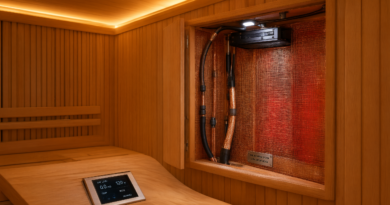
- Wiring layout: Unshielded, non-twisted wires running parallel to the seating area create concentrated fields.
- Control panels and thermostats: Digital displays, touchscreens, and relays can produce localized ELF spikes.
- Proximity to main electrical panel: If the sauna is installed near a home’s breaker box or large appliances, ambient fields can add to internal sources.
Magnetic field strength is measured in milligauss (mG) or microtesla (µT), where 1 µT = 10 mG. Typical indoor ambient levels in homes range from 0.1 to 2.0 mG, depending on wiring and appliance proximity. But inside a poorly designed sauna, readings at the seat or backrest can reach 10–50 mG or more—levels that have been associated with biological effects in epidemiological and laboratory studies.
The Science of Extremely Low Frequency (ELF) Radiation and Cellular Health
Extremely low frequency radiation is non-ionizing, meaning it does not directly break DNA like X-rays. For decades, scientists assumed ELF fields were biologically inert below thermal thresholds. However, research since the 1980s has revealed non-thermal mechanisms by which weak ELF fields can alter cellular function.
In 2002, the International Agency for Research on Cancer (IARC) classified ELF magnetic fields as possibly carcinogenic to humans (Group 2B), based primarily on consistent epidemiological evidence linking residential exposure above 3–4 mG to a doubling of childhood leukemia risk. While the absolute risk remains low, the classification underscores that ELF is not biologically neutral.
More recent mechanistic research points to voltage-gated calcium channels (VGCCs) as a primary target. According to the work of Dr. Martin Pall and others, low-intensity ELF fields can activate VGCCs in cell membranes, leading to an influx of calcium ions. This triggers a cascade of intracellular signaling that increases:
- Reactive oxygen species (ROS) and oxidative stress
- Nitric oxide production, which can react with superoxide to form peroxynitrite—a potent oxidant
- Mitochondrial dysfunction and reduced ATP synthesis
- Inflammatory cytokine release
- Disruption of the blood-brain barrier in some studies
These effects are particularly relevant during infrared sauna use. Infrared therapy itself is designed to enhance mitochondrial respiration, increase circulation, and stimulate cellular repair. But if the same environment exposes cells to ELF-induced oxidative stress, the net benefit may be partially offset—especially for individuals with compromised detoxification pathways or high heavy metal burdens.
Laboratory studies on human cells have shown that ELF exposure at levels as low as 2–10 mG can alter gene expression, increase heat shock protein production, and affect cell cycle progression. While not all studies agree, the weight of evidence supports a precautionary approach: in a wellness device used regularly, minimizing ELF exposure is a rational health measure.
How Low-EMF Infrared Sauna Technology Protects Cellular Health
The term ‘low-EMF’ is not merely marketing. In well-engineered saunas, specific design choices dramatically reduce both electric and magnetic fields at the user’s body. These include:
- Shielded wiring: Twisted pair or shielded cables cancel opposing magnetic fields and prevent electric field leakage. In an ultra-low EMF cabin, all AC wiring inside the walls is encased in grounded metal conduit or uses twisted, shielded pairs.
- Low-EMF heater designs: Heating panels can be wired in a bifilar pattern (current flows in opposite directions within the same panel) to cancel magnetic fields. Some manufacturers use DC power supplies located far from the seating area to eliminate AC fields at the source.
- Zero EMF sauna technology: Advanced systems may incorporate active cancellation coils that generate opposing fields to neutralize residual magnetic emissions, or use fully shielded, grounded heating elements with integrated Mu-metal shielding.
- Distance and layout engineering: Placing transformers, relays, and power supplies in the roof or floor rather than behind the backrest can reduce exposure by orders of magnitude, because magnetic field strength falls rapidly with distance (roughly as the inverse square or cube, depending on source geometry).
- EMF shielding in saunas: Some cabins include built-in conductive mesh or metallic foil layers connected to ground, which block electric fields but have less effect on magnetic fields unless high-permeability alloys are used.
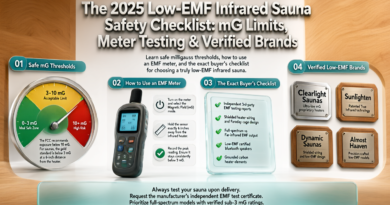
Verification is essential. Reputable manufacturers publish third-party EMF meter testing results showing milligauss levels at specific measurement points (seat, backrest, foot area, control panel). A true low-EMF infrared sauna should deliver readings below 2 mG at the seat and back, and ideally below 1 mG. Some ‘zero EMF’ models achieve 0.1–0.3 mG—essentially indistinguishable from background.
ELF Exposure During Detoxification: Why Low EMF Matters More When Sweating
Detoxification is a primary reason people use infrared saunas. Infrared heat raises core body temperature, increases sweat production, and mobilizes stored toxins—including heavy metals—from tissues. This process relies on healthy cellular transport, ATP availability, and antioxidant capacity.
However, heavy metal detox low EMF is not just a catchy phrase. Heavy metals themselves can increase oxidative stress and impair mitochondrial function. Adding ELF-induced ROS on top of a heavy metal burden can create a synergistic toxic effect. Research on combined exposures suggests that electromagnetic fields may enhance the cellular uptake of certain metals and worsen oxidative damage.
By choosing a sauna with ultra-low ELF emissions, you create an environment where infrared therapy can work without adding a second, invisible stressor. This is especially important for:
- Individuals with chronic fatigue, autoimmune conditions, or multiple chemical sensitivity
- People undergoing heavy metal chelation or detox protocols
- Anyone using the sauna daily as part of safe home wellness routines
- Children, pregnant women, and those with implanted electronic devices (who have additional EMF sensitivity)
In short, low-EMF design is not a luxury—it is a prerequisite for maximizing the cellular health benefits of infrared therapy.
Interpreting Milligauss (mG) Levels in Saunas: What Research Suggests
There is no universal regulatory limit for ELF exposure in consumer saunas. The International Commission on Non-Ionizing Radiation Protection (ICNIRP) sets a general public exposure limit of 2000 mG for 50 Hz magnetic fields, but this is based solely on acute effects like nerve stimulation and does not account for long-term, non-thermal biological effects.
In contrast, building biology guidelines (e.g., from the Institute of Building Biology + Sustainability) recommend much lower levels for sleeping areas: <0.2 mG for magnetic fields and <1 V/m for electric fields. While a sauna session is shorter than sleep, the exposure is more intense and often occurs in a small, enclosed space with direct contact to surfaces.
Based on the precautionary principle and the VGCC literature, a sensible benchmark for a low-EMF infrared sauna is:
- Below 2 mG at the seat and backrest during full operation (heaters on high)
- Ideally below 1 mG at the same positions for an ‘ultra-low EMF’ claim
- Electric fields below 10 V/m at the seat, though magnetic fields are typically the greater concern
To verify these levels, use a quality EMF meter capable of measuring ELF magnetic fields (e.g., a gaussmeter with a frequency range covering 50–60 Hz). Turn on all heaters at maximum power, close the door if possible, and take readings at head, chest, seat, and foot levels. Keep the meter at least 6 inches from the surface to avoid contact artifacts, and record the highest sustained reading. If a manufacturer refuses to provide test results or discourages independent testing, that is a red flag.
Choosing a Safe Home Sauna: Translating Science into Buying Criteria
When comparing a low-EMF vs standard infrared sauna, the differences are often invisible but measurable. A standard sauna built with conventional AC wiring and unshielded heaters may produce 10–50 mG at the backrest. A well-engineered low-EMF model will typically be 1–10 times lower—often below 1 mG.
Here is what to look for when evaluating how to choose a safe home sauna:
- Verified low EMF brands: Look for brands that publish independent lab reports, not just in-house claims. Third-party certification from organizations like EMF Testing Labs or similar adds credibility.
- Shielded wiring as standard: Ask about the wiring method. Twisted pair, shielded cable, or metal conduit should be specified for all AC power inside the cabin.
- Low-EMF heater design: Inquire about bifilar winding, DC conversion, or magnetic field cancellation. Avoid models where heating elements are directly behind the backrest without shielding.
- EMF meter testing: Request a test report showing mG levels at multiple points with heaters on. If possible, test the sauna yourself before purchase or use a return policy that allows independent verification.
- Placement in the home: Even a perfect sauna can be compromised by nearby high-EMF sources. Install the sauna away from breaker panels, refrigerators, and other large appliances. Consider having an electrician check the circuit for net current imbalances that can create elevated magnetic fields.
- Overall safe home wellness integration: Combine your low-EMF sauna with other practices: use battery-powered or shielded electronics nearby, avoid Wi-Fi routers near the sauna, and ground the sauna frame properly.
Ultimately, a zero EMF sauna technology claim should be treated with healthy skepticism. True zero is physically impossible because the Earth itself has a static magnetic field. What matters is reducing artificial AC ELF fields to levels that are biologically negligible—typically below 0.2–0.5 mG, which is near the natural background in many homes.
Conclusion: The Cellular Case for Low-EMF Infrared Saunas
The intersection of infrared therapy and ELF science is clear: infrared wavelengths promote mitochondrial health, circulation, and detoxification, but ELF radiation from poorly designed electrical systems can induce oxidative stress and undermine those benefits. By selecting a low-EMF infrared sauna with shielded wiring, cancellation technology, and verified milligauss levels below 2 mG—ideally below 1 mG—you create a wellness sanctuary that supports cellular health rather than adding to your toxic burden.
As research on non-thermal ELF effects continues to evolve, the precautionary principle remains your most reliable guide. In a market flooded with unverified claims, arm yourself with an EMF meter, demand transparent test data, and choose a cabin engineered with your long-term cellular health in mind.