Low-EMF Heaters vs Standard Heaters: What the Label Actually Means
When shopping for a home infrared sauna, the phrase “low EMF” appears everywhere, yet its meaning is rarely explained. Shoppers often get stuck trying to decide whether paying extra for a low-EMF heater is a genuine safety upgrade or just marketing. This guide breaks down the technical differences, the real-world trade-offs, and a decision framework to help you choose based on your household’s needs.
Understanding EMF in Infrared Saunas
Electromagnetic fields (EMF) are generated whenever electricity flows. In an infrared sauna, the heating elements produce both electric fields (measured in volts per meter, V/m) and magnetic fields (measured in milligauss, mG). Standard heaters typically produce magnetic fields in the range of 10-30 mG at close range, while low-EMF heaters are engineered to reduce that to under 3 mG, sometimes as low as 0.5 mG. These numbers vary widely by model and measurement distance, so a label alone is not a guarantee.
The term “low EMF” is not regulated by a single US agency. Some manufacturers use third-party testing, while others rely on internal measurements. This inconsistency is why comparing EMF ratings requires looking at the testing method, the distance from the heater, and whether both electric and magnetic fields are reported.
How Low-EMF Heaters Work
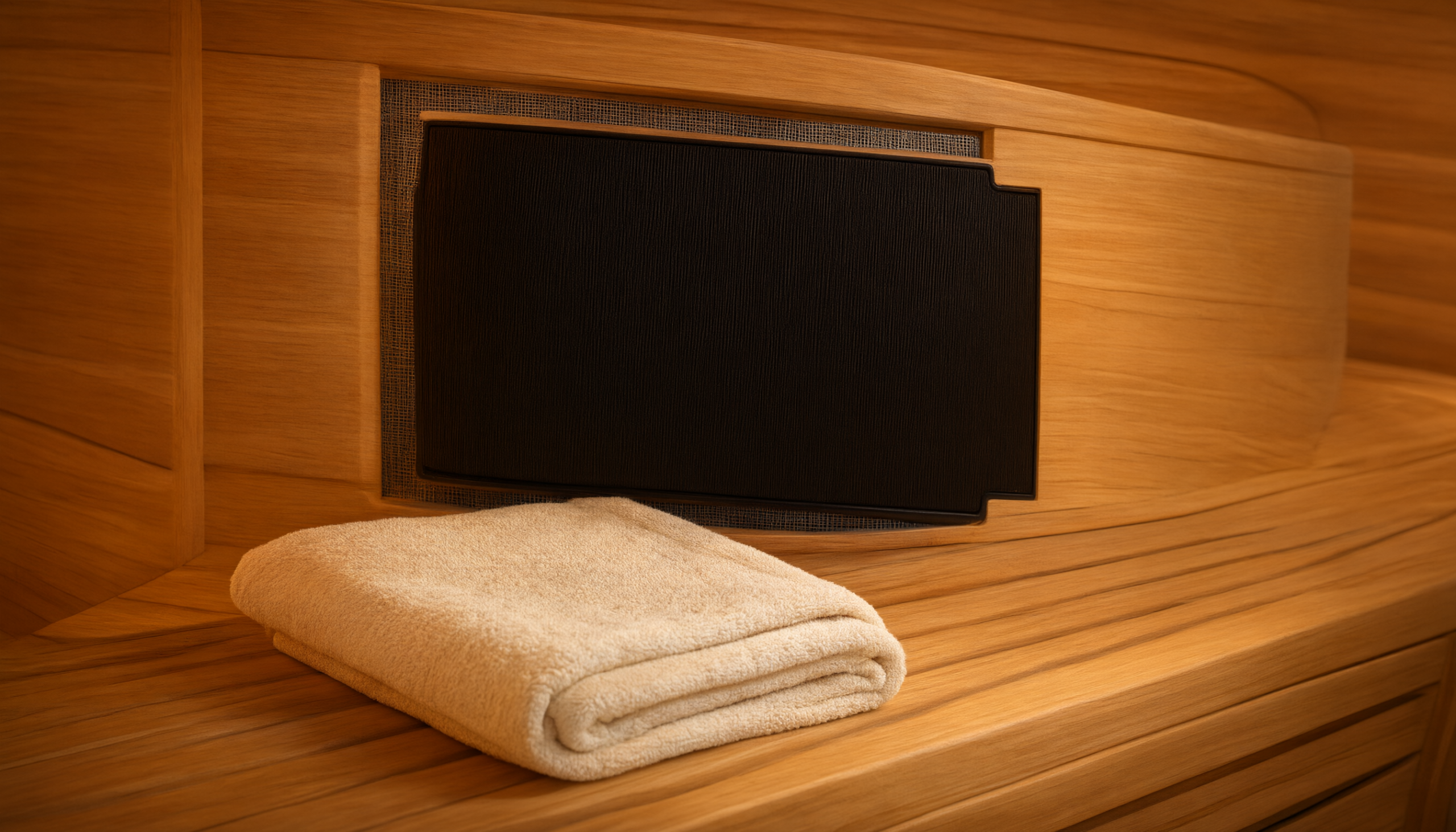
Low-EMF infrared heaters use several technical approaches to reduce field emissions. The most common is twisted or shielded wiring that cancels magnetic fields. Some designs add a conductive coating or metal mesh around the heating element. Others reposition the element geometry so that fields cancel each other. These changes add manufacturing cost but do not fundamentally alter the infrared output or heating efficiency. A low-EMF heater can produce the same warmth as a standard heater at the same wattage.
What “Standard” Heaters Actually Emit
Standard infrared heaters are not inherently dangerous, but they do produce measurable EMF. For context, a typical hair dryer can emit 10-70 mG at 6 inches, and a microwave oven can leak 10-30 mG at 1 foot. Standard sauna heaters often fall within a similar range when measured at the back or side panels. The key difference is proximity and duration: sauna sessions last 20-45 minutes, and the user sits close to the heaters. This is why some shoppers prefer lower EMF levels, even though no consensus exists on a safe threshold.
Side-by-Side: Low-EMF vs Standard Heaters
The table below summarizes the main differences across six decision factors. These are typical ranges, not exact specifications, because every manufacturer designs differently.
| Decision Factor | Low-EMF Heater | Standard Heater |
|---|---|---|
| Typical magnetic field at 4 inches | 0.5-3 mG | 10-30 mG |
| Electric field (V/m) | Often <50 V/m | Often 100-300 V/m |
| Price impact | Adds roughly 15-30% to cabin cost | Baseline cost |
| Heating performance | Equivalent to standard at same wattage | Equivalent to low-EMF at same wattage |
| Shielding materials | Twisted wiring, metal mesh, conductive coatings | Basic insulation, no extra shielding |
| Best for | Sensitive users, daily users, those wanting lower exposure | Budget shoppers, occasional users, those comfortable with typical household EMF |
Note: These figures are examples from typical low-EMF sauna heater designs and vary by model. Always request the manufacturer’s EMF test report for the specific cabin you are considering.
Strengths and Trade-offs of Low-EMF Heaters
Low-EMF heaters appeal to shoppers who want to minimize their overall electromagnetic exposure, especially if they already use the sauna daily or have concerns about cumulative exposure. The trade-off is cost: the shielding adds to the price, and not all “low-EMF” claims are equally verified. Some cabins only shield the back panels, leaving the side heaters at standard levels. Others may use a low-EMF label without independent testing. A modern low-EMF far-infrared sauna with full shielding typically costs more than a comparable standard model, but many users find the peace of mind worth the premium.
Strengths and Trade-offs of Standard Heaters
Standard heaters keep the cabin price lower and are perfectly adequate for most residential use. If you use the sauna once or twice a week and are not particularly concerned about EMF, a standard heater will deliver the same warmth and infrared spectrum. The main trade-off is that you accept higher field levels, which may matter if you have a pacemaker, are pregnant, or simply prefer to reduce all controllable EMF sources. Also, some standard heaters have inconsistent field patterns, so one side of the cabin may measure higher than the other.
Best-Fit User Profiles
- Low-EMF heater: Daily sauna users, households with children, anyone with electromagnetic sensitivity concerns, or buyers who want third-party verification of low emissions.
- Standard heater: Budget-conscious shoppers, occasional users (less than 3 sessions per week), or those who already accept similar EMF levels from other home appliances.
- Hybrid approach: Some cabins offer low-EMF shielding on the back wall only, which reduces the largest field source at a moderate price increase. This can be a good middle ground.
What the Label Actually Means
The phrase “low EMF” is not a standardized certification. It can mean anything from “we twisted the wires” to “we tested with a third-party lab and publish the results.” To cut through the marketing, ask these questions before buying:
- What is the measured magnetic field at 4 inches from each heater panel? A reputable manufacturer will provide a number, not just a label.
- Who performed the test? Independent labs are more trustworthy than in-house measurements.
- Does the low-EMF claim cover all panels or just the backrest? Some cabins shield only the area closest to the spine.
- What is the electric field level? Magnetic fields get most attention, but electric fields can also be reduced with good grounding and shielding.
A low-EMF label is only as good as the test report behind it. Always ask for the numbers, not the marketing.
Common Mistakes Comparison Shoppers Make
- Assuming all low-EMF saunas are equal. Shielding quality varies enormously. One model may measure 0.5 mG at the back and 8 mG at the sides, while another is uniformly under 1 mG.
- Ignoring the electric field. Magnetic fields are only half the story. A cabin with excellent magnetic shielding but poor grounding can still produce high electric fields.
- Paying for a label without verification. Some “low-EMF” models cost hundreds more but lack any published test data. If the manufacturer won’t share numbers, treat the claim with skepticism.
- Overlooking usage patterns. A standard heater in a cabin used once a month produces far less cumulative exposure than a low-EMF heater used daily. Your habits matter more than the label.
Myth vs Reality: “Low-EMF Means Less Heat”
A persistent myth is that low-EMF heaters are less powerful or produce a weaker infrared output. In reality, the heating element’s wattage and emitter material determine the heat output, not the shielding. A 500-watt low-EMF heater produces the same infrared energy as a 500-watt standard heater. The shielding only affects the electromagnetic field, not the thermal performance. If a salesperson claims otherwise, that is a red flag.
How to Decide: A Decision Framework
Instead of asking “which is better?”, ask “which is better for my household and usage?” Follow this four-step process:
- Assess your usage frequency. Daily users get more value from low-EMF shielding because the exposure adds up. Occasional users may not justify the extra cost.
- Check your household’s EMF sensitivity. If anyone has a medical device, is pregnant, or reports symptoms around electronics, lean toward low-EMF. Otherwise, standard heaters are generally acceptable.
- Request test reports for any cabin you are considering. Compare the actual mG and V/m numbers at the same distance. A low-EMF claim without data is not a reason to pay more.
- Balance the budget against other features. If the low-EMF upgrade forces you to sacrifice cabin size, wood quality, or a better control system, it may not be worth it. A shielded home sauna cabin with cheap heater panels is still a compromise.
For a deeper dive into how different sauna categories compare on EMF, heat-up time, and build quality, you can explore the model comparisons on yardsauna.net. The right choice is the one that matches your actual usage, not the one with the most reassuring label.
Frequently Asked Questions
What is a safe EMF level for a sauna?
There is no US federal standard for residential sauna EMF. Many low-EMF manufacturers aim for under 3 mG at 4 inches, which is far below typical household appliances. Some international guidelines suggest keeping chronic exposure under 2-4 mG, but these are not legally binding. The safest approach is to choose the lowest EMF level that fits your budget and verify it with test data.
Do low-EMF heaters cost more to run?
No. Shielding does not change the heater’s wattage or energy consumption. A low-EMF heater uses the same electricity as a standard heater of the same wattage. The only cost difference is the upfront purchase price, not ongoing operating costs.
Can I retrofit a standard sauna to be low-EMF?
Retrofitting is difficult because the shielding is built into the heater panel design. You can sometimes add external shielding materials, but this may affect heat distribution and void warranties. If low EMF is a priority, it is better to buy a cabin designed with low-EMF heaters from the start.
This article is for general informational purposes only. Specifications, dimensions, and price ranges mentioned are typical examples that vary by model and change frequently – always verify current details directly with manufacturers or retailers before making a purchase decision.