
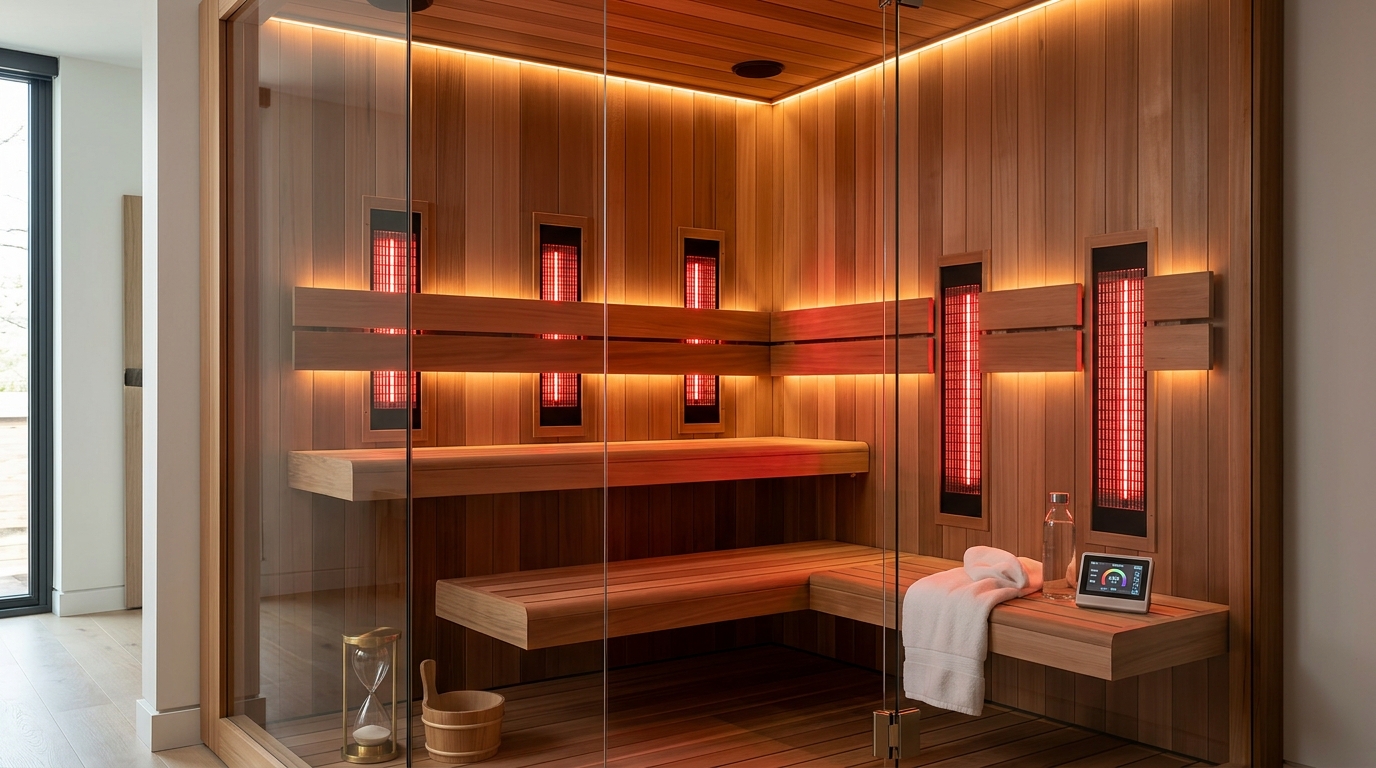
Near, Mid, or Far? The Ultimate Guide to Full-Spectrum Infrared Sauna Wavelengths
When shopping for an infrared sauna, you will quickly encounter technical terms like Far-Infrared (FIR), Mid-Infrared (MIR), and Near-Infrared (NIR). While traditional saunas rely on heating the air around you, infrared saunas use light waves to heat your body directly.
Understanding the differences between these three wavelengths—and why full-spectrum saunas combine them all—is essential for matching your home setup with your personal health goals.
The Wavelength Breakdown: Near, Mid, and Far
The infrared spectrum is divided into three distinct categories based on how deeply the light waves penetrate human tissue:
[ Skin Surface ]  ─────────> Near-Infrared (NIR): Collagen, Skin & Cellular Renewal
   │
[ Muscle & Joints ] ───────> Mid-Infrared (MIR): Circulation, Pain & Soft Tissue
   │
[ Deep Core/Organ ] ───────> Far-Infrared (FIR): Core Heating, Sweating & Detoxification
1. Near-Infrared (NIR): Cellular Energy & Skin Rejuvenation
- Penetration Depth: Shallowest (Skin surface to tissue)
- Wavelength: ~700 to 1400 nm
Near-infrared light is closest to visible red light. Rather than generating intense heat, NIR is absorbed directly by mitochondria (the powerhouses of your cells).
- Primary Benefits: Promotes collagen production, reduces skin inflammation, accelerates wound healing, and enhances cellular energy (ATP) production.
2. Mid-Infrared (MIR): Muscle Recovery & Joint Relief
- Penetration Depth: Moderate (Soft tissue, muscles, and joints)
- Wavelength: ~1400 to 3000 nm
Mid-infrared wavelengths penetrate deeper into soft tissue than NIR. This level of heat helps expand blood vessels and increase peripheral circulation.
- Primary Benefits: Soothes joint stiffness, speeds up recovery after intense resistance training, and targets chronic muscle inflammation.
3. Far-Infrared (FIR): Deep Sweating & Cardiovascular Conditioning
- Penetration Depth: Deepest (Body core and fat tissue)
- Wavelength: ~3000 to 100,000 nm
Far-infrared is the workhorse of infrared heat therapy. Because FIR waves raise your core body temperature from the inside out, they trigger a profuse, toxin-clearing sweat at much lower ambient temperatures than traditional steam saunas (around 120°F–140°F / 49°C–60°C).
- Primary Benefits: Elevates heart rate for cardiovascular conditioning, promotes deep relaxation, and supports heavy sweating.
Why Choose a Full-Spectrum Infrared Sauna?
Single-wavelength saunas (usually far-infrared only) are great for sweating, but a full-spectrum sauna incorporates heaters for all three bands simultaneously.
| Feature | Single-Wavelength (FIR Only) | Full-Spectrum (NIR + MIR + FIR) |
| Primary Mechanism | Core thermal heating | Thermal heating + Photo-biomodulation |
| Skin Benefits | Moderate (sweat cleansing) | High (direct red light collagen stimulation) |
| Pain Management | General muscle warmth | Targeted deep joint & soft tissue therapy |
| Session Customization | Temperature control only | Independent control of light spectrums |
3 Tips for Optimizing Your Infrared Session
- Hydrate Beforehand: Drink 16–24 oz of electrolyte-rich water before entering. Infrared heat warms core tissues fast, leading to rapid fluid loss.
- Sit Upright: Position your back directly in front of the heater panels so the infrared waves hit your spine and key muscle groups evenly.
- Keep Sessions to 20–30 Minutes: For maximum metabolic benefits without overheating, stick to 20–30 minute sessions, 3 to 5 times per week.