
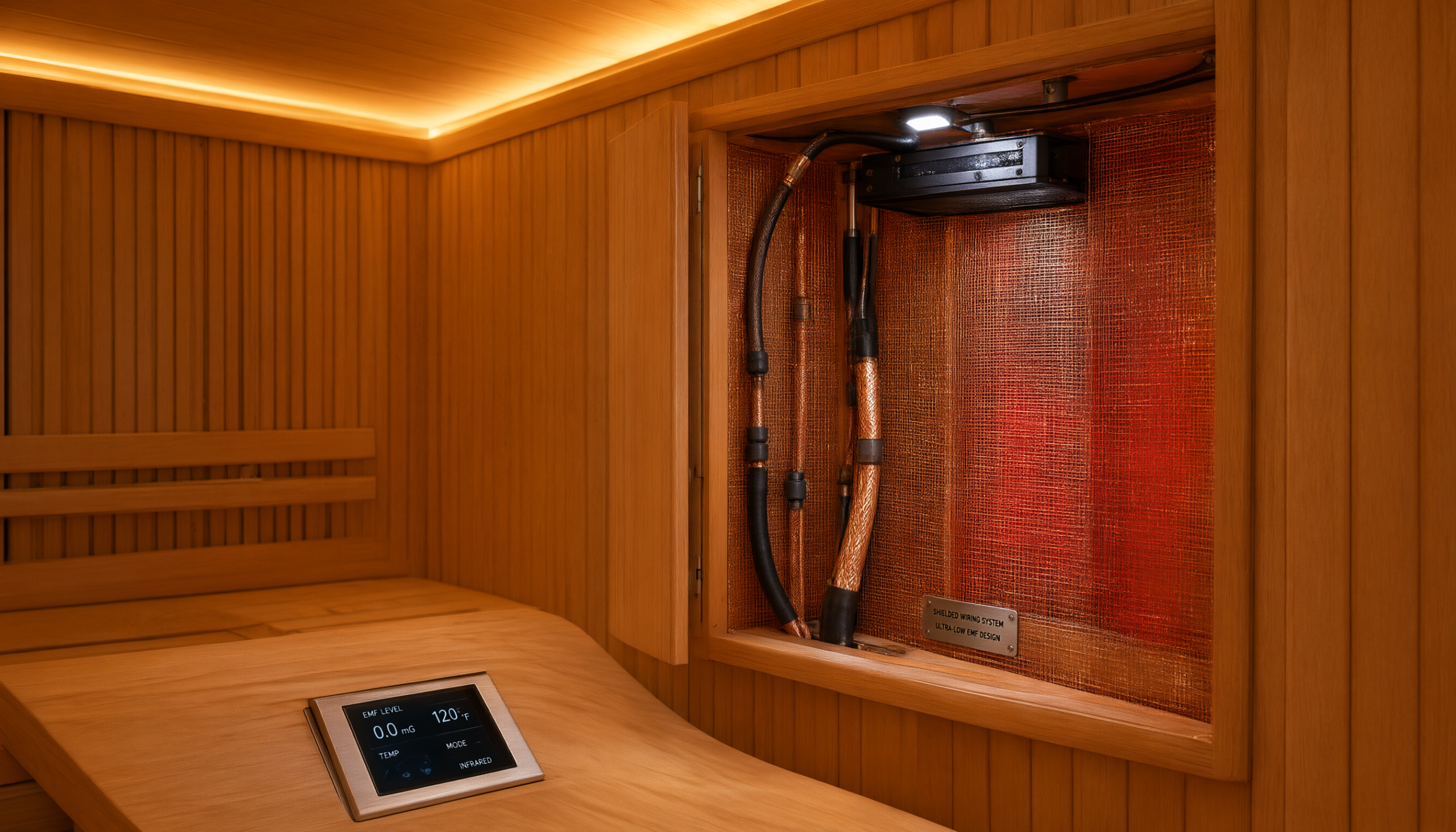
The Engineering Secrets Behind Zero EMF Sauna Technology: Shielded Wiring and Ultra-Low EMF Cabin Design
When shopping for a low-EMF infrared sauna, most buyers are told to look for the label, but few understand the actual engineering that separates a genuinely ultra-low EMF cabin from a standard model that merely claims safety. This deep dive explores shielded wiring, electric and magnetic field suppression, and the construction principles behind zero EMF sauna technology, giving you practical knowledge to evaluate any brand.
Electric and Magnetic Fields in Infrared Saunas: Why mG Levels Matter
Every electrical device produces two distinct types of fields: electric fields (measured in volts per meter, V/m) and magnetic fields (measured in milligauss, mG). In a standard infrared sauna, alternating current (AC) at 50 or 60 Hz flows through heater panels, power cables, and control circuits. This creates extremely low frequency (ELF) radiation throughout the cabin. While electric fields can be relatively easy to block with conductive shielding, magnetic fields penetrate wood, plastic, and even human tissue with little attenuation. That is why the most rigorous low-EMF sauna designs focus primarily on reducing magnetic field exposure at the occupant’s body positions.
Typical standard infrared saunas often measure 5 to 20 mG near the backrest or seat, and sometimes over 50 mG directly adjacent to heater panels. In contrast, a true ultra-low EMF cabin aims for readings below 2 mG at all occupant contact points, with verified zero EMF sauna technology often achieving 0.5 mG or less—near the noise floor of a quality EMF meter. Understanding this distinction is the first step toward safe home wellness.
The Role of Shielded Wiring in Zero EMF Sauna Technology
Shielded wiring is the backbone of any legitimate low-EMF infrared sauna. Unlike standard unshielded cable, shielded wiring uses a conductive foil or braided mesh surrounding the current-carrying conductors. This shield intercepts electric fields and, when properly grounded, drains them harmlessly to earth. But shielded wiring alone is not enough. The geometry of the wire run, grounding strategy, and termination points all determine whether the shield reduces or even worsens field emissions.
In high-quality low-EMF sauna construction, every power wire inside the cabin is either run through flexible metal conduit or uses shielded cable with a dedicated drain wire. The drain wire is grounded at exactly one end—usually at the main power entry—to prevent ground loops that can create circulating currents and secondary magnetic fields. Twisted pair configurations are used for low-voltage control signals to cancel induced fields through common-mode rejection. Additionally, power and signal cables are physically separated by at least 6 to 12 inches wherever possible, reducing capacitive coupling.
Another critical technique is minimizing loop area. Any time a current flows out and returns along a different path, it creates a magnetic loop. By routing the hot and neutral wires tightly together, the opposing currents generate magnetic fields that largely cancel each other. This is why reputable low-EMF cabin manufacturers use custom wiring harnesses with paralleled conductors rather than daisy-chaining heater panels with long, loose loops.
Suppressing Magnetic Fields in Ultra-Low EMF Cabins
Magnetic fields are notoriously difficult to shield. Unlike electric fields, they cannot be blocked by simple conductive enclosures unless you use expensive high-permeability alloys like mu-metal, which is impractical for a sauna. Therefore, the most effective magnetic field suppression strategies rely on three principles: distance, cancellation, and low-current design.
Distance is the simplest and most powerful tool. Magnetic field strength falls off roughly with the cube of distance for a small source. By positioning power supplies, transformers, and high-current wiring as far as possible from the seating area—ideally in a separate external control box or in the rear corner away from the backrest—designers can achieve dramatic reductions in mG levels at the occupant’s body. Many ultra-low EMF cabins route all high-voltage wiring along the floor perimeter and up the back corners, never behind or beside the seat.
Cancellation is achieved through precise conductor pairing. In a low-EMF infrared sauna, heater panels are often wired in a back-to-back configuration where the supply and return leads run adjacent to each other. The magnetic fields from the opposing currents cancel, leaving a residual field that is often below 0.5 mG even a few inches from the wire. Some advanced designs also use DC power for all control circuitry and LED lighting. Direct current produces static magnetic fields only during switching, and no ELF oscillation, effectively eliminating the 50/60 Hz field from those components.
Finally, low-current design reduces the source strength. Using high-efficiency carbon-based heater panels with high resistance means lower current for a given wattage. Lower current directly translates to weaker magnetic fields. Similarly, solid-state relays and zero-crossing switching avoid the sudden current spikes that can create transient magnetic bursts. Toroidal transformers are preferred over traditional EI-core transformers because their donut-shaped core contains the magnetic flux within the core itself, dramatically reducing stray fields.
Construction Principles for a Low-EMF Infrared Sauna Cabin
Beyond wiring, the physical construction of an ultra-low EMF cabin plays a vital role in EMF shielding in saunas. The cabin walls are typically wood, which offers no magnetic shielding but can be lined with grounded aluminum foil or copper mesh to block electric fields. This conductive lining must be continuous and connected to the safety ground. However, it must be carefully installed to avoid creating unintended ground loops. Premium manufacturers use a single-point grounding system where all shielding, conduits, and equipment grounds meet at one bus bar near the power entry.
The heater panels themselves are a major focus. Standard ceramic or metal rod heaters can act as antennas, radiating electric and magnetic fields directly into the cabin. Leading low-EMF infrared sauna brands use carbon fiber or carbon-nanotube heating panels that have a uniform resistive layer. More importantly, they arrange the internal heating element in a serpentine pattern with adjacent traces carrying current in opposite directions, providing inherent magnetic field cancellation at the panel surface. Some panels include an additional grounded backing layer that suppresses electric fields to near zero.
Fasteners and structural metal components are also considered. While a few screws will not create significant fields, large metallic brackets or ungrounded metal frames can become secondary radiators if they intercept stray electric fields. Therefore, low-EMF cabin construction often uses non-magnetic stainless steel or brass hardware, and avoids continuous metallic runs that could form loops. The door, hinges, and control panel housing are all checked for grounding continuity.
Even the placement of the main power cord matters. A power cord draped across the floor under the bench can expose a user’s feet to elevated mG levels. In verified low-EMF brands, the power entry is a dedicated rear penetration with a short, shielded whip that immediately enters a metal junction box. The junction box itself is grounded and acts as a Faraday cage for the terminations.
EMF Meter Testing: Verifying mG Levels in Real Conditions
No engineering claim is complete without independent verification. To confirm that a sauna is truly a low-EMF infrared sauna, you should perform EMF meter testing under realistic operating conditions. Use a quality gaussmeter capable of measuring ELF magnetic fields with a frequency range covering 40-100 Hz, with tri-axis (3D) measurement and true RMS response. Place the meter at the exact positions where your body will be: seat surface, lower back, upper back, calf area, footrest, and head position if seated upright.
Testing must be done with the sauna fully heated and all heaters operating at maximum power. Many manufacturers quote mG levels with heaters off or at low power, which is meaningless. A genuine ultra-low EMF cabin will maintain readings below 2 mG at every contact point, with most areas below 1 mG. Some zero EMF sauna technology claims achieve 0.2 to 0.4 mG, which is indistinguishable from background in most homes. For comparison, standard saunas frequently register 10 to 30 mG at the backrest under the same test conditions.
Electric fields should also be measured using a body voltage meter or an E-field meter. A person sitting in the sauna should not see significant induced body voltage above a few tens of millivolts. If electric field shielding is present and grounded, the body voltage will remain very low even when the heaters are on. Magnetic fields do not induce body voltage, so this test specifically verifies the electric field suppression system.
How to Choose a Safe Home Sauna: Verified Low EMF Brands and Engineering Signals
When evaluating low-EMF infrared sauna options, look beyond marketing language. Ask for the specific mG levels at defined distances from the heater panels and at the seat and backrest. Reputable brands provide third-party test reports from independent labs or publish real-time EMF meter readings on video. Avoid any brand that cannot specify a maximum mG value or that uses vague terms like ‘low EMF’ without numbers.
Key engineering signals of a genuinely safe home wellness product include: shielded wiring with single-point grounding, metal conduit for all power cables, twisted pair low-voltage wiring, back-to-back conductor routing for cancellation, external or remote power supply placement, carbon-based heating panels with ground-plane shielding, and published mG thresholds verified by EMF meter testing. Some verified low EMF brands go further by offering a pre-delivery EMF test certificate for each unit, showing actual readings from your specific sauna.
It is also important to consider detoxification and EMF safety together. Many people use infrared saunas for heavy metal detox and cellular health infrared therapy. However, if the sauna exposes you to elevated ELF radiation, you may be adding a stressor while trying to remove toxins. A true low-EMF infrared sauna supports the body’s natural healing processes without the electromagnetic burden found in standard models. This is why choosing a zero EMF sauna technology is not just a comfort feature—it is a fundamental part of safe home wellness.
Conclusion
The difference between a standard infrared sauna and a genuine ultra-low EMF cabin lies in the details of electrical design and construction. Shielded wiring, magnetic field cancellation, distance-based layout, and rigorous EMF meter testing are the hallmarks of zero EMF sauna technology. By understanding these engineering principles, you can confidently choose a low-EMF infrared sauna that delivers true cellular health infrared therapy without the hidden risk of elevated milligauss levels. Demand numbers, verify with your own meter, and prioritize brands that demonstrate a real commitment to electromagnetic hygiene.