Will a 2-Person Infrared Sauna Fit Your Space? Sizing & Clearance Guide
You have decided a two-person infrared sauna is the right wellness investment for your home. Now comes the practical question: will it actually fit in the space you have in mind? Getting the sizing right before you buy saves you from delivery-day surprises, cramped sessions, and costly remodeling. This guide walks you through every dimension, clearance, and layout consideration so you can confidently choose a sauna that fits your home and your routine.
Understanding 2-Person Sauna Dimensions
Two-person infrared saunas are designed for side-by-side seating, which means they are wider than they are deep. Most models fall in a range of 45 to 55 inches wide, 38 to 48 inches deep, and 72 to 78 inches tall. The YardSauna Forest 2-Person Infrared Sauna measures 48 inches wide by 42 inches deep by 75 inches high, which is a comfortable middle-of-the-road footprint for two average adults. Keep in mind that these are exterior dimensions; the interior bench width is usually a few inches less, so if you and your sauna partner are both tall or broad-shouldered, you may want to test the bench width before committing.
Ceiling height is often the forgotten dimension. A 75-inch tall sauna fits under a standard 8-foot ceiling with room to spare, but if you are placing the sauna in a basement with ductwork, a sloped attic, or a room with a ceiling fan, you need to measure the lowest obstruction, not just the ceiling. Add at least 2 to 3 inches of clearance above the sauna for heat dissipation and easy assembly. If you have a 7-foot ceiling (84 inches), the Forest model still leaves 9 inches of clearance, which is plenty.
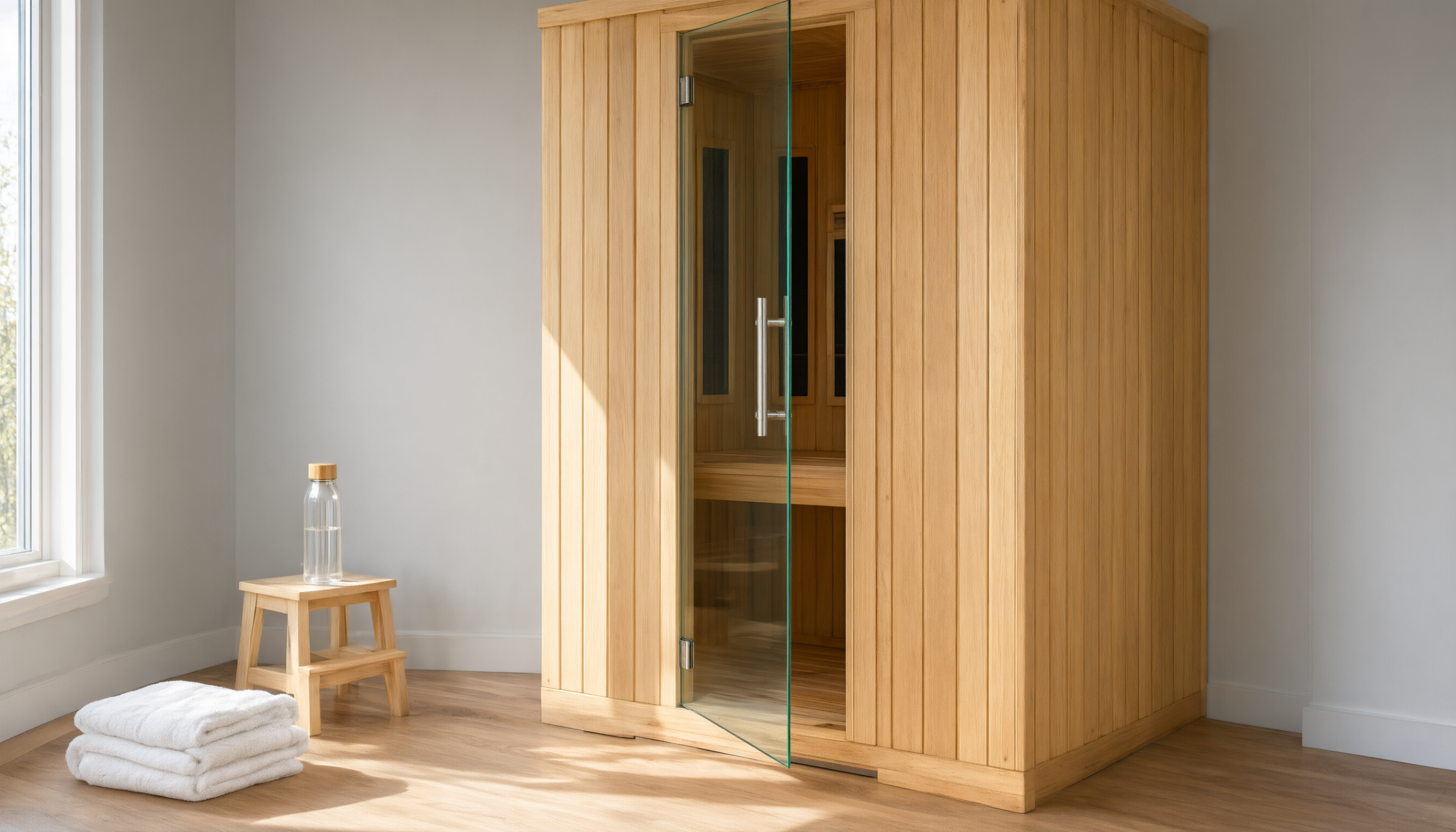
Door swing is another dimension that catches people off guard. The Forest sauna has a full-length tempered glass front door, and you need enough room in front of the sauna for that door to open fully without hitting a wall or another piece of furniture. The door swings outward, so plan for at least 24 to 30 inches of clear space in front of the sauna. If you are tight on space, consider a model with a sliding door, but most two-person infrared saunas use a hinged glass door for a more open feel.
Interior Bench Dimensions and Seating Comfort
Inside the sauna, the bench is the real test of comfort. The Forest sauna features an extra-wide bench designed to seat two adults side-by-side, but the actual seat width is about 44 inches after accounting for the side panels. That gives each person roughly 22 inches of hip room, which is adequate for average builds but may feel snug for larger users. If you and your partner are both over 250 pounds or have broad shoulders, you might want to look at a slightly wider model or accept that you will be sitting shoulder-to-shoulder.
Bench depth matters too. A deeper bench allows you to sit back with your legs extended or even curl up, while a shallow bench forces you to sit upright with knees bent. The Forest bench is 17 inches deep, which is typical for a two-person unit and works well for most people. If you are tall, check the distance from the bench to the ceiling; you want at least 5 to 6 inches of headroom when seated so you do not feel closed in.
Finally, consider how you like to sit in a sauna. Some people prefer to sit cross-legged or with a leg tucked up, which requires more bench depth. If that is you, measure the interior depth and compare it to your preferred sitting position. The Forest interior depth is about 38 inches, giving you room to stretch your legs out in front of you, but not enough to lie down.
Clearance Requirements: What You Need Around the Sauna
Clearance is the space you leave around the sauna for safety, ventilation, and maintenance. The general rule of thumb is to leave at least 6 inches on each side and behind the sauna, and 24 to 30 inches in front for the door. This allows air to circulate around the heater vents, prevents heat buildup against walls, and gives you room to access the power cord and control panel.
For the Forest sauna, the manufacturer recommends a minimum of 6 inches of clearance on all sides except the front, where you need enough room for the door to swing open. In a typical home, that means you need a footprint of about 60 inches wide by 54 inches deep (including the front clearance) for the sauna itself. If you are placing the sauna in a corner, you can reduce the side clearance on the two walls to 4 inches, but keep the back and front clearances as recommended.
Ventilation is another reason for clearance. Infrared saunas generate heat, and even though they do not produce steam, they need airflow to prevent the cabin from becoming stuffy. The Forest sauna has multi-speed cabin ventilation, but that only works if air can actually move around the unit. If you enclose the sauna in a tight alcove, you may need to add a small vent or leave a larger gap on one side.
Electrical access is also part of clearance. The Forest sauna plugs into a standard 120-volt outlet, and the power cord is usually located on the back or side of the unit. You need enough room to reach the plug without moving the sauna, and you should never use an extension cord. Plan your outlet location before you assemble the sauna, and make sure the cord is not pinched against a wall.
Flooring and Weight Considerations
The weight of a two-person infrared sauna is often overlooked. The Forest sauna weighs approximately 250 pounds empty, and when you add two adults, the total load on your floor is around 700 to 800 pounds concentrated in a 4-foot by 3.5-foot area. Most residential floors are rated for 40 pounds per square foot, which means the sauna plus occupants is well within safe limits. However, if you are placing the sauna on an upper floor, check the floor joist spacing and consider placing the sauna near a load-bearing wall.
The sauna should sit on a level, solid surface. Hardwood, tile, laminate, and concrete are all fine, but carpet is not recommended because it can trap moisture and make the sauna unstable. If you must place the sauna on carpet, use a rigid plywood platform underneath to distribute the weight and provide a stable base. The Forest sauna has a solid floor panel, so it does not require a separate base, but the surface underneath should be clean and dry.
Moisture is a minor concern with infrared saunas because they do not produce steam, but you will still sweat, and some of that sweat can drip onto the floor. Place a towel or a small mat just outside the sauna door to catch drips, and consider a waterproof mat inside if you sweat heavily. The Forest sauna’s tourmaline-enriched floor heater helps evaporate moisture, but a little extra protection never hurts.
Room Size Recommendations for a 2-Person Sauna
Now that you know the clearance requirements, you can figure out the minimum room size. For the Forest sauna, the absolute minimum room dimensions are 60 inches wide by 54 inches deep, assuming you place the sauna against a wall with the door facing into the room. That is a 5-foot by 4.5-foot footprint, which fits in a small spare bedroom, a large walk-in closet, or a corner of a finished basement.
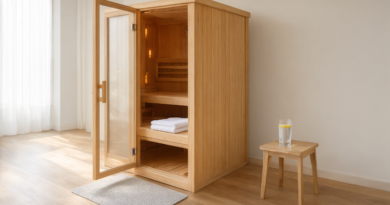
But minimum size is not comfortable size. You also need room to move around the sauna, open the door, and get in and out without bumping into walls. A more realistic recommendation is a room that is at least 7 feet by 7 feet, or about 49 square feet. That gives you enough space to walk around the sauna, open the door fully, and even place a small bench or stool next to it for towels and water bottles.
If you want to use the sauna as a social space, with room for two people to stand and chat before and after a session, aim for a room that is 8 feet by 8 feet or larger. This is common in dedicated wellness rooms, larger basements, or converted garages. Remember that the sauna itself takes up about 14 square feet of floor space, so in a 64-square-foot room, you still have 50 square feet of open space, which is plenty for a couple of chairs or a small table.
Consider the room’s shape as well. A long, narrow room may technically have enough square footage, but the sauna might block the walkway or make the room feel cramped. A square or slightly rectangular room works best. Also think about the door to the room itself; you need to be able to get the sauna through the door during assembly. The Forest sauna ships in flat panels, so you can carry them through a standard 30-inch door, but measure your doorways and hallways before ordering.
Placement Ideas for Common Home Layouts
Basements are the most popular location for home saunas because they are cool, private, and often have unused space. A corner of a finished basement is ideal; you can place the sauna with its back against one wall and one side against another, leaving the front and one side open for access. Just make sure the basement is dry and has a nearby outlet.
Spare bedrooms and home offices are also good options. A 10-foot by 10-foot bedroom can easily accommodate the sauna along one wall, leaving the rest of the room for a bed or desk. The sauna’s low EMF design and quiet operation make it suitable for a space where you also work or sleep, though you may want to schedule sauna sessions for times when you are not on a video call.
Garages are possible but require more preparation. You need to insulate the garage, ensure the floor is level, and provide climate control because infrared saunas do not perform well in freezing temperatures. If you live in a mild climate and have a finished garage, it can work, but a basement or indoor room is usually a better choice.
Bathrooms are a classic sauna location, but they require careful moisture management. The sauna should be placed away from the shower and bathtub, and the bathroom must have a good exhaust fan. The Forest sauna is made from Canadian Hemlock, which is naturally resistant to moisture, but you still do not want it to be splashed with water. A large master bathroom with a separate dry area can work well.
How a 2-Person Infrared Sauna Works: The Complete Mechanism
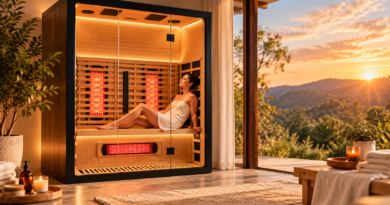
Understanding how a two-person infrared sauna heats your body helps you appreciate why sizing and placement matter. Unlike a traditional sauna that heats the air around you, an infrared sauna uses radiant heat to warm your body directly. The heaters emit infrared light, which penetrates your skin and heats your tissues from the inside out. This allows the sauna to operate at a lower air temperature, typically 120 to 140 degrees Fahrenheit, while still making you sweat profusely.
The Forest sauna uses a combination of high-output quartz full-spectrum heaters and ultra-low EMF carbon panels. Quartz heaters produce near, mid, and far infrared wavelengths, which penetrate to different depths. Near-infrared reaches the deepest, targeting muscles and joints, while far-infrared heats the surface of your skin for a soothing warmth. The carbon panels provide even, consistent heat across the back and sides, filling in the gaps that quartz heaters alone might miss.
In addition to the main heaters, the Forest sauna includes a wide-format overhead red light and NIR array. Red light and near-infrared therapy are believed to support skin health, muscle recovery, and cellular function, though research is ongoing. The overhead array ensures that both occupants receive equal exposure, which is a key advantage of a well-designed two-person sauna.
The tourmaline-enriched floor heater is another mechanism that sets the Forest apart. Tourmaline is a mineral that emits far-infrared radiation when heated, and the floor panel warms your feet and lower legs. Because heat rises, the floor heater helps create a more uniform temperature from floor to ceiling, so you do not have cold feet while your head is sweating. This is especially noticeable in a two-person sauna, where two bodies can create uneven heat distribution.
All of this heat is controlled by a digital touch console that lets you set the temperature and timer. The Forest sauna also has multi-speed ventilation to bring in fresh air and prevent the cabin from becoming stuffy. The heaters are designed to be low EMF, meaning they produce minimal electromagnetic fields, which is a consideration for people who are sensitive to EMF or who want to minimize their exposure.
Common Mistakes to Avoid When Sizing a 2-Person Sauna
Even experienced buyers make sizing mistakes. Here are the most common pitfalls and how to avoid them.
1. Forgetting the door swing. You measure the room, the sauna fits, but then you cannot open the door because a wall or a couch is in the way. Always account for the full arc of the door, which is usually 24 to 30 inches. If space is tight, consider a sauna with a sliding door, but most two-person models have a hinged glass door.
2. Underestimating ceiling height. A 75-inch sauna fits under an 8-foot ceiling, but what about that low beam, duct, or light fixture? Measure the lowest point in the room, not just the ceiling. You need at least 2 inches of clearance above the sauna for assembly and heat dissipation.
3. Ignoring electrical requirements. The Forest sauna plugs into a standard 120-volt outlet, but that outlet needs to be within reach of the power cord, which is usually 6 to 8 feet long. Do not use an extension cord, and do not plug the sauna into a circuit that is already loaded with other high-draw appliances. If you are not sure, have an electrician check the circuit.
4. Placing the sauna on an uneven or soft surface. Carpet is the worst offender because it compresses under the sauna’s weight, making the unit unstable and trapping moisture. Use a level, solid surface, or place a plywood platform under the sauna if you must use carpet.
5. Forgetting about assembly space. The Forest sauna arrives in flat panels, and you need room to lay out the panels and move around during assembly. A room that is barely big enough for the finished sauna may be too small for assembly. Plan to assemble the sauna in a larger space and then move it into place, or clear the room completely before you start.
6. Not considering future use. You might buy a two-person sauna for solo use, but what if you want to share it later? Make sure the room can accommodate a second person getting in and out comfortably, not just the sauna itself.
Practical Tips and a Pre-Purchase Checklist
Before you commit to a specific sauna model, run through this checklist to make sure your space is ready.
- Measure the room’s width, depth, and ceiling height at the lowest obstruction.
- Mark the sauna’s footprint on the floor with painter’s tape, including the door swing arc.
- Check the floor for level and stability; use a level tool.
- Locate a dedicated 120-volt outlet within 6 feet of the planned sauna location.
- Ensure the room has adequate ventilation, either through a window, vent, or the sauna’s own fan.
- Consider the path from the front door to the sauna room; measure doorways and hallways to ensure the panels can be carried through.
- Decide on flooring protection: a waterproof mat inside and a towel or mat outside the sauna.
- Plan for accessories: a small table or shelf for towels, water, and a timer.
Once you have confirmed the space, you can move on to choosing the right sauna. The YardSauna Forest 2-Person Infrared Sauna is a solid option for most homes because of its balanced dimensions and thoughtful features. At 48 inches wide, it fits through standard doorways and into most rooms, and its 75-inch height works under 8-foot ceilings. The extra-wide bench and dual-coverage heating make it a comfortable choice for two people, and the low-EMF design is a plus for health-conscious buyers.
Buyer Considerations: Comparing 2-Person Sauna Options
When you are shopping for a two-person infrared sauna, you will encounter a wide range of prices and features. Budget models can be found for under $2,000, while premium models exceed $6,000. The difference usually comes down to heater quality, wood type, EMF shielding, and extra features like chromotherapy or Bluetooth speakers.
The Forest sauna sits in the mid-to-premium range at $4,288. For that price, you get high-output quartz full-spectrum heaters, ultra-low EMF carbon panels, a tourmaline floor heater, and a wide-format red light and NIR array. These are features that are often missing from cheaper models, which may only have carbon panel heaters and no red light therapy. The Forest also uses 100% non-toxic Canadian Hemlock, which is a durable, attractive wood that resists warping and has low off-gassing.
One trade-off to consider is assembly. The Forest uses tongue-and-groove modular panels that two adults can assemble in 45 to 60 minutes, which is faster than many competitors. However, some budget models are even easier to put together, while some premium models are more complex. If you are not handy, you may want to hire a professional assembler, which adds to the cost.
Another consideration is the control panel and user interface. The Forest has a digital touch console that is intuitive and easy to read, with both Fahrenheit and Celsius options. This is a small detail, but it makes a big difference in daily use. Some cheaper saunas have confusing controls or only display Celsius, which can be frustrating.
Finally, think about the long-term value. A well-built sauna like the Forest should last 10 to 15 years with proper care, while a budget model may need replacement heaters or panels after a few years. The Forest is UL/ETL/CE/ISO 9001 certified, which means it has been tested for safety and quality. That peace of mind is worth the higher upfront cost for many buyers.
Video Walkthrough of a 2-Person Sauna
YouTube: The Best 2 Person Saunas I Own Cheap & Premium – Budget vs high-end comparison
In this video, Matt Justice, a certified sauna reviewer, walks through his top picks for two-person infrared saunas at both the budget and premium ends of the market. He starts with a budget-friendly model, pointing out its strengths in aesthetics and heater layout, but also noting that it lacks a front wall heater and has a frustrating floating floor design that makes assembly difficult. He emphasizes the importance of a good control panel, which many cheap saunas get wrong.
Matt then discusses what he looks for in a premium two-person sauna, including better heat coverage, higher-quality materials, and easier assembly. He is candid about the trade-offs at each price point, helping viewers understand what they are giving up when they save money. The video is a practical guide for anyone trying to decide between a cheap and a premium two-person sauna.
Closing Summary: Is the YardSauna Forest Right for Your Space?
Choosing a two-person infrared sauna is as much about the room as it is about the sauna. You need to measure your space carefully, account for clearance and door swing, and think about how you will use the sauna day to day. The YardSauna Forest 2-Person Infrared Sauna offers a balanced footprint at 48 inches wide by 42 inches deep, making it a practical fit for many homes. Its 75-inch height works under standard 8-foot ceilings, and the extra-wide bench comfortably seats two adults. The high-output full-spectrum heating, tourmaline floor heater, and low-EMF design are features that justify its $4,288 price tag for buyers who want a quality sauna without overspending.
Before you buy, double-check your room dimensions, electrical outlet placement, and assembly path. If everything checks out, the Forest sauna is a solid choice that will provide years of relaxing, low-EMF infrared sessions. As with any wellness product, this information is for informational purposes only, and you should consult a professional if you have specific health or electrical concerns.
Frequently Asked Questions
1. What is the minimum room size for a 2-person infrared sauna?
The minimum room size depends on the sauna’s dimensions and clearance requirements. For the YardSauna Forest, which is 48 inches wide by 42 inches deep, you need at least 60 inches by 54 inches of floor space, plus room for the door to swing open. A room that is 7 feet by 7 feet is more comfortable and allows you to move around the sauna.
2. How much clearance does a 2-person infrared sauna need?
Most manufacturers recommend at least 6 inches of clearance on the sides and back of the sauna for ventilation and maintenance. In front, you need 24 to 30 inches for the door to open fully. If the sauna is placed in a corner, you can reduce the side clearance to 4 inches, but keep the back and front clearances as recommended.
3. Can a 2-person infrared sauna go on carpet?
It is not recommended to place an infrared sauna directly on carpet because the carpet can compress under the weight, making the sauna unstable, and it can trap moisture. If you must use carpet, place a rigid plywood platform underneath the sauna to distribute the weight and provide a stable base.
4. What ceiling height is needed for a 2-person infrared sauna?
Most two-person infrared saunas are between 72 and 78 inches tall. The YardSauna Forest is 75 inches tall, so it fits under a standard 8-foot ceiling with 9 inches to spare. You need at least 2 to 3 inches of clearance above the sauna for heat dissipation and assembly, so measure the lowest obstruction in the room.
5. Do I need a dedicated electrical circuit for a 2-person infrared sauna?
Most two-person infrared saunas, including the Forest, plug into a standard 120-volt outlet and draw about 15 amps. It is best to use a dedicated circuit to avoid tripping a breaker, especially if the circuit also powers other appliances. Check the sauna’s electrical specifications and consult an electrician if you are unsure.
6. How much does a 2-person infrared sauna weigh?
The weight varies by model, but the YardSauna Forest weighs approximately 250 pounds empty. When you add two adults, the total load on the floor is around 700 to 800 pounds, which is well within the limits of most residential floors. Place the sauna on a level, solid surface to distribute the weight evenly.
7. Can I put a 2-person infrared sauna in a bathroom?
Yes, a bathroom can be a good location for an infrared sauna if it is large enough and has good ventilation. Place the sauna away from the shower and bathtub to avoid water splashes, and make sure the bathroom has an exhaust fan to control humidity. The sauna should be on a dry, level floor.
8. Is assembly difficult for a 2-person infrared sauna?
The difficulty depends on the model. The YardSauna Forest uses tongue-and-groove modular panels that two adults can assemble in 45 to 60 minutes. Some budget models are easier, while some premium models are more complex. Clear the room and follow the instructions carefully, or hire a professional if you are not comfortable with DIY assembly.
9. What is the difference between a 2-person and a 1-person infrared sauna in terms of space?
A 2-person sauna is wider to accommodate side-by-side seating, typically 45 to 55 inches wide, while a 1-person sauna is usually 35 to 40 inches wide. The depth and height are similar. A 2-person sauna requires about 4 to 6 square feet more floor space, so make sure your room can accommodate the extra width.
10. Can I use a 2-person infrared sauna outdoors?
Most infrared saunas, including the YardSauna Forest, are designed for indoor use only. They are not weatherproof and can be damaged by rain, snow, and extreme temperatures. If you want an outdoor sauna, look for a model specifically designed for outdoor use, or build a weatherproof enclosure.
11. How long does a 2-person infrared sauna take to heat up?
Infrared saunas heat up faster than traditional saunas because they heat the body directly rather than the air. The Forest sauna typically reaches its operating temperature of 120 to 140 degrees Fahrenheit in 15 to 20 minutes. Some users prefer to preheat for 30 minutes for a more intense session.
12. Are 2-person infrared saunas energy efficient?
Yes, infrared saunas are generally more energy efficient than traditional saunas because they operate at lower temperatures and heat up quickly. The Forest sauna uses high-output quartz and carbon heaters that are designed for efficiency. Expect to pay about $0.15 to $0.30 per hour of use, depending on your electricity rates.
For more on low-EMF home infrared saunas and the models we offer, visit yardsauna.com.
This article is for informational purposes only and does not constitute medical advice. Always consult a qualified healthcare provider before starting any new wellness routine, especially if you have pre-existing conditions or are pregnant.