
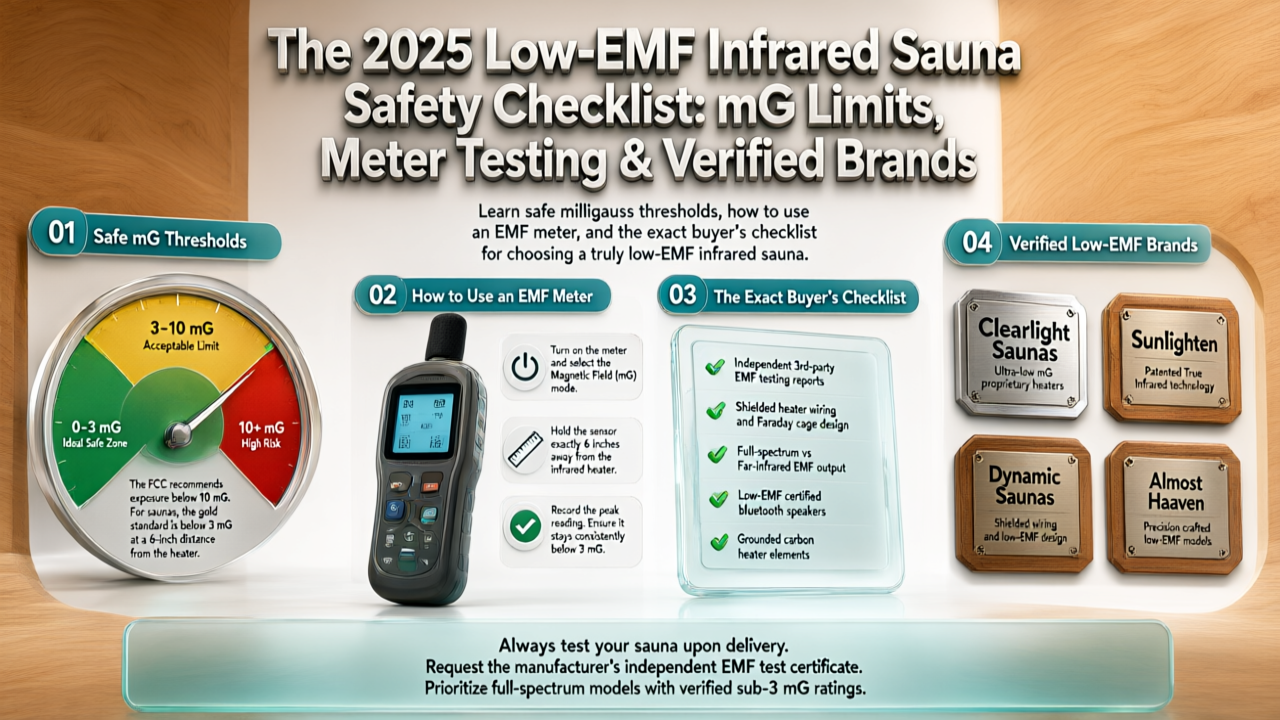
The 2025 Low-EMF Infrared Sauna Safety Checklist: mG Limits, Meter Testing & Verified Brands
Why a Low-EMF Infrared Sauna Safety Checklist Is Non-Negotiable
Infrared saunas promise deep detoxification, cardiovascular conditioning, and cellular health infrared therapy. However, the very electrical systems that generate therapeutic infrared heat can also produce measurable extremely low frequency (ELF) radiation—specifically magnetic fields—if not engineered with precision. For a home wellness device you sit inside for 30–60 minutes several times per week, cumulative exposure to elevated milligauss (mG) levels may undermine the detoxification and EMF safety goals you started with. This guide gives you a rigorous, practical buyer’s safety checklist, safe mG thresholds, and a step-by-step EMF meter testing protocol so you can choose a truly low-EMF infrared sauna and verify it before and after delivery.
Understanding EMF, ELF, and Milligauss (mG) Thresholds
Electromagnetic fields (EMF) in saunas split into electric fields and magnetic fields. Electric fields are produced by voltage and are relatively easy to shield with grounded metal or conductive paint. Magnetic fields are produced by current flow and are harder to block; they require distance, twisted pair wiring, or specialized mu-metal shielding. The unit you will see on an EMF meter for sauna testing is milligauss (mG) for magnetic flux density, or volts per meter (V/m) for electric fields. Since infrared sauna heaters are resistive loads, the dominant concern is magnetic fields from power cords, heating element connections, and control panels.
Electric Fields vs Magnetic Fields
Electric fields originate from voltage potential even when current is not flowing—like a plugged-in cord that is not powering anything. Magnetic fields only exist when current flows. In a sauna, the heating elements draw significant current, so magnetic fields can spike near element connections, power supply wires, and the main junction box. A low-EMF infrared sauna design must address both, but magnetic fields are the primary metric for mG testing because they penetrate human tissue more readily and are linked in some research to biological effects from extremely low frequency (ELF) radiation.
Safe Milligauss (mG) Levels for Sauna Use
No universal government standard exists for residential ELF magnetic fields, so the most respected reference for home wellness is the Building Biology Evaluation Guidelines. They classify sleeping areas (and by extension, restorative spaces like saunas) as:
- No concern: below 0.2 mG
- Slight concern: 0.2–1.0 mG
- Severe concern: 1.0–5.0 mG
- Extreme concern: above 5.0 mG
For a seated sauna session, most informed buyers use a pragmatic target of 1.0 mG or less at the seat and torso height when all heaters are at full power. Many standard infrared saunas measure 3–15 mG near the walls and 2–8 mG at the center seat. A genuinely low-EMF infrared sauna should consistently read below 1.0 mG at the center of the bench and below 2.0 mG within 6 inches of the heater panels. Anything above 5.0 mG at the seat is not considered ultra-low EMF cabin performance, regardless of marketing claims.
The Buyer’s Safety Checklist: 10 Non-Negotiables for a Low-EMF Infrared Sauna
Use this checklist when comparing brands, reading spec sheets, or interviewing sales reps. Every point is designed to separate genuine low-EMF engineering from greenwashed marketing.
1. Shielded Wiring and Twisted Pair Construction
Ask whether the sauna uses shielded wiring for all AC power runs inside the cabin. Shielded wiring consists of a conductive layer around the hot and neutral conductors, which reduces electric field radiation. For magnetic fields, the key is twisted pair construction—running the hot and neutral wires tightly twisted so their opposing magnetic fields cancel. Verified low EMF brands will specify both: twisted, shielded power cables from the junction box to each heating panel.
2. Verified Third-Party mG Testing
Never accept a brand’s own claim without seeing a third-party test report. Request a PDF showing measurements taken with a calibrated gaussmeter (like a Gigahertz Solutions ME3851A or TriField TF2) at multiple points inside the cabin: floor, seat, backrest, 6 inches from heaters, and control panel. The report should state the meter model, calibration date, and the sauna model tested. If the brand refuses or only provides marketing phrases like ‘zero EMF sauna technology,’ walk away.
3. Distance from Heating Elements
Magnetic field strength drops rapidly with distance. A low-EMF design ensures the occupant’s body is at least 4–6 inches away from the nearest heating panel, and the backrest design prevents direct contact with hot element terminations. Carbon panel heaters generally produce lower magnetic fields than ceramic tube heaters because the current is distributed over a larger resistive area, but even carbon panels need proper wire routing. Ask for the specific mG reading at the seated position, not just 12 inches away.
4. No ‘Zero EMF’ Fallacy
There is no such thing as a truly zero EMF sauna when it is plugged in and heating. Even the best ultra-low EMF cabin will have some background magnetic field from the building’s wiring and the earth’s own DC magnetic field. A brand that claims absolute zero EMF sauna technology is either using misleading marketing or measuring with the unit unplugged. Accept only the term ‘low-EMF’ or ‘ultra-low EMF’ with specific mG numbers under load.
5. Steel or Mu-Metal EMF Shielding in Saunas
Some manufacturers add grounded steel panels or mu-metal foil behind the wooden interior to absorb or redirect magnetic fields. While mu-metal is expensive and rarely used in consumer saunas, a continuous grounded steel enclosure can provide partial magnetic field reduction and full electric field shielding. Ask whether the sauna chassis is electrically bonded and grounded, and whether the shielding material covers the entire heating zone, not just a decorative strip.
6. Low-EMF Certified Control Panels
The digital control panel, timer, and thermostat can be significant EMF sources because they contain transformers and switching electronics. Look for control panels that are physically separated from the seating area or shielded with a grounded metal enclosure. Some brands use a low-voltage DC control system with the AC transformer located outside the cabin, which dramatically reduces in-cabin magnetic fields. Ask where the transformer is located.
7. Manufacturer Transparency on ELF Radiation
A trustworthy brand will publish unedited videos of an independent tester walking through the sauna with a gaussmeter while heaters are on. They will specify the measurement distance and the sauna model. They will also explain their wiring diagram and shielding strategy. If the website only shows an image of a meter reading zero with no context, be suspicious. Transparency about extremely low frequency (ELF) radiation levels is a hallmark of verified low EMF brands.
8. Real-World Customer EMF Meter Readings
Search independent forums, YouTube reviews, and social media groups for actual customer EMF meter testing of the model you are considering. Real-world conditions vary, but if multiple customers consistently measure below 1.0 mG at the seat, that is strong evidence. If customers report readings of 3–10 mG and the brand claims ‘low EMF,’ the engineering does not match the marketing.
9. Heavy Metal Detox Low EMF Integration
If you plan to use the sauna for heavy metal detox, remember that heavy metal detox low EMF protocols assume the body is not simultaneously fighting electromagnetic stress. A sauna that exposes you to elevated mG levels during a detox session may counteract the cellular benefits. Therefore, your checklist for how to choose a safe home sauna must include a strict mG limit—ideally below 1.0 mG—to support, not hinder, detoxification and EMF safety.
10. Post-Purchase Testing Protocol
Commit to testing the sauna yourself upon delivery. The final section gives a step-by-step protocol. If your readings exceed the brand’s claims, contact support immediately. A reputable company will troubleshoot, replace a faulty heating panel, or accept a return. A company that dismisses your meter as ‘inaccurate’ without offering to test with a calibrated meter is a red flag.
How to Use an EMF Meter to Test a Sauna Before and After Purchase
EMF meter testing is the only way to verify that your new low-EMF infrared sauna performs as advertised in your own home. You do not need to be an engineer; you need a quality gaussmeter, a consistent protocol, and patience.
Choosing the Right Meter
For sauna testing, you need a meter that measures low-frequency magnetic fields in milligauss (mG) or microtesla (µT). Avoid cheap ‘ghost hunting’ meters that only detect AC electric fields. Recommended models include the TriField TF2 (measures magnetic, electric, and RF), the Gigahertz Solutions ME3851A (highly accurate for ELF magnetic fields), and the Cornet ED88TPlus. Ensure the meter is set to measure magnetic fields (not electric) and is in the appropriate frequency range for 50/60 Hz power systems.
Step-by-Step Magnetic Field Testing Protocol
- Baseline measurement: Turn off the sauna and unplug it. Stand in the center of the sauna with the meter held at chest height. Record the background level. It should be below 0.2 mG in most homes.
- Power up: Plug in the sauna, turn on all heaters to maximum, and set the temperature to the highest setting. Wait 10 minutes for full current draw.
- Position the meter: Hold the gaussmeter at arm’s length, with the sensor face perpendicular to the suspected field source. Measure at: center of bench at seat height; 6 inches from each heater panel; backrest area; floor near power cord entry; and control panel surface.
- Move slowly: Magnetic fields can have hot spots near wiring junctions. Sweep the meter slowly across the seating area and along the walls every 6 inches.
- Record maximum values: Write down the highest reading at each location. Do not average; peak values matter for exposure assessment.
- Test with heaters cycling: Some saunas have relay switching that briefly increases magnetic fields. Observe the meter for 2–3 minutes each location to catch spikes.
- Compare to the brand’s report: Your readings at the same locations should be within 20–30% of the third-party report, accounting for background fields and meter calibration.
Interpreting Your Results
Use the thresholds from the earlier section. If your center seat measurement is below 1.0 mG, the sauna meets strict low-EMF criteria. Between 1.0 and 2.0 mG is acceptable for occasional use but not ideal for daily detox protocols. Above 2.0 mG at the seat means the sauna does not qualify as low-EMF infrared sauna in practice, regardless of the label. Above 5.0 mG is considered extreme by Building Biology standards and may negate the benefits of cellular health infrared therapy.
Low-EMF vs Standard Infrared Saunas: What the Data Shows
A standard infrared sauna with unshielded, untwisted wiring and ceramic heaters placed close to the body can easily produce 5–15 mG at the seat and 20–50 mG near the heater panels. By contrast, a well-engineered low-EMF infrared sauna with shielded wiring, twisted pair cables, and carbon panel heaters typically measures 0.3–1.5 mG at the seat and 1–4 mG within 6 inches of the panels. This is not a minor difference—it is a tenfold to fiftyfold reduction in ELF exposure during each session. When you compare low-EMF vs standard infrared sauna options, the mG reading at the seated position should be the primary decision metric, not the presence of chromotherapy lights or Bluetooth speakers.
Verified Low-EMF Brands and Certifications to Look For
While this guide does not endorse specific brands without independent verification, certain certifications and practices separate the verified low EMF brands from the rest. Look for:
- Published third-party test reports from an accredited lab or independent EMF consultant, with meter model and calibration date.
- A clear statement of mG levels at seat, backrest, and 6 inches from heaters, under full load.
- Use of twisted pair, shielded wiring with photos or diagrams of the internal wiring.
- Grounded steel chassis or mu-metal shielding in saunas where applicable.
- Transparent videos showing real-time EMF meter testing during operation.
- Customer reviews that include actual meter readings, not just subjective impressions.
- Certifications like CE, ETL, or UL for electrical safety, combined with independently verified ELF data.
Brands that meet all these criteria are rare. Expect to pay more for a true ultra-low EMF cabin, but the investment protects the very purpose of your sauna: safe home wellness and detoxification without electromagnetic stress.
Final Safety Checklist: Print-and-Go
Use this condensed checklist when shopping or when your sauna arrives:
- Manufacturer provides third-party mG report under full load: Yes / No
- Center seat reading below 1.0 mG: Yes / No
- 6-inch heater panel reading below 2.0 mG: Yes / No
- Wiring is twisted pair and shielded: Yes / No
- Control panel transformer located outside cabin or shielded: Yes / No
- Brand does not claim absolute ‘zero EMF’: Yes / No
- You own or can borrow a calibrated gaussmeter: Yes / No
- Return policy allows testing within 30 days: Yes / No
If every answer is yes, you are on track to own a genuinely low-EMF infrared sauna that supports cellular health infrared therapy, heavy metal detox low EMF protocols, and long-term safe home wellness.