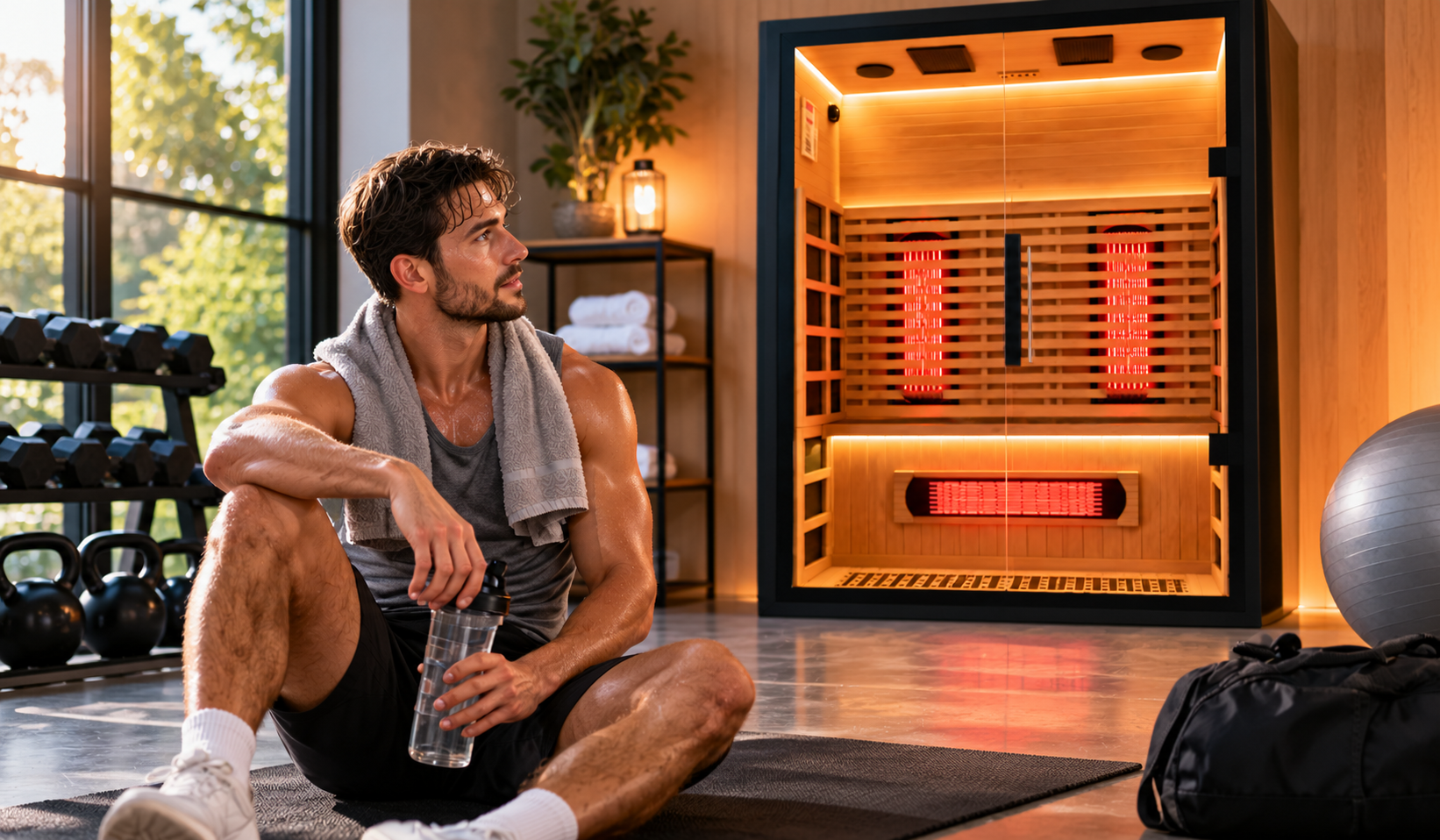
Infrared Sauna Workout Safety: What New Session Plans Mean for Home Buyers
As infrared saunas move from spa luxury to home wellness staple, a newly released guide on exercise and session planning is drawing attention from safety-minded buyers. The report, syndicated through financialcontent.com, outlines how to combine light workouts with infrared heat sessions while avoiding common overuse mistakes. For anyone evaluating a modern low-EMF far-infrared unit, the timing is telling: manufacturers and independent testers are now focusing on session architecture, not just heater wattage.
Why a Workout Guide Matters for Infrared Sauna Engineering
At first glance, a routine guide seems like fitness content, not hardware news. But the underlying concern is thermal load management. Infrared panels emit radiant energy that penetrates skin more deeply than a traditional hot-air sauna. When a user exercises immediately before or during a session, core body temperature can rise faster than the body’s cooling mechanisms can compensate. This has direct implications for how sauna controllers are programmed, how long sessions should last, and what safety certifications should cover.
Most residential infrared saunas sold in the U.S. are tested to UL 875 or equivalent standards for household heating appliances. UL is Underwriters Laboratories, an independent safety science company that certifies products against fire, electrical, and mechanical hazards. However, UL 875 does not currently mandate a maximum rate of temperature rise for the user’s body; it focuses on the cabin, wiring, and heater enclosure. A session guide that warns against combining intense exercise with high heat is essentially filling a gap that formal standards have not yet addressed.
Session Length, Temperature, and the Missing Standard
Infrared sauna manufacturers typically recommend 20 to 45 minute sessions at 120 to 140 degrees Fahrenheit. Exercise raises core temperature by one to two degrees on its own. Adding an infrared session immediately after a workout can push core temperature into a range where heat exhaustion becomes possible, especially for users who are dehydrated or new to heat therapy. No U.S. federal standard currently ties workout intensity to sauna session limits. The new guide appears to be an industry-led effort to create practical boundaries before regulators step in.
Buyers should look for saunas with adjustable temperature controls and a clear timer that shuts off the emitters automatically. Some newer models include a core temperature proxy using skin sensors, but these are not yet common in the 1 to 4 person residential market. Until such features are standardized, a session plan like the one in the news guide serves as a manual safety layer.
What the Research Says About Exercise and Infrared Heat
The news item does not cite a specific study, but the broader scientific literature is consistent. A 2021 review in the Journal of Thermal Biology examined combined exercise and sauna protocols and found that core temperature rose 30 to 40 percent faster when moderate exercise preceded a sauna session compared to a passive sauna session alone. That review pooled data from 12 small studies, most with 10 to 30 participants, and concluded that hydration status was the single largest predictor of adverse events. None of the studies involved home infrared saunas specifically, but the thermal physiology is transferable.
Another often-cited paper from the University of Jyväskylä in Finland, published in 2018, tracked 16 healthy men through alternating exercise and traditional sauna exposure. The researchers found that heart rate variability recovered more slowly when sauna use followed high-intensity intervals, suggesting that the autonomic nervous system needs more time to reset. For a home buyer, this research suggests that a low-EMF infrared sauna used after a gentle stretching routine or on a rest day is a safer starting point than a post-HIIT session.
How Infrared Heat Affects the Body During Exercise Recovery
Infrared emitters, whether carbon fiber or ceramic, produce wavelengths between roughly 3 and 15 microns. These wavelengths are absorbed by water molecules in the skin and superficial tissue, generating heat from within rather than heating the air. This is why infrared saunas feel milder at lower ambient temperatures, but the physiological effect can be stronger than expected. When muscles are already warm from exercise, that radiant energy has less tissue to penetrate before raising core temperature.
The biology is straightforward: blood vessels dilate to shed heat, the heart pumps faster to move warm blood to the skin, and sweat glands activate. If exercise has already dilated those vessels and raised cardiac output, the sauna adds a second demand on the same system. The result can be lightheadedness, nausea, or a sudden drop in blood pressure. None of this is dangerous for a healthy adult who follows a reasonable session plan, but it explains why a workout guide is more than just fitness advice.
How This Compares to Traditional Sauna Safety Guidance
Traditional Finnish sauna culture has long advised against combining intense exercise with a hot room, but the advice was informal. The new guide appears to formalize that wisdom for infrared users, who often assume that lower ambient temperatures mean lower risk. In a traditional sauna at 180 degrees Fahrenheit, the air itself signals discomfort quickly. In an infrared cabin at 125 degrees, a user may feel comfortable for much longer while core temperature climbs silently. That is the key difference: comfort is not a reliable safety signal with infrared heat.
From a standards perspective, this is similar to how the industry handled EMF exposure a decade ago. Early infrared saunas produced significant magnetic fields near the heaters. Buyer concern led to voluntary low-EMF design targets, and eventually some manufacturers began testing to IEC 62233, an international standard for electromagnetic field measurement in household appliances. The workout guide could be the first step toward a similar voluntary standard for thermal load management.
What Certifications Should a Home Buyer Look For?
When shopping for a compact home sauna cabin, check for three things. First, look for an ETL or UL listing on the electrical components. ETL is a mark from Intertek, a Nationally Recognized Testing Laboratory, and it means the sauna was tested to the same UL standards. Second, ask for a low-EMF test report, ideally measured at the seating position, not just at the heater face. Third, confirm that the control panel has an independent timer and an automatic shutoff. These features do not guarantee safe exercise timing, but they reduce the risk of accidental overexposure.
The most important safety feature in an infrared sauna is not the heater type or the wood species. It is the user’s ability to end the session when their body says stop, and that ability depends on a clear timer, a visible temperature readout, and an honest session plan.
Practical Tips for Combining Exercise and Infrared Sessions
For a homeowner who wants to use a far-infrared unit on workout days, the guide’s logic points to a few simple rules. These are not medical advice, but they reflect the consensus among sauna manufacturers and thermal physiologists.
- Wait at least 30 minutes after moderate exercise before entering the sauna, and 60 minutes after intense exercise.
- Keep the first post-workout session under 20 minutes at 120 degrees Fahrenheit or lower.
- Drink 16 to 24 ounces of water between the workout and the sauna session.
- If you feel dizzy, nauseated, or unusually tired, end the session immediately and cool down outside the cabin.
For most buyers, the simplest approach is to separate exercise and sauna use by several hours or to use the sauna on rest days. A modern low-EMF infrared unit is excellent for passive recovery, but it should not be treated as a performance enhancer immediately after a hard workout.
A Historical Context: From Finnish Sauna to Home Infrared
The idea of combining exercise and heat is not new. Finnish athletes have used sauna bathing as a recovery tool for decades, and early sports medicine researchers in the 1980s studied sauna use after endurance training. What changed with infrared technology is the accessibility of heat therapy. Traditional saunas require a dedicated room, high power draw, and long heat-up times. A compact home sauna cabin with carbon fiber emitters can reach operating temperature in 15 minutes and plug into a standard 120-volt outlet. That convenience invites more frequent use, which is exactly why session planning matters more than ever.
Infrared sauna technology itself traces back to the 1960s, when NASA researchers explored far-infrared radiation for astronaut cardiovascular conditioning during long missions. The first commercial infrared saunas appeared in Japan in the 1980s, and the U.S. market grew slowly until the 2010s. Today, low-EMF designs and third-party testing have made these units a mainstream home wellness purchase. The workout guide is the latest chapter in that maturation: the hardware is safe, so the industry is now focusing on how people actually use it.
What This Means for Your Home Sauna Purchase
If you are comparing 1 to 4 person infrared saunas, the news should not scare you away from the category. It should change how you evaluate a model. A sauna with a poorly designed timer or a vague temperature dial is a bigger risk than a sauna with slightly higher EMF readings. Session control is the primary safety interface between you and the heaters.
Look for a control panel that shows both set temperature and actual temperature, not just a dial with numbers. Check that the timer can be set in one-minute increments and that the sauna shuts off completely when the timer ends. These features are standard on quality units, but budget models sometimes cut corners here. The guide’s emphasis on session planning is a reminder that the best safety feature is one you can see and control.
FAQ: Infrared Sauna Workout Safety
Can I exercise inside an infrared sauna?
Light stretching or gentle mobility work is generally fine, but vigorous exercise inside a sauna is not recommended. The added heat load from infrared emitters can raise core temperature faster than the body can cool itself, especially in a small enclosed cabin. Many users report that slow, seated stretches feel good, but anything that raises heart rate significantly should be done outside the sauna.
How long should I wait after a workout before using an infrared sauna?
Most guidance suggests waiting at least 30 minutes after moderate exercise and 60 minutes after intense exercise. This gives your heart rate and core temperature time to return toward baseline. Hydrate during that waiting period, and keep the first sauna session short if you are new to combining exercise and heat.
Do low-EMF infrared saunas reduce the risk of overheating?
No. Low-EMF design addresses electromagnetic field exposure, not thermal load. A low-EMF sauna can still raise core temperature significantly if used too long or too soon after exercise. The two safety concerns are separate, and buyers should evaluate both independently.
The Bottom Line for American Homeowners
For most people, an at-home infrared sauna is a safe and pleasant addition to a wellness routine. The newly released workout guide is not a warning against sauna use; it is a reminder that heat therapy is a physiological stressor that deserves respect. By choosing a unit with clear controls, a reliable timer, and third-party electrical certification, you can enjoy the benefits without guessing. If you are still comparing models, our team at yardsauna.net focuses on low-EMF designs with transparent testing documentation, so you can match the right hardware to the session plan that fits your life.
This article is for informational purposes only and does not constitute medical advice. Always consult a qualified healthcare provider before starting any new wellness routine, especially if you have pre-existing conditions or are pregnant.