Home Infrared Sauna Buying Guide: Types, Sizes, Costs
Infrared saunas have moved from luxury spas into American homes, promising deep tissue warmth, relaxation, and potential cardiovascular benefits at lower temperatures than traditional steam saunas. But with dozens of models ranging from budget-friendly blankets to full cedar cabins, the buying decision can feel overwhelming. This guide breaks down the real options—sauna types, sizes, heater technology, wood materials, and price points—so you can match a unit to your space, budget, and wellness goals without falling for marketing hype.
Understanding Infrared Sauna Types
Infrared saunas use light waves to heat your body directly rather than heating the air around you. This allows for a more comfortable experience at lower ambient temperatures (typically 120–140°F) compared to traditional saunas (160–200°F). But not all infrared saunas are created equal. The three main categories you will encounter are far-infrared, near-infrared, and full-spectrum models.
Far-Infrared Saunas
Far-infrared (FIR) saunas are the most common and affordable option for home use. They use ceramic or carbon panel heaters that emit wavelengths between 6 and 15 microns, which penetrate the skin superficially to induce sweating. FIR saunas operate at lower surface temperatures, making them safe for longer sessions. They are ideal for general relaxation, detoxification, and mild muscle relief. However, they may take 15–30 minutes to reach full operating temperature.
Near-Infrared Saunas
Near-infrared (NIR) saunas use incandescent bulbs or LED arrays that emit wavelengths from 700 to 1400 nanometers. These shorter waves penetrate deeper into tissue, targeting muscles and joints more directly. NIR saunas heat up almost instantly and are often used for targeted therapy, such as post-workout recovery or localized pain management. They produce less ambient heat, so you may not sweat as profusely as in a FIR sauna. Many athletes prefer NIR for its deeper tissue effect.
Full-Spectrum Saunas
Full-spectrum saunas combine far, mid, and near-infrared emitters in one cabin. This allows you to customize your session: near-infrared for deep tissue, mid-infrared for improved circulation, and far-infrared for relaxing sweat. Full-spectrum units cost more than single-spectrum models but offer the greatest versatility. If you want one sauna that can do it all, this is the category to consider—but be prepared to pay a premium.
Choosing the Right Size and Capacity
Infrared saunas for home use typically range from one-person compact units to four-person family cabins. The right size depends on your available floor space, how many people will use it regularly, and your intended use (e.g., solo relaxation vs. couples therapy).
One-Person Saunas
One-person saunas are the smallest and most affordable, usually measuring around 3 feet wide by 3 feet deep and 6 feet tall. They fit in a closet, bathroom corner, or even a large walk-in shower area. These units are perfect for individuals with limited space or budget. However, they can feel cramped for taller users—check interior height before buying.
Two-Person Saunas
Two-person saunas are the most popular size for couples or solo users who want extra room to stretch out. Typical dimensions are 4 feet wide by 4 feet deep. They offer bench seating for two adults side by side or one person lying down. Two-person models strike a good balance between footprint and comfort, and they remain relatively easy to assemble.
Three- to Four-Person Saunas
Three- and four-person saunas are larger cabins, often 5–6 feet wide and 4–5 feet deep. They may feature L-shaped or U-shaped bench layouts to accommodate multiple users. These units require a dedicated room or garage space and a dedicated electrical circuit. They are ideal for families or those who entertain, but they cost significantly more to purchase and operate.
Heater Technology: Ceramic vs. Carbon vs. Halogen
The type of heater inside your infrared sauna affects heat-up time, temperature consistency, and long-term durability. The three main heater technologies are ceramic, carbon, and halogen (near-infrared).
Ceramic Heaters
Ceramic heaters are the traditional choice for far-infrared saunas. They consist of metal rods coated with ceramic that emit infrared energy when heated. Ceramic heaters reach high surface temperatures (up to 170°F) and produce intense, focused heat. They heat up quickly and are very durable. However, the heat can be uneven—hot spots directly in front of the heater and cooler areas elsewhere. Ceramic heaters also tend to use more electricity than carbon panels.
Carbon Panel Heaters
Carbon panel heaters are thin, flat panels that distribute infrared energy evenly across a larger surface area. They operate at lower surface temperatures (around 140°F) but emit a consistent, gentle warmth that many users find more comfortable. Carbon panels are more energy-efficient than ceramic rods and produce fewer hot spots. The downside is a slower heat-up time and a slightly higher upfront cost. Most modern mid-range and high-end saunas use carbon panels.
Halogen or Near-Infrared Heaters
Halogen heaters are used in near-infrared and full-spectrum saunas. They emit visible red and near-infrared light from quartz tubes or bulbs. Halogen heaters heat up instantly and penetrate deeper into tissue. They are often used for targeted therapy and can be mounted on walls or in portable devices. However, halogen bulbs have a shorter lifespan than ceramic or carbon elements and may need replacement every few years.
Wood Materials and Build Quality
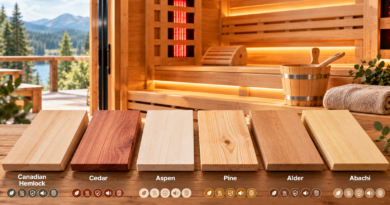
The wood used in your sauna affects durability, insulation, and indoor air quality. The most common woods are western red cedar, Canadian hemlock, and basswood. Each has trade-offs in cost, aroma, and hypoallergenic properties.
Western Red Cedar
Western red cedar is the gold standard for sauna construction. It is naturally resistant to moisture, rot, and insects, and it emits a pleasant, calming aroma. Cedar is lightweight yet strong, and it insulates well. The main drawback is cost—cedar saunas are typically 20–30% more expensive than hemlock models. Some people may also be sensitive to cedar oils.
Canadian Hemlock
Hemlock is a popular budget-friendly alternative to cedar. It is a strong, dense softwood with a pale, uniform color and virtually no aroma. Hemlock is less resistant to moisture than cedar, but it performs well in the low-humidity environment of an infrared sauna. It is an excellent choice for those with chemical sensitivities or who prefer a neutral scent.
Basswood
Basswood is a hypoallergenic hardwood with a light, even grain and no discernible odor. It is often used in saunas for people with allergies or asthma. Basswood is more expensive than hemlock but less than cedar. It is not as moisture-resistant as cedar, so proper ventilation is important.
Realistic Price Ranges and What You Get
Home infrared sauna prices vary widely based on size, heater type, wood, and brand reputation. Here is what you can expect at different budget levels:
- Under $1,500: Portable or one-person saunas with basic ceramic heaters and hemlock or poplar wood. Limited features, shorter warranty, and thinner panels. Good for beginners or tight budgets.
- $1,500–$3,500: One- to two-person saunas with carbon panel heaters, better wood (hemlock or basswood), and added features like chromotherapy lighting, Bluetooth speakers, and digital controls. This is the sweet spot for most home buyers.
- $3,500–$6,000: Two- to three-person full-spectrum saunas with premium cedar wood, low-EMF shielding, and advanced control systems. Higher build quality and longer warranties.
- $6,000 and up: Four-person or custom-sized saunas with top-tier materials, medical-grade low-EMF certification, and luxury features like ergonomic backrests, dual-zone heating, and smartphone app control.
Remember that the purchase price is not the only cost. You will also need to budget for shipping, professional assembly (unless you are handy), and electrical work. Most two-person saunas require a dedicated 15-amp or 20-amp circuit, while larger units may need 30 amps or more. Always consult a licensed electrician to ensure your home’s wiring can handle the load.
How Infrared Sauna Heating Works
Infrared saunas use electromagnetic radiation in the infrared spectrum to heat objects directly, rather than heating the air. When infrared waves strike your skin, they are absorbed and converted into heat energy, raising your core body temperature and inducing sweat. This process is more efficient than traditional convection heating because less energy is lost to the surrounding air. The result is a deep, penetrating warmth that can be achieved at lower ambient temperatures, making infrared saunas more tolerable for longer sessions.
Practical Safety Checklist Before You Buy
Before you commit to a home infrared sauna, run through this checklist to avoid common pitfalls:
- Measure your space: Leave at least 6 inches of clearance on all sides for ventilation and access to the control panel. Check ceiling height—most saunas need at least 6 feet 6 inches.
- Verify electrical requirements: Check the manufacturer’s spec sheet for voltage, amperage, and plug type. Have a licensed electrician inspect your panel and install a dedicated circuit if needed.
- Confirm low-EMF claims: Look for third-party testing or certification for EMF levels. Reputable brands will provide documentation. If a company makes vague claims, ask for specifics.
- Check warranty terms: A good sauna should have at least a 3-year warranty on heaters and electronics, and a 5-year warranty on wood structure. Read the fine print for exclusions.
Background: The Rise of Home Infrared Saunas
Infrared sauna technology has roots in the mid-20th century, when Japanese researchers first explored the therapeutic effects of infrared radiation. By the 1980s, infrared saunas began appearing in North American wellness clinics. Over the past two decades, falling manufacturing costs and growing interest in home wellness have made infrared saunas accessible to average homeowners. Today, the market offers a wide range of options, from portable one-person tents to custom-built cedar cabins, with prices to match nearly any budget. This democratization has been a boon for consumers, but it also means more low-quality imports and misleading marketing claims—making an informed buying guide more important than ever.
Infrared saunas operate at lower temperatures than traditional saunas, yet they can produce a more vigorous sweat due to direct tissue heating—a key reason many users find them more comfortable for regular use.
Closing Summary: Bringing It All Home Safely
Choosing a home infrared sauna is a balance of space, budget, and intended use. Far-infrared carbon panel saunas offer the best combination of comfort and energy efficiency for most families, while near-infrared and full-spectrum models cater to athletes and therapy-focused users. Always verify the manufacturer’s specifications for dimensions, electrical requirements, and EMF levels before purchasing, and have a licensed contractor or electrician handle installation and wiring. This article is for informational purposes only and does not constitute professional buying or installation advice.
Frequently Asked Questions
1. What size infrared sauna should I buy?
The right size depends on how many people will use it and your available space. A one-person sauna fits in a small room or closet, while a two-person model is ideal for couples or solo stretching. Measure your floor area and leave at least 6 inches of clearance on all sides before choosing.
2. How much does a home infrared sauna cost?
Prices range from under $1,500 for basic one-person units to over $6,000 for large full-spectrum cedar cabins. Most buyers spend between $2,000 and $4,000 for a quality two-person carbon panel sauna. Factor in shipping, assembly, and electrical work for the true total cost.
3. What is the difference between far-infrared and near-infrared saunas?
Far-infrared saunas use ceramic or carbon panels to emit longer wavelengths that heat the skin’s surface and induce sweating. Near-infrared saunas use halogen bulbs or LEDs that penetrate deeper into muscle tissue for targeted therapy. Full-spectrum models combine both wavelength ranges.
4. Are infrared saunas safe for daily use?
For most healthy adults, daily infrared sauna sessions of 20–40 minutes are considered safe. Stay hydrated, limit initial sessions to 15 minutes, and consult your doctor if you have cardiovascular conditions, are pregnant, or take medications that affect heat tolerance.
5. Do infrared saunas use a lot of electricity?
A typical two-person infrared sauna draws 1,500–2,000 watts, similar to a space heater or hair dryer. At average US electricity rates, a 30-minute session costs roughly 15–25 cents. Larger saunas or those with ceramic heaters may use more power.
6. What is low-EMF and why does it matter?
EMF stands for electromagnetic fields, which are produced by electrical devices. Low-EMF saunas are designed to minimize magnetic and electric field exposure, often by shielding wiring and using specific heater configurations. Look for third-party tested models if EMF exposure is a concern.
7. Can I install an infrared sauna myself?
Many one- and two-person infrared saunas are designed for DIY assembly using interlocking panels and basic tools. However, electrical connection should always be performed by a licensed electrician. Larger units or those requiring hardwiring are best left to professionals.
8. What wood is best for an infrared sauna?
Western red cedar is the most durable and aromatic, but also the most expensive. Canadian hemlock is a solid budget choice with low odor. Basswood is hypoallergenic and ideal for sensitive individuals. All three perform well in the low-humidity infrared environment.
9. How long do infrared sauna heaters last?
Ceramic and carbon panel heaters typically last 5–10 years with regular use. Halogen bulbs used in near-infrared saunas may need replacement every 1–3 years. Check the manufacturer’s warranty for specific coverage on heating elements.
10. Do I need a special electrical outlet for an infrared sauna?
Most one- and two-person saunas plug into a standard 120-volt outlet, but they often require a dedicated 15-amp or 20-amp circuit to avoid tripping breakers. Larger three- and four-person units may need 240-volt hardwired connections. Always consult the spec sheet and a licensed electrician.
For more on low-EMF home infrared saunas and the models we offer, visit yardsauna.com.
This article is for informational purposes only and does not constitute professional buying or installation advice. Always verify specifications and dimensions with the manufacturer before purchase, consult a licensed contractor or electrician for installation and wiring questions, and check local building and electrical codes before buying or installing a home sauna.
Some links in this article point to our product pages at yardsauna.com where you can explore our low-EMF infrared sauna models.