Home Infrared Sauna Buying Guide: Types, Sizes, Heaters, and Costs
Infrared saunas have moved from spa luxury to a realistic home upgrade, and the health claims are compelling: better circulation, muscle recovery, and deep relaxation without the intense heat of a traditional steam sauna. But the market is crowded with options that vary wildly in build quality, heater technology, and price. This guide breaks down what actually matters so you can choose a sauna that fits your space, your budget, and your wellness goals.
Why Homeowners Are Choosing Infrared Saunas
Unlike a conventional Finnish sauna that heats the air to 180°F or more, an infrared sauna uses invisible light waves to warm your body directly. The air stays cooler—typically between 120°F and 150°F—which makes sessions more tolerable for people who find traditional saunas overwhelming. Research suggests that infrared heat can increase heart rate, promote sweating, and may support cardiovascular health and pain relief, though more long-term studies are needed. For many buyers, the appeal is simple: a low-maintenance, plug-in unit that fits in a spare room or garage.
How Infrared Heat Works
Infrared heaters emit electromagnetic radiation in the far-infrared spectrum, which penetrates the skin to a depth of about 1.5 inches. This directly warms muscle tissue and blood vessels, triggering a sweat response at lower ambient temperatures. Most home saunas use carbon fiber or ceramic heaters, each with different heat profiles and EMF characteristics. The key is that infrared does not rely on convection, so the sauna warms up in 10 to 20 minutes instead of an hour.
Types of Home Infrared Saunas
You will see three main categories when shopping: full-spectrum, far-infrared, and near-infrared. Full-spectrum units combine near, mid, and far wavelengths and are often marketed for skin health and detoxification. Far-infrared saunas are the most common for home use and focus on deep tissue warmth. Near-infrared models are less common as standalone units and are sometimes paired with red light therapy panels. For most residential buyers, a far-infrared or full-spectrum sauna between 1 and 4 persons is the practical sweet spot.
Size and Footprint: 1 to 4 Person Models
Sauna sizes are usually labeled by person count, but those labels are generous. A two-person sauna often means two people sitting shoulder to shoulder with knees touching. Measure your available floor space and doorways before comparing models. A compact one-person sauna may need a footprint of 3 feet by 3 feet, while a four-person corner unit can occupy 6 feet by 6 feet or more. Ceiling height matters too: most home saunas are 75 to 80 inches tall, but some require up to 84 inches of clearance.
Heater Technology: Carbon Fiber vs. Ceramic
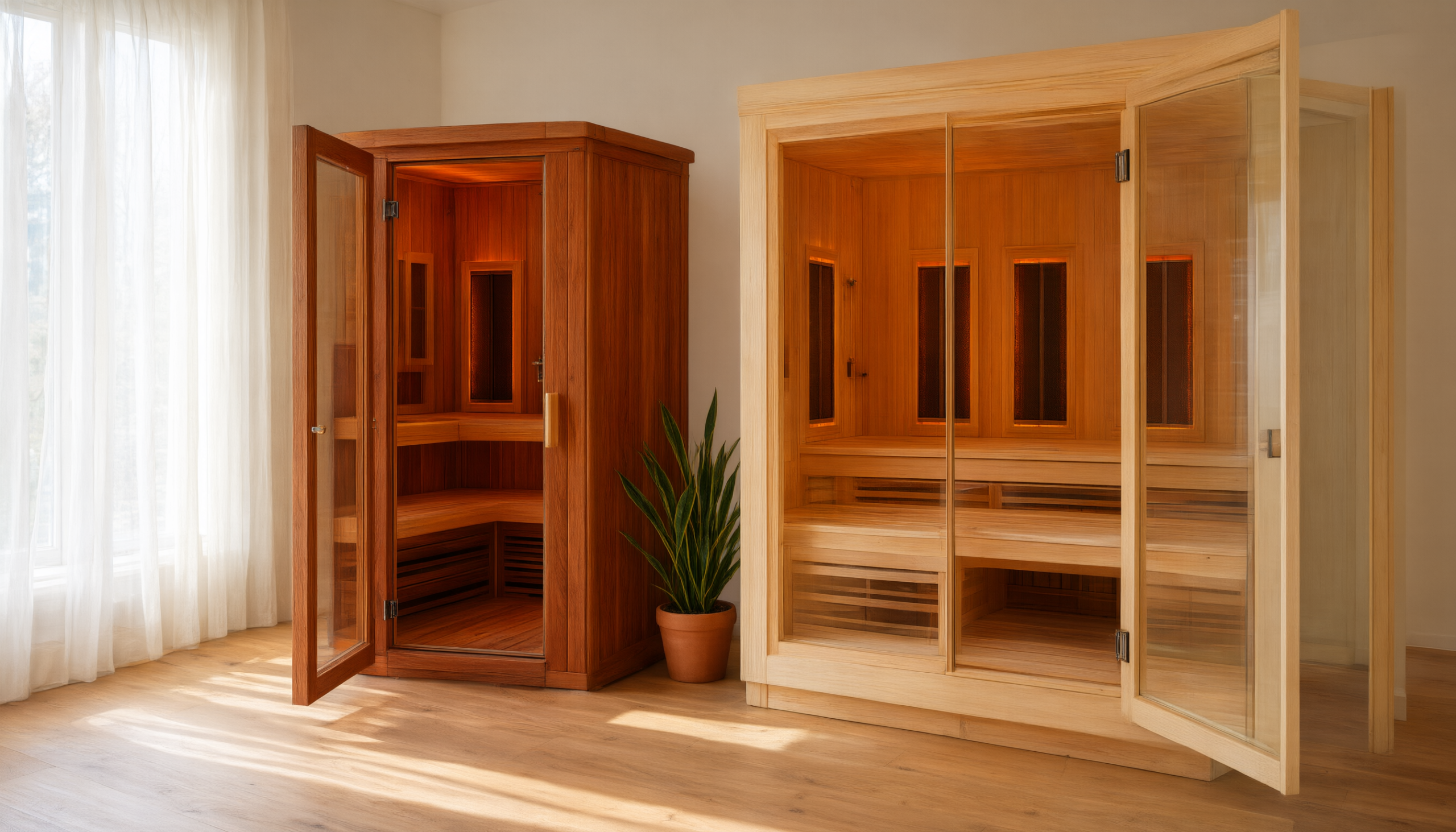
Carbon fiber heaters are thin, flexible panels that distribute heat evenly across a larger surface area. They tend to run cooler per panel but cover more of the body, which many users find more comfortable. Ceramic heaters are traditional rod-style elements that get hotter in a smaller area, producing more intense localized heat. Both can be effective, but carbon fiber panels are generally associated with lower EMF readings and more uniform warmth. Check the manufacturer’s EMF specifications rather than relying on marketing language.
Wood and Materials: What Actually Matters
Most quality infrared saunas use Canadian hemlock, western red cedar, or basswood. Hemlock is affordable and durable but has a mild scent. Cedar is naturally aromatic and resistant to moisture, but it costs more and may irritate people with fragrance sensitivities. Basswood is hypoallergenic, lightweight, and often used in higher-end models. Avoid saunas made from plywood or MDF with veneer, as these can off-gas when heated. Look for solid wood construction, preferably with tongue-and-groove joinery.
What to Check Before You Buy
Beyond the headline features, there are several practical checks that separate a good sauna from a disappointing one. Start with the electrical requirements: many 1-2 person saunas plug into a standard 120V outlet, but larger 3-4 person units often need a dedicated 240V circuit. Confirm the amperage draw and hire a licensed electrician if the sauna requires a new circuit. Also verify the warranty length and what it covers—heaters, controls, and wood structure should have separate terms.
Infrared sauna therapy shows promise for cardiovascular health and chronic pain, but the quality of the sauna itself—especially heater type and EMF shielding—can significantly affect both safety and results.
EMF and Electrical Safety
All electrical devices emit some electromagnetic fields, but poorly shielded sauna heaters can produce elevated EMF levels near the body. Reputable manufacturers publish EMF readings, often below 10 milligauss at the seating position. If EMF is a concern, look for saunas with shielded wiring, low-EMF carbon panels, and third-party test reports. Never modify the electrical system yourself; always defer to the manufacturer’s specifications and a licensed electrician for installation.
Practical Safety Checklist
- Measure your doorway, ceiling height, and floor space before ordering; freight delivery is curbside only.
- Confirm whether the sauna plugs into a standard outlet or requires a dedicated 240V circuit.
- Ask for the EMF test report and check the warranty terms for heaters and wood.
- Plan for assembly: most saunas arrive in panels and take two people two to four hours to build.
Cost and Value: What You Should Expect to Pay
Home infrared saunas range from about $1,500 for a basic one-person unit to over $8,000 for a large four-person full-spectrum model with premium wood and low-EMF certification. Mid-range two-person saunas typically fall between $2,500 and $4,500. The price difference usually reflects heater quality, wood species, EMF shielding, and control features like chromotherapy lighting or Bluetooth speakers. Avoid the cheapest models with thin wood and ceramic rods, as they often have higher EMF and shorter lifespans.
Installation and Delivery: What to Expect
Most saunas ship via freight on a pallet and are delivered to your curb or driveway, not inside your home. You will need to move the panels inside yourself and assemble them according to the included instructions. Some larger units require a liftgate or even a forklift, so check with the seller before delivery day. If you are not comfortable with assembly, many dealers can recommend a local handyman or assembly service for an additional fee.
Video Walkthrough: How Shipping and Delivery Works
YouTube: How Shipping Your Sauna Works – freight delivery and curbside drop-off explained
This on-camera walkthrough from a sauna retailer shows the entire freight delivery process, from warehouse packaging to curbside drop-off. The sauna is placed on a pallet and shipped via a national freight carrier, not a standard parcel truck. Once it reaches a local terminal, the carrier contacts you to schedule a delivery window, usually offering two or three days to choose from. On delivery day, the driver lowers the pallet to the ground with a liftgate, but larger saunas may require you to have a forklift or crane available. The video stresses that you must inspect all boxes for damage before signing, and that the carrier will not move the sauna into your garage or assemble it. If you find damage, photograph it and contact the seller for replacement parts.
Making the Right Choice for Your Home
Buying a home infrared sauna is a decision that blends health goals, space constraints, and budget. Focus on the fundamentals: a solid wood frame, low-EMF carbon heaters, a realistic size for your room, and clear electrical requirements. Do not be swayed by detox claims or celebrity endorsements; instead, compare specifications across at least three models and read owner reviews about heat-up time, comfort, and durability. This article is for informational purposes only and does not constitute professional buying or installation advice.
Frequently Asked Questions
1. What size infrared sauna should I buy?
Measure your available floor space and ceiling height first. A one-person sauna needs about 3 feet by 3 feet, while a four-person corner model can require 6 feet by 6 feet or more. Remember that person counts are often optimistic, so if you want room to stretch out, size up.
2. How much does a home infrared sauna cost?
Prices range from about $1,500 for a basic one-person unit to over $8,000 for a large full-spectrum sauna with premium wood and low-EMF certification. Most two-person models fall between $2,500 and $4,500. The cost reflects heater quality, wood species, EMF shielding, and extra features.
3. What is the difference between carbon fiber and ceramic heaters?
Carbon fiber panels distribute heat evenly over a larger surface and typically produce lower EMF readings. Ceramic rod heaters get hotter in a smaller area, creating more intense localized warmth. Carbon fiber is generally preferred for comfort and safety, but both can work well.
4. Do infrared saunas use a lot of electricity?
A typical 1-2 person sauna draws 1,200 to 1,800 watts on a standard 120V outlet, similar to a space heater. Larger 3-4 person units may require a 240V circuit and draw 3,000 to 5,000 watts. Operating costs are usually $0.20 to $0.50 per hour depending on local electricity rates.
5. Are infrared saunas safe for daily use?
For most healthy adults, daily use of 20 to 40 minutes is considered safe, but you should stay hydrated and listen to your body. People with cardiovascular conditions, pregnant women, and those on certain medications should consult a doctor before using any sauna. Start with shorter sessions at lower temperatures.
6. What is a low-EMF sauna and why does it matter?
Low-EMF saunas are designed with shielded wiring and heater configurations that reduce electromagnetic field exposure at the seating position. Reputable brands publish EMF readings, often below 10 milligauss. If you are sensitive to EMF or want to minimize exposure, look for third-party test reports.
7. Can I put an infrared sauna in my garage or basement?
Yes, as long as the space is dry, well-ventilated, and meets the electrical requirements. Avoid damp basements without a dehumidifier, as moisture can damage the wood and electronics. The floor should be level and able to support the sauna’s weight, typically 200 to 500 pounds.
8. How long does it take to assemble a home sauna?
Most infrared saunas arrive as pre-cut panels and take two people about two to four hours to assemble. No special tools are usually required, but you will need to move the panels from the curb to the assembly location. Some dealers offer assembly services for an extra fee.
9. Do infrared saunas require special ventilation?
Infrared saunas do not produce steam, so they need less ventilation than traditional saunas. However, a small vent or cracked window helps prevent moisture buildup from sweat. Follow the manufacturer’s recommendations for air gaps and placement.
10. What wood is best for an infrared sauna?
Canadian hemlock is affordable and durable, western red cedar is aromatic and moisture-resistant, and basswood is hypoallergenic and lightweight. Avoid plywood or MDF with veneer, as these can off-gas when heated. Solid tongue-and-groove construction is a sign of quality.
11. Will my homeowners insurance cover a sauna?
Most standard policies cover a sauna as personal property, but you should notify your insurer and confirm coverage limits. Some insurers may require a professional installation or a dedicated circuit. Check your policy and ask about any exclusions for heat-producing appliances.
12. How long do infrared saunas last?
A well-built infrared sauna with carbon fiber heaters can last 10 to 20 years with proper care. Ceramic heaters may need replacement after 5 to 10 years. The wood structure should last indefinitely if kept dry and away from direct moisture.
For more on low-EMF home infrared saunas and the models we offer, visit yardsauna.com.
This article is for informational purposes only and does not constitute professional buying or installation advice. Always verify specifications and dimensions with the manufacturer before purchase, consult a licensed contractor or electrician for installation and wiring questions, and check local building and electrical codes before buying or installing a home sauna.