Sauna Backrests and Headrests: A Buyer’s Guide
If your sauna sessions end with a stiff neck or an aching lower back, the bench itself may be fine—but your posture is not. A well-chosen backrest or headrest can turn a 20-minute sweat into a genuinely restorative ritual by supporting the spine’s natural curves and letting your shoulders drop away from your ears. This guide walks through what to look for, what to avoid, and how to match an accessory to your specific sauna bench without guesswork.
Why Backrests and Headrests Matter in Home Saunas
Most home sauna benches are flat, horizontal cedar or hemlock planks. They are excellent at resisting moisture and heat, but they do nothing to cradle the human body. When you sit upright on a flat bench, your pelvis tilts backward, your lumbar spine flattens, and your neck muscles have to work to hold your head up. Over a long session, that strain can outweigh the relaxation benefits you came for.
A contoured backrest fills the gap between the bench and your lower back, encouraging a more neutral spine. A headrest raises your head just enough to align your neck with your spine, reducing tension in the upper trapezius and suboccipital muscles. Many owners describe the difference as moving from sitting on a park bench to sitting in a supportive lounge chair—without any upholstery to trap sweat.
The History of Sauna Ergonomics
Traditional Finnish saunas were simple: a wooden bench, a bucket of water, and a ladle. Bathers sat upright or lay down, often using a folded birch branch or a rolled towel for neck support. As home saunas became common in North America in the late 20th century, manufacturers began offering optional backrests and headrests as premium add-ons. Early designs were simple angled boards; today’s versions are often shaped with gentle curves, cutouts for ventilation, and even adjustable angles.
That evolution matters because it means there is no single ‘correct’ shape. Your body, your bench height, and your preferred sitting position all influence which accessory will feel right. What works for a tall person in a barrel sauna may be useless for a shorter person in a cabin sauna.
Types of Sauna Backrests and Headrests
Despite the variety of shapes and marketing names, most backrests and headrests fall into a few functional categories. Understanding these categories helps you shop by need rather than by appearance.
Fixed-Angle Backrests
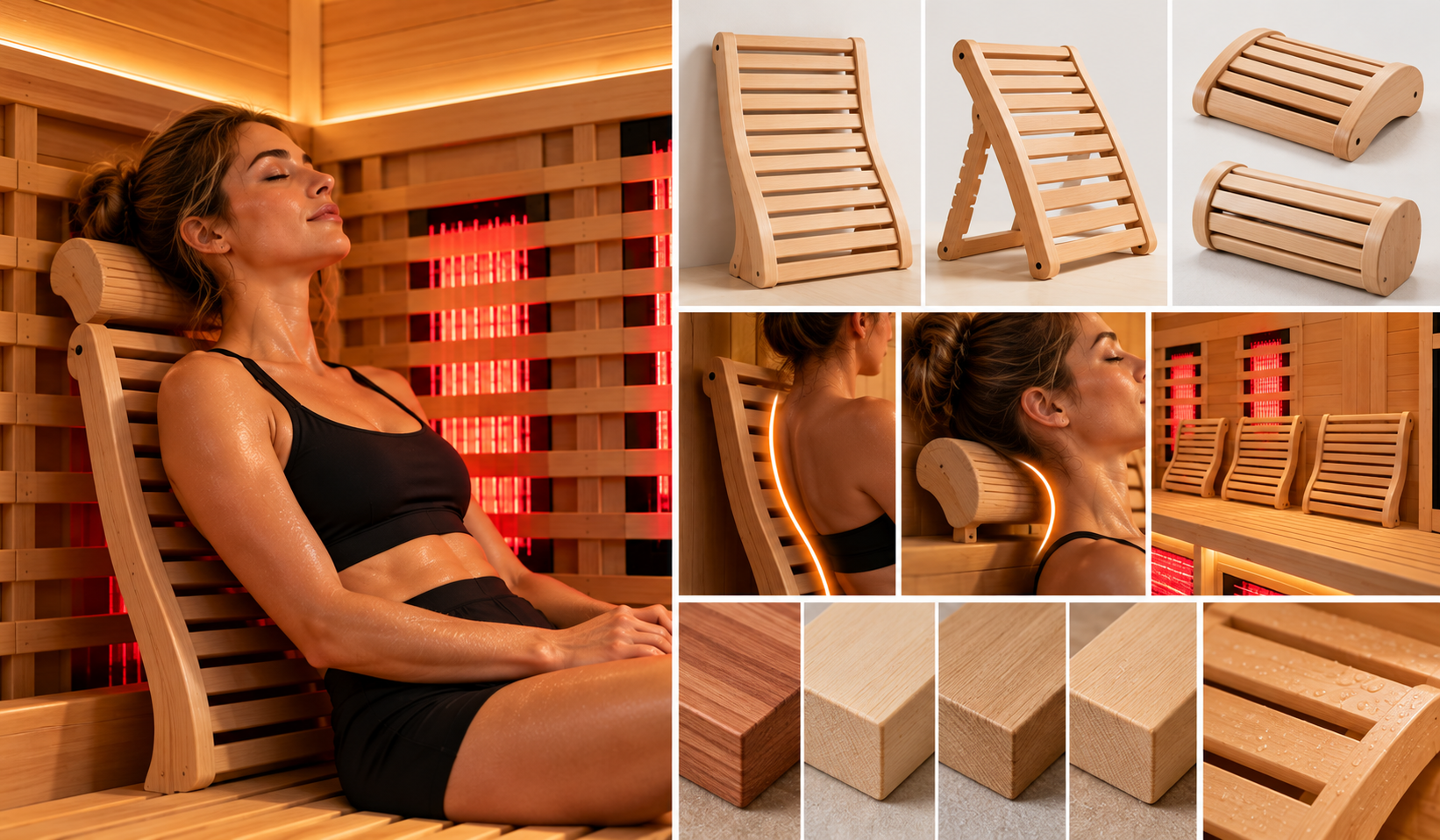
These are the most common and usually the most affordable. A fixed-angle backrest is a single piece of wood—often cedar, aspen, or abachi—cut with a gentle slope and sometimes a lumbar curve. It sits on the bench behind you, leaning against the wall or a vertical support. The angle is typically between 10 and 20 degrees from vertical, which is enough to open the hip angle without pushing you too far forward.
Fixed-angle backrests are simple, durable, and easy to move. They require no hardware, so you can reposition them between sessions or remove them entirely when you want to lie down. The trade-off is that the angle cannot be adjusted, so if the bench is unusually high or low, the backrest may not hit your lumbar spine in the right place.
Adjustable Backrests
Adjustable models use a hinge, a sliding bracket, or a series of notches to change the angle. Some adjust from nearly flat to a steep 45 degrees. This flexibility is useful in multi-user households where people of different heights share the sauna. It is also helpful if you alternate between sitting upright and reclining.
The downside is complexity. Moving parts can loosen over time, and metal hardware—even stainless steel—will eventually show signs of heat and humidity. If you choose an adjustable backrest, check that all fasteners are rust-resistant and that the mechanism is easy to operate with wet hands.
Headrests and Neck Rolls
Headrests are smaller than backrests and support only the head and neck. They come in two broad styles: contoured wooden blocks that sit on the bench or attach to the wall, and softer rolls made from heat-tolerant fabrics or wood wrapped in a thin layer of natural fiber. Wooden headrests are more common because they resist moisture and do not harbor bacteria.
A good headrest should raise your head no more than two to three inches off the bench. Too high, and it forces your chin toward your chest, which can strain the back of the neck. Too low, and it does nothing. The best approach is to test a rolled towel first: fold a towel to different heights, lie back, and note which height feels most neutral. Then look for a headrest with a similar profile.
Materials: What Works in High Heat and Humidity
Sauna interiors regularly reach 150 to 190 degrees Fahrenheit with humidity spikes when water is thrown on the rocks. Any accessory you bring inside must handle that environment without warping, cracking, off-gassing, or growing mold.
Wood Species Compared
- Cedar: The classic choice. Western red cedar is lightweight, naturally rot-resistant, and has a pleasant aroma. It is soft enough to be comfortable against bare skin but durable enough for daily use. It can darken over time, which many owners like.
- Aspen: Lighter in color and nearly odorless. Aspen is a good choice for people sensitive to scents. It is slightly harder than cedar and resists staining well.
- Abachi (Obeche): A West African hardwood often used in sauna accessories because it stays cool to the touch even at high temperatures. It is pale, smooth, and very resistant to heat transfer. Abachi is less aromatic than cedar and tends to be more expensive.
- Hemlock: Sometimes used for backrests, though less common than cedar or aspen. Hemlock is strong and pale, but it can be more prone to splintering if not sanded well.
Whatever wood you choose, look for smooth, rounded edges and a fine sanded finish. Rough edges can irritate skin when you are sweaty, and splinters are a real risk in a hot, humid room.
What to Avoid
Avoid any backrest or headrest made from plywood, particleboard, or MDF. These engineered woods contain adhesives that can off-gas formaldehyde when heated. Avoid painted or varnished surfaces; the finish can soften, peel, or release fumes. Avoid metal frames unless the metal is explicitly rated for high-humidity environments. Even then, metal can become uncomfortably hot to touch.
Soft cushions and foam pillows are also problematic in a sauna. They absorb sweat, take a long time to dry, and can develop mildew. If you want a softer surface, look for a thin, removable cover made from natural linen or cotton that you can wash after every few sessions—but even then, most sauna experts recommend sticking with bare wood.
How to Choose the Right Size and Fit
Compatibility is the number one reason sauna accessories get returned or abandoned. A backrest that is too wide will crowd a two-person bench. A headrest that is too tall will force your neck into an awkward angle. Before you buy, take three measurements inside your sauna.
Measure Your Bench and Wall
- Bench depth: Measure from the front edge of the bench to the wall behind it. A backrest should not take up more than one-third of that depth, or you will have no room to sit.
- Bench height: Measure from the floor to the top of the bench. This determines how tall a backrest can be before it hits your shoulder blades instead of your lumbar spine.
- Wall clearance: If the backrest leans against the wall, check that the wall is flat and free of vents, light fixtures, or heater guards that could interfere.
Once you have those numbers, compare them to the accessory’s listed dimensions. If the manufacturer does not list dimensions, ask before buying. And always cross-reference your sauna’s owner manual for any restrictions on aftermarket accessories—some warranties are voided by unapproved add-ons, especially if they contact the heater or block airflow.
Test the Angle Before Committing
A simple way to test what angle you need is to sit on your bench with a rolled towel behind your lower back. Try different towel thicknesses and positions. If a thick roll feels best, you need a backrest with a pronounced lumbar curve. If a thin roll is enough, a gently angled board will do. If you cannot get comfortable with any towel, the problem may be your bench height rather than the backrest—in which case a footrest or a lower bench might help more.
Installation and Placement Tips
Most backrests and headrests are freestanding—you simply place them on the bench and lean them against the wall. That makes them easy to try and move. But a few models are designed to be mounted with screws or brackets. Before drilling into your sauna wall, check the owner manual for the wall construction and any restrictions on fasteners.
For freestanding backrests, place the bottom edge about two to three inches from the wall. This allows the backrest to lean at a stable angle without sliding. If the bench is slick from sweat, a small piece of non-slip shelf liner under the backrest can help, but make sure it is heat-resistant and does not melt.
For headrests, position them so that the highest point supports the base of your skull, not the top of your head. When you lie back, your chin should be roughly parallel to the floor. If your chin tilts up, the headrest is too low; if it tilts down, the headrest is too high.
Care and Maintenance
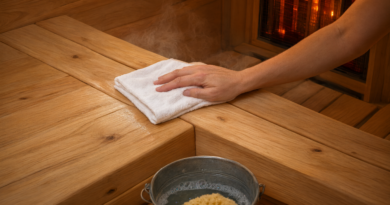
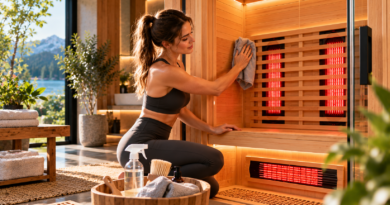
Wooden backrests and headrests need very little care, but they do need some. Sweat contains salts and oils that can darken wood and, over time, create a sticky residue. After each session, wipe the accessory with a clean, damp cloth—water only, no soap—and let it air dry. Once a month, give it a light sanding with fine-grit sandpaper if the surface feels rough, then wipe away the dust.
Do not oil or seal sauna wood. Oils and sealants can trap moisture, change the wood’s heat-transfer properties, and release fumes when heated. If the wood becomes stained, that is normal and not a defect. Many owners consider the patina part of the sauna’s character.
Comfort in a sauna is not about adding more padding—it is about aligning the body so that heat, gravity, and breath can do their work without resistance.
Practical Safety Checklist
- Check that the accessory does not block any vents, heater guards, or temperature sensors.
- Ensure all edges are smooth and free of splinters before first use.
- Test the angle with a rolled towel before buying a fixed-angle backrest.
- Verify that any metal hardware is rust-resistant and does not become hot to the touch.
How Heat Affects Wood Over Time
Wood expands and contracts with changes in temperature and humidity. In a sauna, the cycle is extreme: hot and dry during a session, cooler and more humid between sessions. Over months and years, this cycling can cause small cracks, especially in thick pieces of wood. These cracks are usually cosmetic and do not affect function. However, if a crack runs all the way through a backrest or headrest, it can weaken the piece and should be replaced.
To minimize cracking, allow the sauna to cool gradually after use rather than opening the door wide immediately. Keep the accessory out of direct contact with the heater, and do not leave it in a sauna that is stored outdoors in freezing temperatures if the wood is not rated for that range.
Budget Considerations
Backrests and headrests range from inexpensive flat boards to hand-shaped hardwood pieces with adjustable hardware. In general, a simple fixed-angle cedar backrest costs less than a contoured abachi model, and a basic wooden headrest costs less than an adjustable one. The most expensive option is not always the most comfortable. Many owners find that a $30 cedar backrest works as well as a $150 contoured one, provided the angle matches their body.
Before spending money, try the towel test described above. If a simple rolled towel gives you the support you need, a basic backrest will likely be sufficient. If you need more precise support, invest in a contoured or adjustable model. And remember that comfort is subjective—what feels great to one person may feel wrong to another, so if possible, try a friend’s accessory before buying your own.
Summary: Comfort Without Compromise
A backrest or headrest is a small investment that can change how you feel about your sauna. The key is to match the accessory to your body and your bench, not to buy the most expensive or best-reviewed model sight unseen. Measure your bench, test your preferred angle with a towel, choose a heat-safe wood, and keep the accessory clean and dry. When in doubt, consult your sauna’s owner manual and the accessory manufacturer’s specifications for fit and compatibility. This article is for informational purposes only and does not constitute professional buying advice.
Frequently Asked Questions
1. Do I need both a backrest and a headrest?
Not necessarily. Many people find that a backrest alone solves most of their comfort issues, especially if they sit upright. A headrest is more useful if you like to lie down on the bench or if you have neck tension when sitting. Start with one and add the other only if you feel a gap in support.
2. How do I know if a backrest will fit my sauna bench?
Measure the depth and height of your bench, then compare those numbers to the accessory’s listed dimensions. A backrest should not take up more than one-third of the bench depth, and its height should not push against your shoulder blades. Always check your sauna’s owner manual for any restrictions on aftermarket accessories.
3. What is the best wood for a sauna backrest?
Cedar and aspen are the most common choices. Cedar is aromatic and rot-resistant; aspen is nearly odorless and pale. Abachi is also excellent because it stays cool to the touch, but it tends to cost more. Avoid plywood, MDF, or any wood with a painted or varnished finish.
4. Can I use a regular pillow in my sauna?
No. Regular pillows and foam cushions absorb sweat and can develop mildew. They may also off-gas when heated. If you want a softer surface, use a thin, washable cover made from natural fiber over a wooden headrest, but even that requires frequent washing.
5. How do I clean a wooden sauna backrest?
Wipe it with a clean, damp cloth after each session—water only, no soap or chemicals. Let it air dry completely. If the surface feels rough, lightly sand it with fine-grit sandpaper and wipe away the dust. Do not oil, seal, or varnish sauna wood.
6. Will a backrest block the heat from my sauna heater?
It should not if it is placed correctly. Keep the backrest away from the heater and any vents or sensors. If your sauna is small, a tall backrest could deflect heat away from your body, so test the airflow after installation. Consult your owner manual for minimum clearances.
7. Are adjustable backrests worth the extra cost?
They can be, especially if multiple people of different heights use the sauna or if you like to alternate between sitting and reclining. However, adjustable mechanisms have more parts that can wear out. If you are the only user and you know your preferred angle, a fixed backrest is simpler and often more durable.
8. Can I make my own sauna backrest?
Yes, if you have basic woodworking skills. Use a heat-safe wood like cedar or aspen, sand all edges smooth, and avoid any glue or finish that is not rated for high heat. Test the angle with a towel before cutting. If you are unsure, a commercial backrest is safer and not much more expensive.
9. Why does my wooden headrest feel too hard?
Wood is naturally firm, and that firmness is actually good for support—soft pillows allow your neck to sink into an unnatural position. If the hardness is uncomfortable, try a thin linen cover or adjust the height. A headrest that is too high or too low can create pressure points that feel like hardness.
10. How long should a sauna backrest last?
With proper care, a solid wood backrest can last for many years, often as long as the sauna itself. Expect some color change and small cracks from heat cycling, which are cosmetic. Replace the backrest if it develops a full-depth crack, becomes wobbly, or shows signs of mold.
For more on low-EMF home infrared saunas and the models we offer, visit yardsauna.com.
This article is for informational purposes only and does not constitute professional buying advice. Product specifications, compatibility, and availability vary by sauna model and change over time – always verify current details directly with manufacturers or retailers before making a purchase.