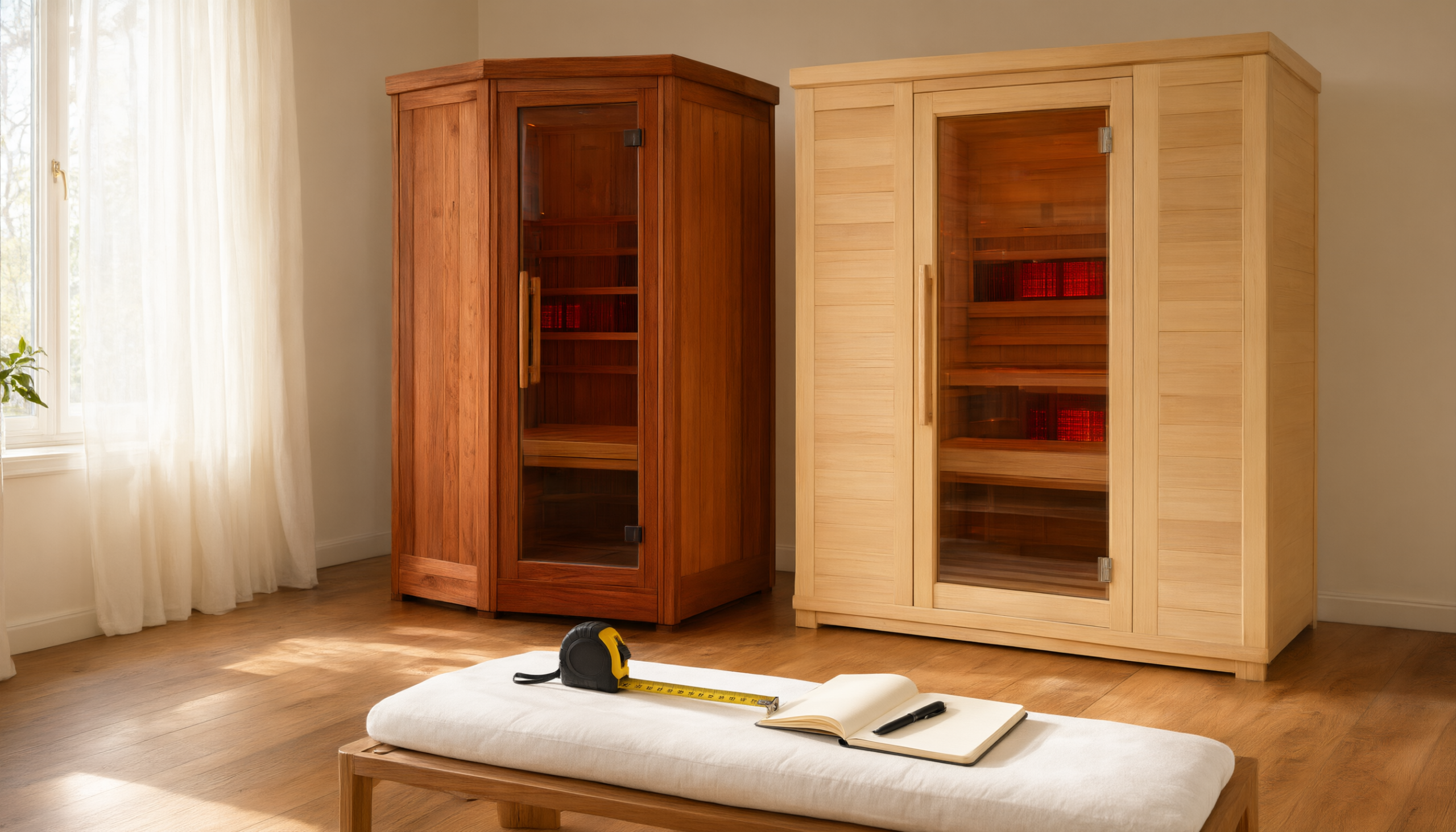
Home Infrared Sauna Buying Guide: Compare Types, Sizes, and Costs
Infrared saunas promise deep relaxation, better sleep, and a gentle daily detox — but the wrong model can leave you with a cramped, underpowered box that collects dust. This guide compares the real options in home infrared saunas so you can match the right size, heater type, and wood to your space and budget.
Understanding Infrared Sauna Basics
Infrared saunas use light to heat your body directly, rather than heating the air around you like a traditional Finnish sauna. This means lower ambient temperatures — typically 120–140°F versus 180–200°F — and a more comfortable session for people who find conventional saunas overwhelming. The heat penetrates about 1.5 inches into the skin, which is why many users report a deeper sweat at a lower temperature.
How Infrared Heat Works
Infrared panels, usually made of carbon or ceramic, emit electromagnetic waves in the infrared spectrum. Your skin absorbs this energy and converts it to heat, raising your core temperature and triggering a sweat response. The key difference from a traditional sauna is that the air stays relatively cool, so you can breathe easily and stay in longer.
A Short History of Home Saunas
Home saunas have been part of American wellness culture since the mid-20th century, but infrared technology only became affordable for residential use in the early 2000s. Early models were often flimsy and emitted high electromagnetic fields (EMF). Today’s low-EMF designs use shielded wiring and carbon-based panels, making them a safer and more efficient choice for daily use.
Comparing Sauna Types: Infrared vs. Traditional
Before you buy, decide whether you want an infrared sauna or a traditional steam sauna. Each has distinct advantages and trade-offs.
- Infrared saunas heat the body directly, use less electricity, and require no plumbing or special ventilation. They are easier to install in a spare room or basement.
- Traditional Finnish saunas use a heater (electric or wood-fired) to warm the air and often include water for steam. They reach higher temperatures and offer a more intense, humid experience.
- Steam rooms are not saunas at all — they operate at 100% humidity and much lower temperatures. They require waterproof construction and are generally more expensive to build.
For most homeowners, an infrared sauna is the practical choice because it is modular, plug-and-play, and can be moved if you relocate. However, if you crave the ritual of löyly (throwing water on hot rocks), a traditional sauna may be worth the extra cost and complexity.
Sizing Your Sauna: 1 to 4 Person Models
Infrared saunas are sold in standard footprints that roughly correspond to the number of people they can hold. But be realistic about how you will actually use the space.
- One-person sauna (about 3′ x 3′ to 3′ x 4′): Fits in a large closet or corner. Best for solo daily use, but can feel claustrophobic if you like to stretch out.
- Two-person sauna (about 4′ x 4′ to 4′ x 5′): Comfortable for one person lying down or two people sitting side by side. The most popular size for couples.
- Three-person sauna (about 5′ x 5′ to 5′ x 6′): Offers a bench or L-shaped seating. Good for families, but requires a dedicated room or garage space.
- Four-person sauna (about 6′ x 6′ or larger): True social sauna. Needs a solid floor and often a 240V electrical circuit. Check your home’s panel capacity before ordering.
Measure your available floor space and add at least 6 inches of clearance on all sides for assembly and airflow. Also check ceiling height — most infrared saunas are 75 to 80 inches tall, but some corner models are lower.
Heater Technology: Carbon vs. Ceramic
The heart of any infrared sauna is its heating panels. Two main types dominate the market: carbon and ceramic.
Carbon Panel Heaters
Carbon panels distribute heat evenly over a large surface area, producing a gentle, consistent warmth. They are often marketed as low-EMF because the panels can be wired in series to cancel magnetic fields. Carbon heaters typically reach full output in 5–10 minutes and are very energy efficient.
Ceramic Tube Heaters
Ceramic heaters emit infrared from a focused point, which can feel more intense on the back or shoulders. They heat up faster than carbon and are often used in commercial saunas. However, they may have higher EMF readings unless properly shielded, and the heat can feel uneven if you sit too close.
Look for a sauna that lists its EMF levels in milligauss (mG) at a specific distance — ideally under 10 mG at the seating position. If a manufacturer won’t publish these numbers, treat that as a red flag.
Materials and Build Quality
The wood used in your sauna affects durability, smell, and heat retention. The most common choices are:
- Western red cedar: Naturally resistant to moisture and insects, with a pleasant aroma. The gold standard, but also the most expensive.
- Canadian hemlock: A more affordable softwood that is hypoallergenic and has little scent. Good for people sensitive to cedar oils.
- Basswood: Lightweight and pale, often used in painted or stained saunas. Not as rot-resistant as cedar.
- Poplar: Inexpensive and smooth, but can warp over time if not kiln-dried properly.
Check that the wood is kiln-dried to prevent cracking, and that the panels are at least 1/2 inch thick. Thin panels flex and lose heat. Also look for tongue-and-groove joinery rather than simple butt joints, which can separate with humidity changes.
Price Ranges and What to Expect
Home infrared saunas range from about $1,500 for a basic one-person pop-up model to over $10,000 for a custom-built four-person cabin with premium cedar and advanced controls. Here is a realistic breakdown:
- Budget ($1,500–$3,000): One- or two-person saunas with carbon panels, hemlock or poplar wood, and basic digital controls. May have higher EMF and shorter warranties.
- Mid-range ($3,000–$6,000): Two- or three-person saunas with low-EMF carbon panels, cedar or hemlock, Bluetooth speakers, and chromotherapy lighting. Better insulation and fit.
- Premium ($6,000–$12,000+): Three- or four-person saunas with full-spectrum heaters (near, mid, and far infrared), thick cedar, ergonomic benches, and medical-grade EMF shielding. Often require 240V wiring.
Always compare the total cost of ownership, not just the sticker price. A cheaper sauna may need a dedicated circuit, a floor reinforcement, or replacement panels within a few years. Read the warranty carefully — some cover only the heaters, not the wood or electronics.
Practical Safety Checklist
Before you buy, run through this checklist to avoid common mistakes:
- Verify electrical requirements: Most one- and two-person saunas plug into a standard 120V outlet, but larger models need a 240V circuit. Have a licensed electrician confirm your panel can handle the load.
- Check EMF ratings: Request the manufacturer’s EMF test report. Look for readings below 10 mG at the seating position, measured with a gauss meter.
- Plan for ventilation: Even infrared saunas need some air exchange to prevent moisture buildup. A small vent or a cracked door is usually sufficient.
- Measure your doorway: Saunas ship in panels that must fit through your home’s doors and hallways. A 30-inch door is the minimum for most two-person kits.
Video Walkthrough: Avoiding Common Sauna Installation Mistakes
YouTube: Brutally Honest Advice for Sauna Builders – key ventilation and sensor placement tips
In this on-camera walkthrough, a Finnish sauna industry veteran shares the four most common mistakes he sees in sauna projects. The first is skipping ventilation entirely — without an intake and exhaust opening, oxygen levels drop quickly and humidity gets trapped, leading to mold and a suffocating feeling after just a few minutes. He stresses that sauna should be enjoyable, not a test of endurance, and that proper airflow is essential for both comfort and longevity.
The second major mistake involves placing the temperature sensor for an electric heater in the wrong spot. The sensor should be mounted near the ceiling, directly above the heater, not on a side wall or near the door. Incorrect placement causes the heater to cycle off too early or run too hot, ruining the sauna experience. The video also covers two additional errors not detailed in the transcript, but the core message is clear: follow the manufacturer’s installation manual and consult a professional when in doubt.
Closing Summary: Making a Safe, Informed Choice
Buying a home infrared sauna is a significant investment in your health and your home. By understanding the differences in heater technology, wood types, and sizing, you can avoid the pitfalls that lead to buyer’s remorse. Always verify the manufacturer’s specifications for EMF levels, electrical requirements, and ventilation needs, and have a licensed contractor or electrician handle any wiring or structural work. This article is for informational purposes only and does not constitute professional buying or installation advice.
Frequently Asked Questions
1. What size infrared sauna should I buy for home use?
Choose a size based on how many people will use it regularly and the space you have. A one-person sauna works for solo daily sessions, while a two-person model is the most versatile for couples. Measure your room and add at least 6 inches of clearance on all sides for assembly.
2. How much does a home infrared sauna cost?
Expect to pay between $1,500 and $12,000 depending on size, wood, and heater type. Budget models under $3,000 are fine for occasional use, but mid-range saunas from $3,000 to $6,000 offer better durability and lower EMF. Premium models over $6,000 add full-spectrum heat and custom features.
3. Are infrared saunas safe to use every day?
For most healthy adults, daily use of 20–30 minutes at moderate temperatures is considered safe. Stay hydrated, limit sessions if you feel dizzy, and consult your doctor if you have cardiovascular conditions or are pregnant. Always follow the manufacturer’s recommended session length.
4. What is the difference between carbon and ceramic infrared heaters?
Carbon panels emit even, gentle heat over a large area and are often lower in EMF. Ceramic tubes produce more focused, intense heat and heat up faster. Carbon is generally preferred for home use because it is more comfortable and energy efficient.
5. Do I need a special electrical outlet for an infrared sauna?
Most one- and two-person saunas plug into a standard 120V outlet, but larger models may require a dedicated 240V circuit. Check the sauna’s amperage draw and have a licensed electrician verify your panel capacity before ordering.
6. What kind of wood is best for an infrared sauna?
Western red cedar is the top choice for its natural rot resistance and aroma, but it costs more. Canadian hemlock is a good hypoallergenic alternative at a lower price. Avoid soft, thin woods that warp easily, and look for kiln-dried lumber.
7. Can I install an infrared sauna in my basement or garage?
Yes, as long as the space is dry and has adequate electrical service. Basements are ideal because they stay cool, but you may need a dehumidifier. Garages work if they are insulated and you can run a dedicated circuit.
8. How long do infrared sauna heaters last?
Quality carbon or ceramic heaters typically last 5–10 years with regular use. Some manufacturers offer separate warranties for heaters (often 5 years) and electronics (1–2 years). Ask about replacement panel costs before buying.
9. Do infrared saunas require ventilation?
Yes, even though they operate at lower temperatures than traditional saunas. A small vent or a slightly open door allows moisture to escape and prevents mold growth. Proper ventilation also keeps oxygen levels comfortable during longer sessions.
10. Are low-EMF infrared saunas worth the extra cost?
If you plan to use the sauna frequently, yes. Low-EMF models reduce your exposure to electromagnetic fields, which some studies link to health concerns. Look for saunas with EMF readings under 10 mG at the seating position and ask for a test report.
For more on low-EMF home infrared saunas and the models we offer, visit yardsauna.com.
This article is for informational purposes only and does not constitute professional buying or installation advice. Always verify specifications and dimensions with the manufacturer before purchase, consult a licensed contractor or electrician for installation and wiring questions, and check local building and electrical codes before buying or installing a home sauna.
Some links in this article point to our product pages at yardsauna.com where you can explore our low-EMF infrared sauna models.