Home Infrared Sauna Buying Guide: Types, Sizes, Heaters, Materials & Costs
Infrared saunas have moved from luxury spas into American homes, promising deep tissue warmth, relaxation, and potential cardiovascular benefits without the intense heat of traditional steam saunas. But between one-person cedar boxes and four-person carbon-panel cabins, the choices can feel overwhelming. This guide breaks down the real differences in sauna types, sizes, heater technology, materials, and price points so you can make a confident, informed decision.
Why Consider an Infrared Sauna at Home?
Infrared saunas use light to heat your body directly rather than warming the air around you. That means they operate at lower temperatures – typically 120°F to 150°F – compared to 180°F or more in a traditional Finnish sauna. For many people, that lower heat is more comfortable, especially for longer sessions. Research on infrared sauna use suggests potential benefits for cardiovascular health, muscle recovery, and stress reduction, though the evidence is still developing. A 2018 review in Mayo Clinic Proceedings noted that regular sauna bathing, including infrared, is associated with lower blood pressure and improved vascular function, but the authors stressed that more controlled studies are needed.
From a practical standpoint, a home infrared sauna offers convenience. No drive to a gym or spa, no shared space, and the ability to use it daily. But that convenience comes with real costs – both financial and spatial – and not every sauna on the market delivers the same experience.
Infrared Sauna Types: Near, Far, and Full Spectrum
Infrared light is divided into three bands based on wavelength: near, mid, and far. Most home saunas use far infrared, which penetrates the skin more shallowly and is felt as gentle radiant heat. Near infrared penetrates deeper and is often used for skin therapy and wound healing. Mid infrared falls in between. Some manufacturers market full-spectrum saunas that combine all three, but the clinical evidence for any single wavelength is mixed. In practice, far infrared is the workhorse for home saunas because it produces comfortable, even heat with lower surface temperatures on the emitters.
How Infrared Heaters Work
Infrared saunas generate heat through electric emitters – either ceramic rods, carbon panels, or a hybrid of both. Ceramic heaters are the traditional choice: they heat up quickly, reach higher surface temperatures, and emit a focused beam of far infrared. Carbon panel heaters are newer and cover a larger surface area with lower, more even heat. They are often marketed as low-EMF, but all electric heaters produce some electromagnetic fields. The key is how the wiring and shielding are designed. Look for third-party EMF testing reports if that is a concern, and remember that EMF levels drop sharply with distance from the emitter.
Infrared sauna therapy shows promise for cardiovascular health and relaxation, but the quality of the sauna’s heaters, materials, and electrical design matters more than the marketing claims.
Choosing the Right Size and Configuration
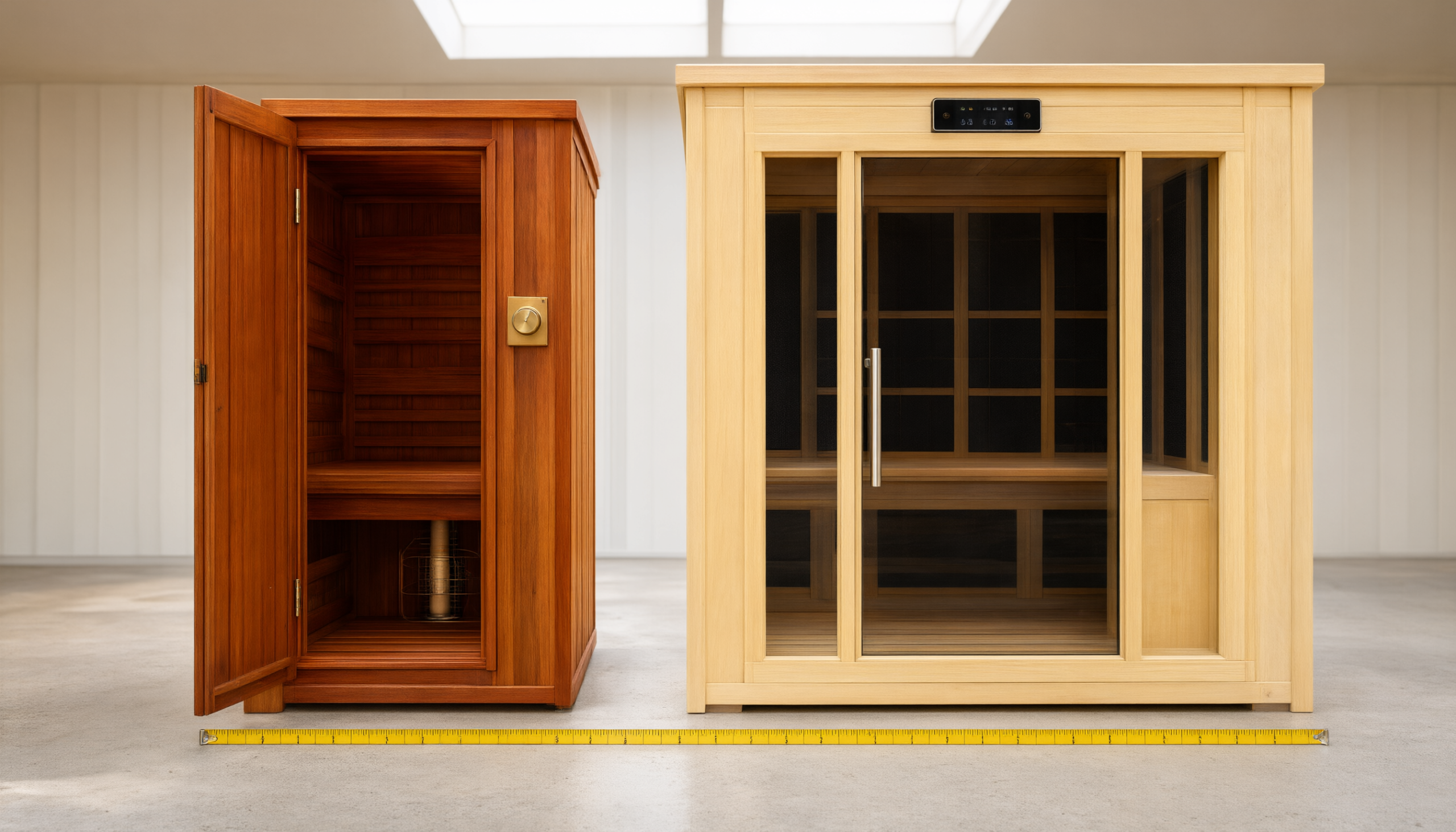
Infrared saunas for home use typically range from one-person units that fit in a corner to four-person cabins that require a dedicated room or garage space. The size you choose depends on three factors: how many people will use it at once, your available floor space, and your budget. A one-person sauna is usually about 3 feet by 3 feet and 6 feet tall, while a four-person model can be 6 feet by 5 feet or larger. Always measure your space and account for door swing, ventilation clearance, and access to a dedicated electrical circuit.
Space and Ventilation Requirements
Infrared saunas do not require plumbing or special ventilation like steam saunas, but they do need a few inches of clearance on all sides for air circulation and heat dissipation. Most manufacturers recommend at least 6 inches of clearance from walls. The room itself should have some airflow – a small window or vent is enough. And because the sauna will draw significant power, you need a dedicated circuit. Most two-person saunas run on a standard 120-volt, 15-amp circuit, but larger models often require 240 volts and a 30-amp or 40-amp breaker. Check the manufacturer’s electrical specifications before you buy, and have a licensed electrician confirm your panel can handle the load.
Materials: Wood, Glass, and What Actually Matters
The interior of an infrared sauna is almost always wood, and the most common species are Western red cedar, Canadian hemlock, and basswood. Cedar is prized for its natural resistance to moisture and insects, and it has a distinctive aroma. Hemlock is a more affordable softwood that is hypoallergenic and has little scent. Basswood is light in color, smooth, and often used in higher-end saunas because it does not off-gas as much as cedar when heated. Avoid saunas made from plywood or particleboard with thin veneers – they can delaminate and release formaldehyde when heated. Look for solid wood or high-quality plywood with low-VOC adhesives, and ask the manufacturer for a materials safety data sheet if you are sensitive to chemicals.
Glass Doors and Insulation
Most infrared saunas have a tempered glass door, which is safe and allows light in. Double-pane glass is better for heat retention, but it adds weight and cost. The walls should be insulated – either with foil-backed foam or fiberglass – to keep the heat in and reduce warm-up time. Check the wall thickness: 1.5 to 2 inches is standard for good insulation without making the sauna too bulky.
Heater Technology: Ceramic vs. Carbon vs. Hybrid
The debate between ceramic and carbon heaters is one of the most common questions buyers ask. Ceramic heaters are rods or tubes that emit infrared from a focused point. They heat up fast and can create a more intense, sweat-inducing session. Carbon panels are flat sheets that emit infrared over a larger area, producing a more even, gentle heat. Some saunas use a hybrid system with carbon panels on the walls and ceramic heaters under the bench or in the footwell. There is no universally better option – it comes down to your heat preference and tolerance. If you like a strong, penetrating heat, ceramic may suit you. If you prefer a softer, more ambient warmth, carbon is a good choice.
Low-EMF and Safety Considerations
All electric devices emit electromagnetic fields, and infrared saunas are no exception. The concern with EMF is long-term exposure, but the science is not settled. If you want to minimize EMF, look for saunas with shielded wiring, twisted pair cables, and carbon panels that are specifically designed to reduce magnetic fields. Reputable manufacturers will provide EMF test results from an independent lab. Keep in mind that EMF levels are highest right next to the heater and drop off quickly with distance, so sitting a few inches away from the wall panels makes a measurable difference.
Price Ranges and What You Get
Home infrared saunas range from about $1,500 for a basic one-person model to $8,000 or more for a four-person full-spectrum sauna with premium wood and advanced controls. In general, you get what you pay for in terms of wood quality, heater density, insulation, and electronics. A $2,000 two-person sauna will likely have thinner walls, fewer heaters, and a basic analog control panel. A $5,000 model from a reputable brand will have thicker cedar, more carbon panels, digital controls, and better EMF shielding. That does not mean the cheaper sauna is unsafe – it just means it will heat less evenly and may not last as long. Always compare the specifications: number of heaters, total wattage, wood species and thickness, and warranty length.
- Check the total wattage and number of heaters – more is not always better, but too few will cause cold spots.
- Verify the wood is solid, kiln-dried, and low-VOC; ask for a materials report if you have allergies.
- Confirm the electrical requirements with a licensed electrician before purchase.
- Look for third-party EMF test results if low-EMF is a priority.
- Read the warranty carefully – coverage for heaters, electronics, and wood structure varies widely.
Installation and Electrical: What You Need to Know
Most infrared saunas are sold as modular kits that two people can assemble in a few hours with basic tools. They do not require plumbing or special flooring, but they do need a level surface and a dedicated electrical circuit. The electrical work is the one part you should never DIY unless you are a licensed electrician. A 120-volt sauna can plug into a standard outlet, but it should be on its own breaker to avoid tripping. A 240-volt sauna must be hardwired by a professional. Always follow the manufacturer’s installation manual and local building codes. If you are placing the sauna in a basement or garage, check for moisture and ensure the floor can support the weight – a four-person sauna can weigh over 500 pounds.
Practical Safety Checklist Before You Buy
- Measure your space and confirm the sauna will fit through doorways and around corners.
- Have an electrician inspect your panel and run a dedicated circuit if needed.
- Choose a location with good airflow and a level, moisture-resistant floor.
- Verify the sauna’s EMF and materials certifications from the manufacturer.
- Plan for regular cleaning – wipe down benches after each use and deep clean monthly.
Background: A Brief History of Infrared Therapy
Infrared light was discovered in 1800 by astronomer William Herschel, who noticed that a thermometer placed just beyond the red end of the visible spectrum registered heat. Medical interest in infrared therapy grew in the 20th century, particularly in Japan and Europe, where infrared lamps were used for pain relief and wound healing. The first commercial infrared saunas appeared in the 1960s, but they were bulky and expensive. Advances in carbon panel technology in the 1990s made home units more affordable and efficient. Today, infrared saunas are a mainstream wellness product in the US, with dozens of brands and a wide range of quality. Understanding this history helps you see through marketing claims: the basic technology is not new, but the materials and electronics have improved significantly.
How Infrared Heat Affects the Body
Infrared radiation is absorbed by the skin and underlying tissues, causing blood vessels to dilate and increasing circulation. This is why you feel warm and may sweat, even at lower air temperatures. The heat also triggers a mild stress response, similar to moderate exercise, which can lead to a temporary increase in heart rate and a drop in blood pressure. Over time, regular sauna use may improve endothelial function – the ability of blood vessels to relax – which is a marker of cardiovascular health. However, these effects are dose-dependent and vary by individual. People with heart conditions, low blood pressure, or who are pregnant should consult a doctor before using an infrared sauna.
Closing Summary: Safety and Everyday Use
An infrared sauna can be a valuable addition to a home wellness routine, but it is an electrical appliance that requires careful planning. The safest approach is to buy from a manufacturer that provides clear specifications, third-party testing, and a solid warranty, and to have a licensed electrician handle the wiring. With proper installation and regular maintenance, a home infrared sauna can provide years of comfortable, low-heat therapy. This article is for informational purposes only and does not constitute professional buying or installation advice.
Frequently Asked Questions
1. What size infrared sauna should I buy?
The size depends on how many people will use it at once and your available space. A one-person sauna is about 3 feet by 3 feet, while a four-person model can be 6 feet by 5 feet or larger. Measure your room and allow at least 6 inches of clearance on all sides.
2. How much does a home infrared sauna cost?
Prices range from about $1,500 for a basic one-person unit to $8,000 or more for a premium four-person full-spectrum sauna. The cost reflects wood quality, heater type and number, insulation, and electronics. Always compare specifications, not just price.
3. What is the difference between ceramic and carbon heaters?
Ceramic heaters are rods that emit focused, intense infrared heat and warm up quickly. Carbon panel heaters cover a larger area with lower, more even heat and are often marketed as low-EMF. Hybrid saunas combine both. Your choice depends on your heat preference.
4. Are infrared saunas safe for daily use?
For most healthy adults, daily use of 20 to 30 minutes at moderate temperatures is considered safe. However, people with heart conditions, low blood pressure, or who are pregnant should consult a doctor first. Stay hydrated and listen to your body.
5. Do infrared saunas use a lot of electricity?
A typical two-person infrared sauna uses about 1.5 to 2 kilowatts per hour, similar to a space heater. Larger models with more heaters use more. The cost depends on your local electricity rates, but most users spend $10 to $30 per month with regular use.
6. What type of wood is best for an infrared sauna?
Western red cedar, Canadian hemlock, and basswood are the most common. Cedar is durable and aromatic, hemlock is hypoallergenic and affordable, and basswood is smooth and low-odor. Avoid plywood or particleboard with thin veneers, which can off-gas when heated.
7. Can I install an infrared sauna myself?
The sauna itself is usually a modular kit that two people can assemble with basic tools. However, the electrical work must be done by a licensed electrician, especially for 240-volt models. Never attempt to wire a sauna yourself unless you are qualified.
8. Do infrared saunas require special ventilation?
Infrared saunas do not need plumbing or exhaust fans like steam saunas, but the room should have some airflow. A small window or vent is sufficient. The sauna itself needs a few inches of clearance on all sides for heat dissipation.
9. What is low-EMF and why does it matter?
Low-EMF means the sauna is designed to reduce electromagnetic field emissions through shielded wiring and panel design. While the health effects of EMF are debated, many buyers prefer lower exposure. Look for third-party EMF test reports from the manufacturer.
10. How long do infrared saunas last?
With proper care, a quality infrared sauna can last 15 to 20 years. The heaters may need replacement after 5 to 10 years, depending on usage. Cheaper models with thin wood and basic electronics may show wear sooner. Check the warranty for coverage details.
11. Can I put an infrared sauna in my basement or garage?
Yes, as long as the space is dry, level, and has adequate electrical capacity. Basements are popular because they are cool and private. Garages work but may be colder in winter, which increases warm-up time. Ensure the floor can support the sauna’s weight.
12. What is the difference between infrared and traditional steam saunas?
Infrared saunas heat the body directly with light at lower air temperatures, typically 120°F to 150°F. Traditional steam saunas heat the air to 180°F or more, creating high humidity. Infrared is often more comfortable for longer sessions and uses less energy.
For more on low-EMF home infrared saunas and the models we offer, visit yardsauna.com.
This article is for informational purposes only and does not constitute professional buying or installation advice. Always verify specifications and dimensions with the manufacturer before purchase, consult a licensed contractor or electrician for installation and wiring questions, and check local building and electrical codes before buying or installing a home sauna.